Fashion Finally Has No Excuse: Generative AI Makes Inclusive Imagery Effortless at Scale
Stylitics Marketing Team
The Stylitics Marketing Team explores the intersection of AI, retail, and shopper experience, sharing strategies and insights that shape the future of product discovery and visual merchandising.
For decades, the fashion industry cited cost and logistics as the primary barriers to inclusive model photography. Generative AI has officially eliminated both, resulting in a fundamental shift in how enterprise retailers connect with their customers.
For years, the conversation around diversity followed a predictable pattern: brands acknowledged the representation gap, pledged commitments, and then quietly pointed to the same obstacles. They cited the prohibitive cost of studio photography, the logistical nightmare of managing multi-model shoots, and the sheer impossibility of representing every body type, ethnicity, and age across tens of thousands of SKUs.
But those arguments just ran off the runway.
Key Takeaways:
Covering three body types for a 100k SKU catalog traditionally costs $60M+. Stylitics eliminates this barrier, making full-catalog representation economically viable for the first time.
Representation is no longer a logistical bottleneck — generative AI shifts diversity from an expensive “marketing moment” to an automated, scalable configuration within your existing workflow.
Inclusion is now a performance variable — retailers can A/B test diverse imagery to drive segment-specific conversion lift and purchase confidence across all PDPs.
Render a single product for any global market (China, Japan, SE Asia, etc.) using one source asset, unlocking hyper-local relevance without the cost of regional photoshoots.
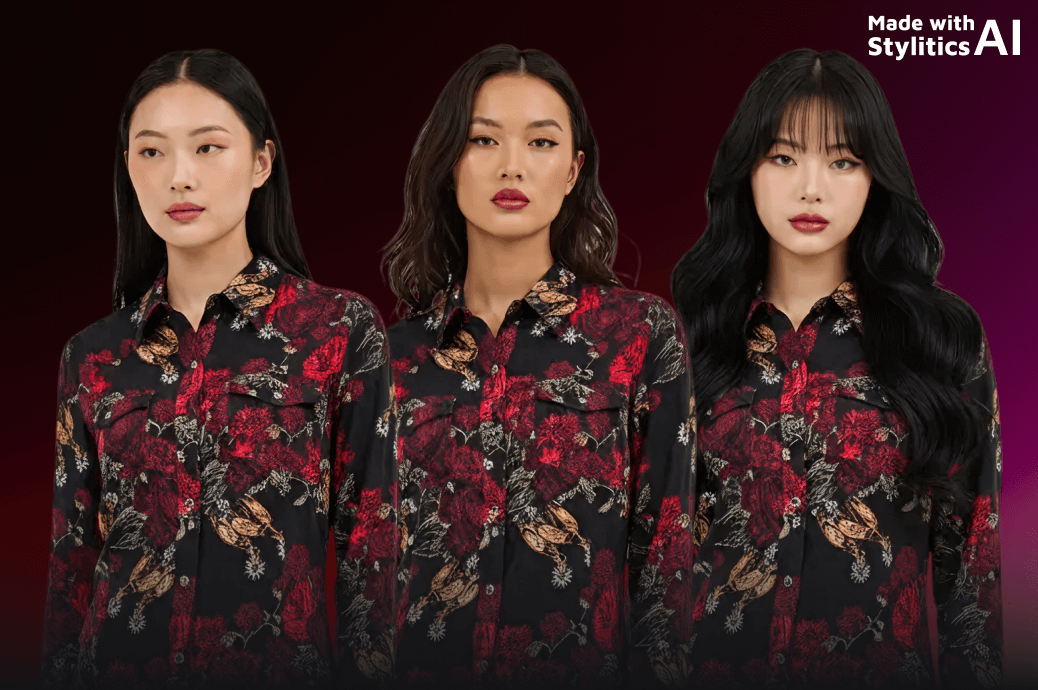
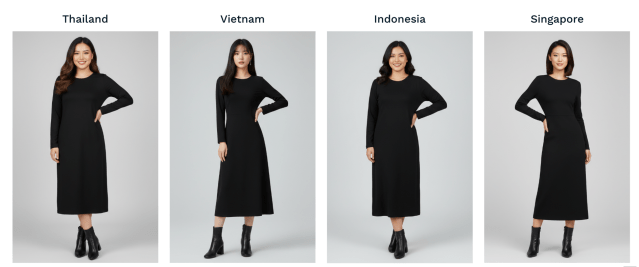
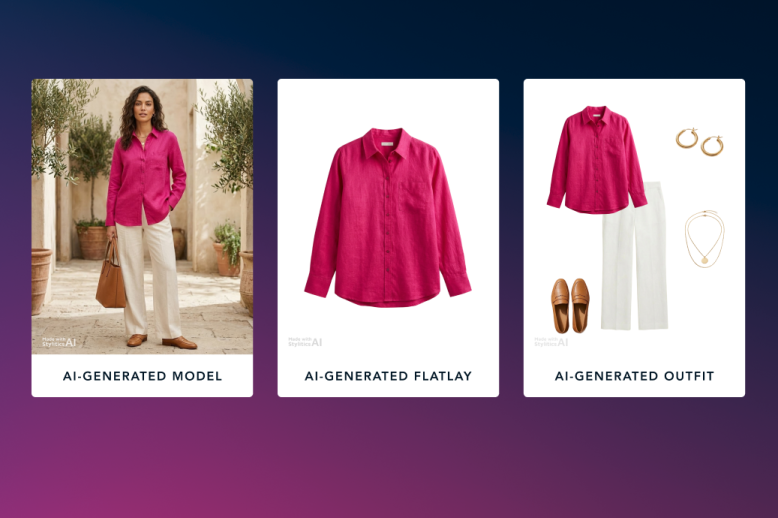
Generative AI on-model imagery has quietly dismantled every structural excuse the industry had. Today, using ecommerce software from companies like Stylitics, a brand can take a single flat-lay product photo and generate studio-quality images on petite, full-figured, tall, and diverse models—across dozens of global markets—in hours, not months. And the technology doing it isn’t a prototype. It’s live, at enterprise scale, powering the visual catalogs of leading retailers right now.
“Diversity used to be a production problem. Generative AI turned it into a configuration choice.”
The Old Math Never Added Up for Inclusion
Traditional on-model photography runs anywhere from $50 to $200 per image once you factor in model fees, studio time, styling, and post-production. For an enterprise retailer with a 100,000-SKU catalog, the math of inclusivity quickly becomes a non-starter. To represent just three body types—petite, standard, and plus—across that inventory, a brand would face a $30 million to $60 million photography bill before even touching international localization.
The result was predictable. Brands occasionally ran inclusive campaigns as “marketing moments” rather than catalog standards. Meanwhile, shoppers who didn’t see themselves reflected in product imagery clicked away. Retailers absorbed the long term conversion loss as a cost of doing business, but saved the short term expense.
Stylitics’ AI Image Studio has fundamentally broken that cycle. By generating on-model imagery at 10–20% of traditional costs, and producing up to 20,000 high-fidelity images per month, the economics have shifted. Representation is no longer a multi-year capital project; it is a tactical decision made at the start of every season.
One Product, Every Shopper
The core capability is simple to describe, but remarkably difficult to execute: upload a flat lay or existing product shot, and the system returns photorealistic on-model images that accurately render the garment’s drape, fabric weight, hardware, and fit—across whatever model specifications a brand defines.
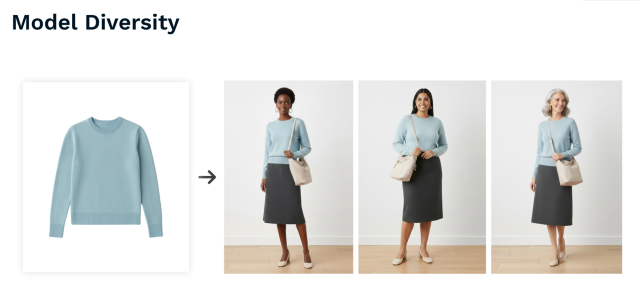
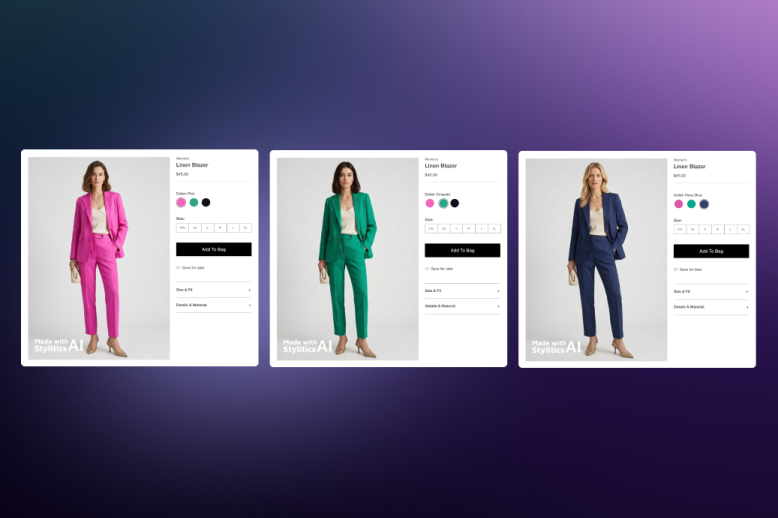
Model diversity isn’t a filter applied after the fact. It’s built into the generation engine itself. Brands can select from a wide range of sizes, heights, ethnicities, ages, and skin tones. They can define custom model specifications that reflect their brand’s identity. Every output adheres to the brand’s style guide so that inclusive imagery doesn’t come at the cost of creative consistency.
A retailer can now A/B test diverse and inclusive model representations directly on PDP carousels to measure conversion lift by segment. Inclusion stops being an aspiration and becomes a measurable performance variable. When shoppers see themselves in the product, purchase confidence rises.
AI Image Studio Capabilities
Model Diversity: Select from a vast library of sizes, ethnicities, and ages, or define custom model personas unique to your brand identity.
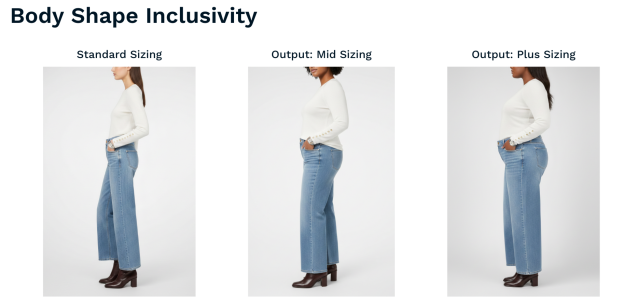
Body Shape Inclusivity: Generate petite, standard, and full-figured variants from a single reference asset, maintaining accurate fabric physics across all silhouettes.
Skin Complexion & Tone: Ensure authentic representation with a wide spectrum of skin tones, calibrated to react naturally to different lighting and environment settings.
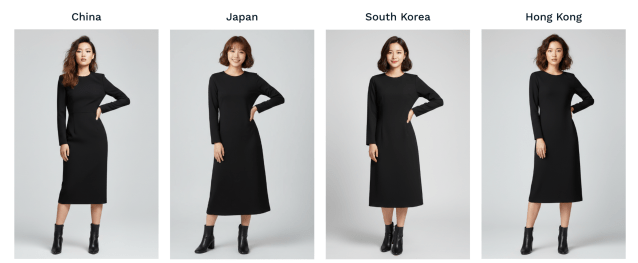
Market Localization: Adapt model aesthetics for regional markets including China, Japan, South Korea, and Southeast Asia to drive hyper-local relevance.
Tuck & Drape: Realistic fabric physics and styling logic ensure garments look worn and fitted to the specific body type, not simply overlaid on a digital frame.
High-Res PDP Standard: Deliver zoom-capable, studio-quality commerce shots that provide shoppers the visual confidence theyt need to convert.
The Global Opportunity: Localization at Last
Diversity in fashion imagery extends beyond body type—it’s also a matter of geography. Brands selling into markets like China, Japan, South Korea, and Southeast Asia have traditionally faced impossible economics when attempting to localize imagery. Between regional photoshoots, local talent, and market-specific post-production, most brands are forced to compromise with a single “global” image set that fails to feel local anywhere.
Generative AI fundamentally changes the feasibility of global scale. The same product can now be rendered on models calibrated to resonate with specific regional demographics, aesthetic sensibilities, and styling preferences—all generated from the same base asset. This level of hyper-localization was previously reserved for luxury houses with massive regional marketing budgets. Stylitics makes it a standard operational capability, delivered through the same automated pipeline at no meaningful additional cost.
Enterprise-Grade Execution, Not a Creative Experiment
The skepticism most retailers bring to AI imagery is reasonable. In-house pilots across the industry have stumbled repeatedly on the same issues: hallucinated details, off-brand outputs, quality control processes that require more human labor than the shoots they replaced, and integration workflows that demand continuous engineering attention.
Stylitics’ AI Studio is designed specifically to solve these failure modes. Our approach utilizes a hybrid, human-in-the-loop quality control model. While our proprietary AI QA Agent evaluates every output against hundreds of technical criteria, it is paired with expert human review to verify the nuances that matter most—logo placement accuracy, fabric texture, and strict brand compliance.
The result is a production-ready engine that delivers the volume of a machine with the eye of a stylist. By offloading the technical and creative heavy lifting, we’ve reduced client involvement to less than two hours per month, backed by ironclad SLA guarantees on both visual quality and delivery turnaround.
Case Study
Global Sportswear Retailer: $20M+ in Studio Photography Savings
$20M+ savings achieved
10,000+ images per week
<2 hours client involvement per month
A global sportswear retailer with a 100,000+ item catalog was spending over $115 per image on traditional studio photography for private label brands. This cost made inclusive coverage economically indefensible. Vendor-supplied photography was inconsistent. Internal AI pilots failed due to poor output quality and the labor drain of manual quality control.
Stylitics replaced the entire workflow, delivering 10,000+ images per week, with two or more distinct looks per SKU. Automated quality assurance through the AI and human-in-the-loop model reduced client involvement to under two hours per month. Their total budget savings exceeded $20 million.
The Infrastructure Behind the Imagery
Inclusive imagery at scale isn’t a creative problem—it’s an operational one. Delivering diverse model images across a live catalog requires more than just an AI prompt; it requires deep integration with existing PIM and DAM systems, automated ingestion of source assets, and smart prioritization logic that accounts for inventory depth and margin.
Stylitics’ handles all of it:
Effortless connection to your existing product feeds (PIM/DAM) for automated asset flow.
Logic to prioritize generation based on inventory depth, margin, or seasonality.
The Conversation Fashion Brands Need to Have
If inclusive imagery is now operationally trivial, what does continued inconsistency say about a brand’s priorities?
The traditional excuses—budget, logistics, and scale—have been eliminated by generative AI. What remains is a question of intent. Shoppers have always known, almost instantly, when a brand wasn’t made for them. When a model on a PDP doesn’t share their body type, skin tone, or frame, that disconnect creates a friction point that costs brands conversions, trust, and long-term loyalty.
For the first time, technology allows every shopper to see exactly how a garment will look on someone who reflects them—their size, their ethnicity, their market. Brands delivering this aren’t doing something radical; they are doing something that is now obvious. The retailers still hedging aren’t facing a technology hurdle—they are facing a priority shift. In a world where representation is now automated, shoppers are getting better every day at telling the difference.
FAQ
No. Diversity is built into the core generation engine. The AI renders garments accurately across different heights, body shapes, and ethnicities, ensuring the fabric physics (drape and fit) look realistic for each specific model persona.
Stylitics uses “Custom Model Personas” and brand-specific style guides. This ensures that every generated image regardless of the model’s ethnicity or size adheres to your specific lighting, posing, and aesthetic standards.
This is an enterprise-grade production engine designed for high volume. It can generate 15,000 to 20,000 on-brand images per month, allowing brands to move beyond “marketing moments” to make inclusive imagery a catalog-wide standard.
Very little. The system integrates directly with your existing PIM or DAM for automated asset flow. Because of our hybrid AI and human-in-the-loop quality control, total client involvement is typically less than two hours per month.