How to Turn Flat Lay Photos Into Model Images Using Generative AI
Stylitics Marketing Team
The Stylitics Marketing Team explores the intersection of AI, retail, and shopper experience, sharing strategies and insights that shape the future of product discovery and visual merchandising.
On-model images outconvert flat lays. It’s not close, and every merchant knows it. The problem is that getting a product on a model has always meant booking a shoot. And at $50 to $200 per image, most catalogs can only afford to do it for a fraction of their inventory. The rest gets a flat lay and a prayer.
Flat lays show the product; on-model images sell the vision. The difference in conversion is well documented, and shows shoppers are consistently more likely to purchase when they can see how a garment fits and moves on a body. The problem has always been that getting from flat lay to model image required a separate photoshoot: booking models, studio time, styling, post-production. A process that costs hundreds of dollars per image and weeks of planning to kickoff.
Key Takeaways:
On-model imagery significantly outconverts flat lays by communicating fit and drape—crucial data points that build buyer confidence and reduce return rates.
Stylitics generates photorealistic assets at 10–20% of the cost of traditional shoots, enabling $20M+ in savings for enterprise-scale catalogs.\
The automated pipeline connects directly to existing PIM/DAM feeds, requiring less than two hours of client involvement per month to produce thousands of weekly images.
A single flat lay can generate a full season of content, including lifestyle scenes, social-first crops, diverse model representations, and all colorway variants.
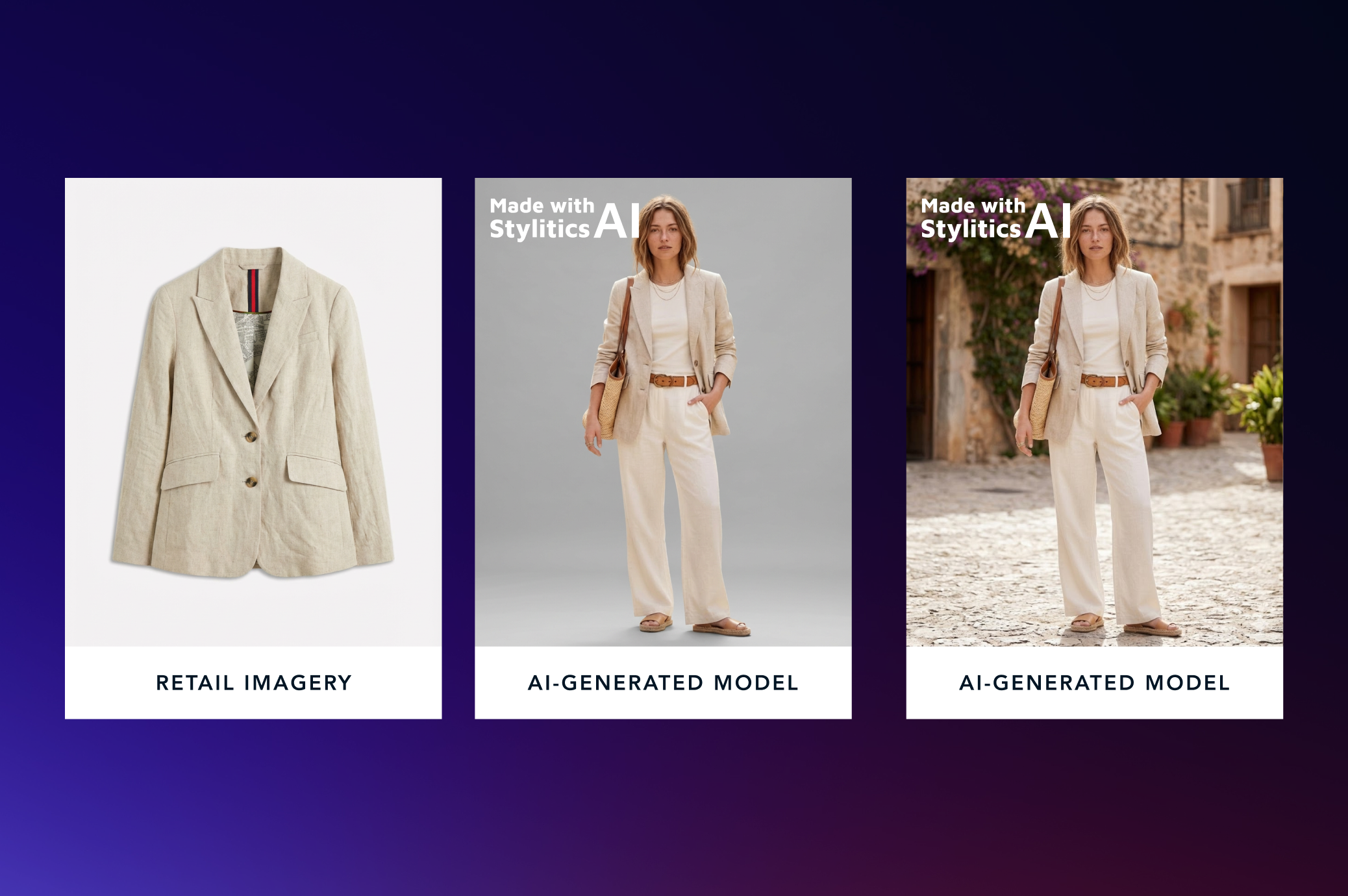
Generative AI has changed that equation entirely. Today, the flat lays already in your catalog are everything you need to generate photorealistic, on-model images at scale. No studio. No shoot. No wait. Your flat lays are already a photoshoot. Generative AI just helps develop the film.
Why Flat Lays Alone Are Leaving Conversions on the Table
Flat lay photography serves an important function in ecommerce. It shows texture, pattern, hardware, and construction detail in a clean, controlled way. For certain retail categories—think accessories, footwear, or home goods—it’s often the ideal primary asset.
But for apparel, the flat lay has a fundamental limitation: it can’t show fit. And fit is what shoppers are actually buying. When a customer looks at a pair of jeans on a flat surface versus on a model mid-stride, they’re getting entirely different information. Visually customers immediately understand the drape, proportion, how the rise sits, how the leg falls. That information is what drives confidence at the point of purchase, and confidence is what drives conversion.
Retailers who rely heavily on flat lay imagery also tend to see higher return rates. Shoppers who can’t visualize fit are more likely to guess wrong—and the cost of that guess lands on the retailer. On-model imagery reduces that uncertainty, which is why the category has historically justified a significant investment in studio time.
How Generative AI Turns a Flat Lay Into a Model Image
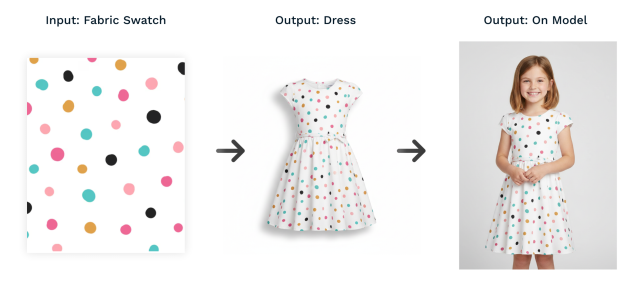
The core process is more sophisticated than it might appear from the output. Uploading a flat lay and getting back a model image involves a series of AI operations happening in sequence: garment parsing to identify the item type, construction details, fabric characteristics, and styling context; model generation calibrated to the brand’s specifications; physics simulation to render realistic drape, tuck, and movement; and quality assurance to verify the output meets brand standards.
Stylitics’ AI Image Studio has engineered this into an enterprise-grade pipeline—one built for the massive volume and consistency that global retail catalogs require. The system ingests flat lays directly from existing product feeds, applies the brand’s custom rules and model specifications, generates photorealistic on-model imagery, runs it through AI and human quality control, and delivers finished assets back to the DAM or commerce platform. The client’s involvement in that entire process amounts to less than two hours per month.
The Image Generation Process
Catalog Ingestion: Flat lays and ghost mannequin shots are pulled automatically from your existing PIM or DAM. No manual uploads or reformatting required.
Garment Parsing: Proprietary computer vision models identify the item type, fabric weight, construction details, hardware, print, and styling context.
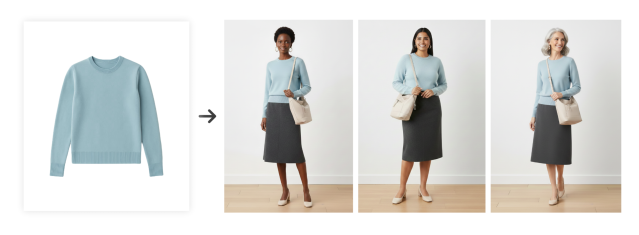
Model & Scene Configuration: Images are generated against your brand’s defined model specifications — size, height, ethnicity, pose, setting, and lighting.
Physics & Styling Simulation: Tuck, drape, and fabric movement are rendered accurately, including hem behavior, waistband sit, and sleeve fall.
AI + Human Quality Control: Every image is scored against hundreds of criteria by AI QA agents, with human expert review for nuance and brand compliance.
Delivery & Integration: Finished assets are automatically formatted for PDP, PLP, social, ads, and mobile, then injected back into your commerce platform.
What “Photorealistic” Actually Means at Enterprise Scale
The quality bar in AI imagery has moved dramatically in a short period of time. Early generative tools produced results that were impressive as demos and unusable in commerce. We all remember the memes—hands with six fingers aside—there were inconsistent fabric rendering, logo placement errors, accessories that bore no resemblance to the reference. Those failure modes became the industry’s proof point for why in-house AI experiments weren’t ready for production.
Enterprise-grade fashion ecommerce software solves for those failures through a combination of model training depth, quality control architecture, and the kind of brand-specific fine-tuning that only comes from working with retail catalogs at scale. Stylitics has spent over a decade building proprietary computer vision models on fashion data—the same models that power item attribution and catalog enrichment across 175+ global retailers. That training depth is what allows the system to render a logo in the right position on a chest, get the drape of a bias-cut dress right, and distinguish between a ponte knit and a jersey when applying fabric physics.
The result is imagery that achieves studio-grade visual quality at 10–20% of traditional photography cost—not as an occasional highlight, but consistently, across thousands of SKUs per week.
CASE STUDY
From $115 Per Image to Pennies on the Dollar: A Global Sportswear Retailer
$20M+ savings
10,000+ images per week
<2 hours client involvement per month
A global sportswear retailer with a 100,000+ item catalog was paying over $115 per image for traditional studio photography on private label lines. The cost made comprehensive on-model coverage impossible. Therefore, a fraction of the catalog had model imagery, and what existed was inconsistent in quality and composition. Internal AI pilots had failed as the outputs required so much manual quality review that the labor cost exceeded the savings.
The solution was a fully automated pipeline built on flat lay inputs. Stylitics ingested the existing product photography, applied brand-specific model and styling configurations, and began generating 10,000+ images per week—each SKU receiving two or more distinct looks for variety. The combination of AI and expert-in-the-loop QA workflow reduced client involvement to under two hours per month. Direct catalog integration meant finished assets appeared in the live commerce platform without manual intervention. Total savings exceeded $20 million.
Beyond the Basic Model Shot: The Full Creative Range
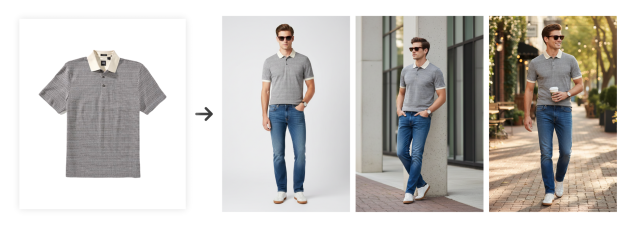
The flat-lay-to-model workflow is the entry point, but the creative range available from the same source asset goes considerably further. Once a garment is in the generation pipeline, the same flat lay can produce imagery across every format and context a modern retail brand needs:
Studio: Clean, consistency-focused solid backgrounds for PDP standard shots, zoom-capable at high resolution.
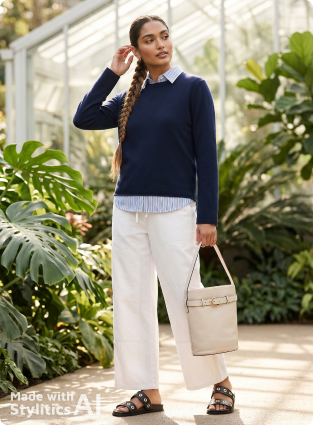
Lifestyle Scenes: Urban, nature, luxury, or abstract environments for editorial and campaign imagery, all generated from the same source.
Social Editorial: Dynamic crops and filters formatted for Instagram and TikTok, ready for paid and organic deployment.
Pose Variation: Standing, walking, sitting, or custom movement — each pose communicating different things about how the garment performs.
Lighting & Mood: Soft box for clean commerce shots, golden hour for campaign warmth, high-contrast editorial for fashion impact.
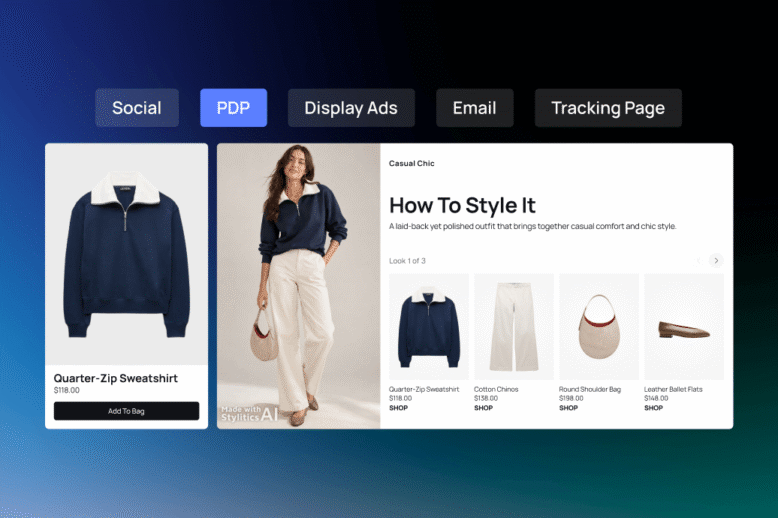
Full Outfitting: AI-paired shoes, accessories, and layers styled to complete every look in a way that reflects your brand’s aesthetic.
Colorway Generation: Every variant rendered on model using your color codes, keeping the full catalog shoppable without additional source assets.
Background Swaps: The same model image reframed for different markets, channels, or seasonal campaigns.
The practical implication is that a single flat lay, processed once, can generate an entire season’s worth of visual assets, including PDP imagery, social content, campaign creative, and marketplace listings, all consistent, all on-brand, all delivered through the same automated pipeline.
The Enterprise Infrastructure That Makes It Operational
The quality of the generated imagery matters. But for enterprise retail, what matters just as much is whether the technology fits the way the organization actually operates. That includes questions as to whether it connects to existing systems, whether it scales without additional headcount, or whether the output can be trusted without a team of people reviewing every image.
Stylitics’ AI Image Studio is designed for these enterprise realities. And underpinning all of it is a risk-free quality guarantee. Every image that doesn’t meet brand standards or turnaround SLA is refunded in full.
The Flat Lay Was Never the Destination
There’s a version of this story where generative AI is a cost-cutting tool—a way to produce on-model imagery more cheaply than the studio alternative. While that’s true, it undersells the massive strategic shift occurring in the industry.
The real transformation happens when the economics of on-model imagery are no longer a constraint. Full catalog coverage. Every colorway on model. Diverse body types and ethnicities represented across every product, not just the hero items. Localized imagery for every market. Seasonal refreshes that don’t require a shoot schedule.
The flat lay was always a workaround for a practical compromise between the imagery brands wanted and the costs they could absorb. Generative AI ends that compromise. The flat lays in your catalog aren’t the final product; they are the raw material. The photoshoot has already happened—Stylitics just helps you develop the film.
FAQ
We use physics and styling simulations to render realistic drape, tuck, and fabric movement, ensuring garments look worn rather than digitally “pasted” on.
Your existing flat lays and ghost mannequin shots are the only “raw material” needed. The system pulls these automatically from your current product feed or DAM.
Yes. Images are calibrated to your “Model DNA”—brand-defined specifications for height, ethnicity, pose, lighting, and styling rules to ensure total consistency.
Every image passes through AI scoring and human expert review. We offer a risk-free guarantee: any image not meeting brand standards or turnaround SLAs is refunded in full.