Best AI Fashion Photography Tools for Enterprise Retail in 2026
Stylitics Marketing Team
The Stylitics Marketing Team explores the intersection of AI, retail, and shopper experience, sharing strategies and insights that shape the future of product discovery and visual merchandising.
There are now dozens of AI tools that will put your clothes on a model. Most of them will do it in under ten seconds, for less than a dollar per image, with no setup required.
That is genuinely useful — for a Shopify boutique with 50 SKUs and no brand manager reviewing every output. It is a different calculation entirely for an enterprise retailer with 100,000 SKUs, a named brand above the door, and a customer base that will notice when a logo is in the wrong place or a fabric drapes in a way that does not reflect how the garment actually fits.
Key Takeaways:
The AI fashion photography market in 2026 is divided into two fundamentally different tiers: self-serve tools built for SMB speed and managed enterprise platforms built for brand safety, QC, and catalog scale.
Self-serve tools like Photoroom, Botika, and Claid are well-suited for small catalogs and Shopify merchants — but they do not offer the quality controls, DAM/PIM integration, or human-in-the-loop oversight that enterprise brands require.
For retailers with 10,000+ SKUs, named brand equity, and PDP accuracy requirements, the risks of self-serve AI generation — hallucinated logos, garment inaccuracies, inconsistent outputs — are not theoretical. They show up in returns, shopper complaints, and brand perception.
Stylitics AI Image Studio is the only fully managed, enterprise-grade solution that combines AI generation with fashion-trained human QC, catalog-scale production, and direct DAM/PIM integration — with a 100% refund guarantee on any image that does not meet brand standards.
Traditional studio photography for on-model PDP images runs $75 to $150 per shot once all-in costs are accounted for. A day of off-figure photography can cost $4,000 to cover 25 to 30 styles. The financial case for AI is unambiguous at any catalog scale. The operational question — which tool is actually built for your situation — is where most enterprise evaluations go wrong.
This guide breaks down the AI fashion photography landscape in 2026: what self-serve tools do well, where they fall short for enterprise use, and what the evaluation criteria actually look like when brand safety, QC, and catalog integration are non-negotiable.
“The question retailers used to ask was whether AI imagery was good enough. That question has been answered. The question now is whether the tool you’re using is built for what happens when it gets something wrong.”
How to Evaluate AI Fashion Photography Tools at Enterprise Scale
Most tool comparisons evaluate AI fashion photography on output quality from a single test image. That is the wrong test for enterprise buyers. The questions that matter at scale are different:
What happens when the AI gets it wrong? Self-serve tools generate an image and deliver it. Enterprise operations need a QA layer — automated evaluation against specific brand criteria, plus human review for the nuances automated systems miss. A logo in the wrong position, a fabric rendering that misrepresents how the garment drapes, a skin tone that renders differently than the brand’s creative brief — these are not edge cases. They are regular outputs from probabilistic AI systems running at volume, and they require a review process before reaching the PDP.
Can it run at catalog scale without degrading? Generating 50 images looks different from generating 15,000 per month. Tools that perform well at low volumes often struggle to maintain consistency, brand alignment, and turnaround guarantees at enterprise catalog scale.
Does it integrate into existing systems? Enterprise retailers do not want to download images and manually upload them to their DAM. The production pipeline needs to connect to existing PIM and DAM systems, ingest product assets automatically, and deliver formatted outputs back into the commerce platform without manual intervention.
Who owns QC? Self-serve tools put QC on the user. Enterprise operations cannot review every image — a 100,000-SKU catalog generating two images per SKU is 200,000 images to evaluate. The QC system has to be built into the service.
With those criteria established, here is how the market looks in 2026.
The Self-Serve Tier: Good Tools for the Right Use Case
These tools are genuinely useful for small-to-mid-size brands, Shopify merchants, and teams that can review outputs themselves before publishing.
Photoroom is the most widely adopted self-serve option, processing over 100 million product images monthly. Its virtual model feature places garments on photorealistic AI models and its background removal and batch processing are fast and clean. It is purpose-built for ecommerce workflows and integrates directly with marketplace formats. Photoroom’s enterprise page is explicit on one point: “we do not use manual QC for every image.” That is the right approach for a self-serve tool optimized for speed. It is the wrong approach for a brand where a misrepresented garment creates a returns problem.
Claid offers a comprehensive product photography suite including on-model generation, background swaps, AI retouching, and batch processing via API. Its AI Fashion Models tool lets brands choose from 100+ models and generate lifestyle and editorial scenes. Claid works well for teams that need volume and API-driven automation. Its limitations are also architectural: it runs a fixed, proprietary model workflow, which means quality control and parameter adjustment are constrained by Claid’s own development roadmap rather than the brand’s specific standards.
Botika is a fashion-specific on-model platform with a native Shopify app, making it particularly useful for Shopify merchants who want to generate images and push them directly to their store. It offers diverse model representation, lifestyle backgrounds, and short-form video generation from still product images — a differentiator for social-first brands. Its pricing runs $33 to $40 per month for limited credits, and third-party reviews note that outputs often require additional finishing before they are PDP-ready. For a small brand with a team member who can do that finishing work, it is a reasonable option. For a 100,000-SKU catalog, the manual review requirement is unsustainable.
Rawshot targets high-volume agencies and creative teams, with 600+ synthetic models, 150+ camera styles, and 1,500+ backgrounds. Its collaborative workflow tools and C2PA content authentication (relevant for EU AI Act compliance) make it one of the more operationally thoughtful SMB tools in the market. It does not offer catalog integration, DAM delivery, or human QC.
What these tools have in common: they are generation engines. They produce an output and deliver it. Brand safety, QC, and integration are the user’s responsibility. For a boutique brand with a small catalog and an internal team that can review outputs, this is fine. For an enterprise retailer where an image going live with a misrepresented logo or an off-brand drape affects thousands of shopper impressions before anyone notices, it is a different risk profile entirely.
Where Self-Serve Tools Break Down at Enterprise Scale
The gap between self-serve and enterprise-grade AI fashion photography is not primarily about image quality. Modern tools from Photoroom, Claid, and Botika can produce images that are visually convincing. The gap is about what happens in the production system around the image.
Enterprise retailers in Stylitics’ conversations describe the problem directly. Many have run in-house AI pilots that failed — not because the generation technology was inadequate, but because the quality control process that followed consumed more resources than it saved. When a team is manually reviewing thousands of outputs per week, comparing each against brand-specific criteria, flagging failures, resubmitting for regeneration, and managing the delivery pipeline, the operational overhead eliminates the cost advantage of AI generation.
The QC problem compounds at brand level. For a small Shopify brand, a generated image that slightly misrepresents a fabric drape is a minor issue — a small number of shoppers see it, and the brand has limited exposure. For a luxury retailer or a brand with significant heritage equity, as Stylitics’ shopper research confirms, accuracy is non-negotiable. Shoppers quickly lose confidence when garment details look wrong. The trust damage from a badly generated hero PDP image is asymmetric to the cost savings that AI was supposed to deliver.
Self-serve tools also do not integrate into enterprise catalog infrastructure. They are designed for manual workflows — upload an image, generate, download, and publish. Enterprise retailers with PIM and DAM systems, automated product feed ingestion, and multi-channel delivery pipelines need a different operational model. The tool needs to connect to existing systems, ingest assets automatically, apply prioritization logic based on inventory and margin, and deliver formatted outputs back into the commerce platform without human intervention at each step.
The Enterprise Tier: Stylitics AI Image Studio
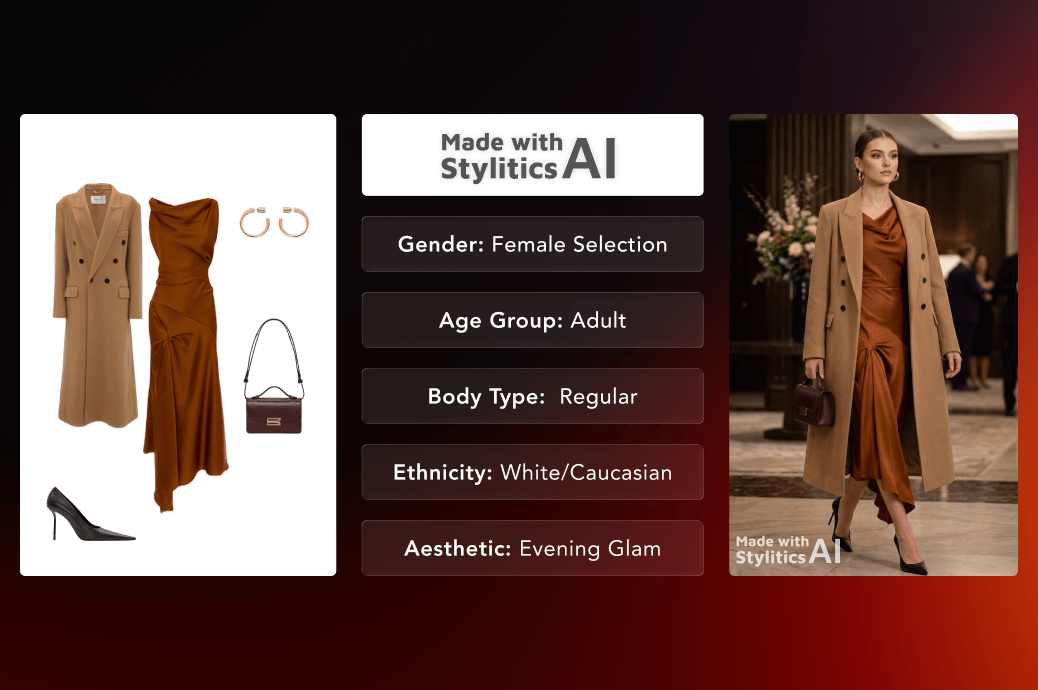
Stylitics AI Image Studio is built for a different problem than the self-serve tools above. It is not a generation engine that a brand’s internal team operates. It is a fully managed production service that handles every step of the pipeline — from asset ingestion through generation, QA, and delivery back into the brand’s existing systems.
The operational model is fundamentally different. Stylitics’ AI Image Studio connects directly to the retailer’s existing PIM or DAM via standard integrations, ingests product assets automatically, generates imagery against brand-specific parameters established during onboarding, evaluates every output through both automated AI QA and fashion-trained human review, and delivers formatted, channel-ready assets back into the commerce platform. Client involvement across this entire process runs under two hours per month.
The QA model is what makes this viable for enterprise use at scale. Every generated image is evaluated by Stylitics’ AI QA Agent against hundreds of specific technical and brand compliance criteria — logo placement, fabric rendering, garment construction, color accuracy, styling standards. Images that pass automated evaluation go to expert human review from a fashion-trained QC team for the nuances that automated systems flag for secondary verification. The combined model means quality failures do not reach delivery. The 100% refund guarantee on any image that does not meet agreed quality standards or SLA makes that commitment contractually real — not a marketing claim.
For brands with significant equity at risk, as Stylitics’ own research with real shoppers documents, this QC layer is not optional. It is the difference between AI generation that builds shopper confidence and AI generation that erodes it.
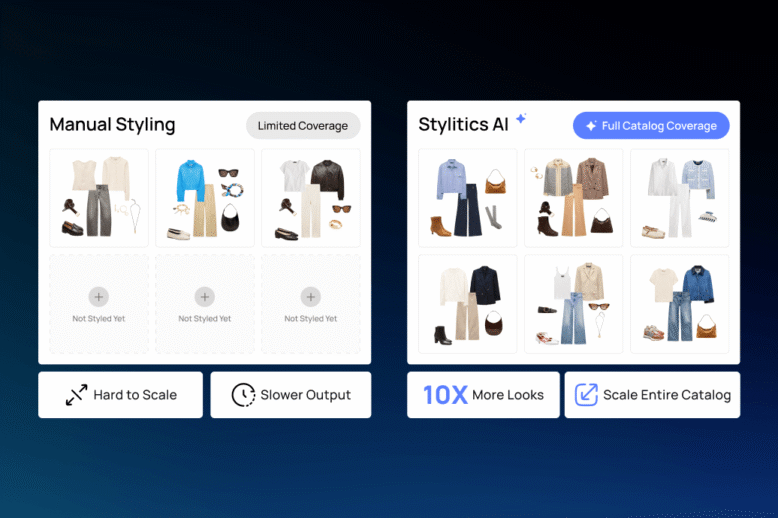
The scale capabilities are also categorically different from the self-serve tier. Stylitics delivers 15,000 to 20,000 images per month at standard production capacity, with enterprise clients reaching 10,000+ images per week. A global sportswear retailer with a 100,000+ item catalog generated two or more distinct looks per SKU per week through the pipeline, saving over $20 million in studio photography costs. That volume is not achievable with a self-serve tool and an internal review team.
How to Choose: A Decision Framework
If you are a Shopify brand with under 5,000 SKUs, an internal team that can review outputs, and a catalog where a misrepresented image is a minor issue: Photoroom, Botika, or Claid are reasonable starting points. They are fast, affordable, and require no setup. Start with a small batch, review the outputs carefully, and evaluate whether the generation quality is consistent enough for your category before scaling.
If you are a mid-size brand with 5,000 to 50,000 SKUs, some brand equity at stake, and limited internal QC capacity: Claid’s API and Rawshot’s collaborative workflows are worth evaluating. Budget for the time your team will spend on QC — it is real, and it scales with volume. Pilot on a low-risk category before applying AI to hero products.
If you are an enterprise retailer with 50,000+ SKUs, named brand equity, PDP accuracy requirements, and existing PIM/DAM infrastructure: The self-serve tools are not built for your situation. The QC problem alone eliminates the cost advantage at scale, and the integration requirement rules out manual-upload workflows. Stylitics AI Image Studio is the only fully managed, enterprise-grade solution in the market — with catalog integration, brand-specific AI training, fashion-trained human QC, and contractual quality guarantees.
Tool Comparison: Quick Reference
Tool
Best For
QC Model
Catalog Integration
Human Review
Pricing Tier
Photoroom
SMB, Shopify sellers
Automated only
None
No
$10–$30/mo
Botika
Shopify stores, small catalogs
User-managed
Shopify only
No
$33–$40/mo
Claid
API-driven mid-market
Automated only
API
No
$9–$39/mo+
Rawshot
Agencies, creative teams
User-managed
None
No
Credit-based
Stylitics AI Image Studio
Enterprise retail, 50K+ SKUs
AI + Human-in-the-loop
DAM/PIM native
Yes
Enterprise
The Risk Calculation Is Different at Enterprise Scale
For a small brand, an AI fashion photography tool that generates a convincing image 90% of the time is genuinely useful. The 10% failure rate surfaces as occasional bad outputs that get caught during manual review or corrected after publication.
For an enterprise retailer with 100,000 SKUs generating two images per SKU, a 10% failure rate is 20,000 images that need to be caught, remediated, and regenerated before they reach the PDP. At that volume, the QC infrastructure required to manage failures from a self-serve tool costs more than the generation savings.
The brands moving fastest on enterprise AI imagery are not choosing the cheapest tool or the fastest tool. They are choosing the tool where quality is guaranteed rather than inspected. That distinction — managed versus self-serve, QC-included versus QC-on-you — is what separates the enterprise tier from the SMB tier, and it is the most important variable in any tool evaluation that involves significant brand equity.
Can enterprise retailers start with a self-serve tool and migrate to Stylitics later?
Yes. Many enterprise retailers run initial pilots with self-serve tools before moving to a managed solution. The trigger for migration is typically the QC overhead — when the internal team’s time spent reviewing and remediating outputs exceeds the cost of a managed service, the economics shift decisively toward a solution where QC is included.
How does Stylitics handle catalog integration for retailers already using a PIM or DAM?
Stylitics connects to existing product feeds through standard integrations, ingesting assets automatically without manual uploads. Finished images are delivered back into the retailer’s DAM or commerce platform in the correct formats and specifications. The setup is handled by Stylitics during onboarding.
What is the minimum catalog size for Stylitics AI Image Studio?
Stylitics is designed for enterprise retail catalogs — brands with significant SKU volumes, existing commerce infrastructure, and brand equity requirements that make QC non-negotiable. For smaller catalogs, the self-serve tools described above are more appropriate starting points.
How does Stylitics’ pricing compare to self-serve tools per image?
Stylitics delivers AI-generated PDP imagery at 10 to 20 percent of traditional studio photography costs. At enterprise volumes, the per-image cost is competitive with premium self-serve tools — with the QC, integration, and brand-safety guarantees included in the service rather than managed separately.



 Shop the Look Let shoppers buy the full outfit directly from any styled image.
 Styled for You Personalized outfit recommendations based on individual shopper preferences.
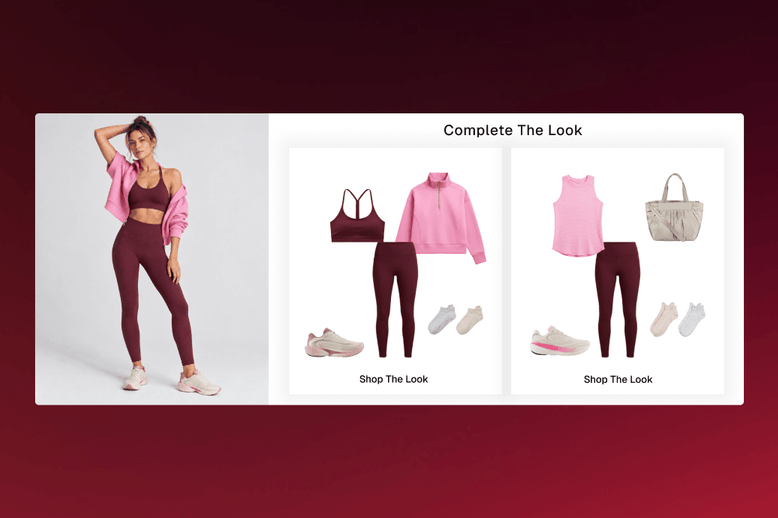
 Complete the Look Suggest complementary pieces to round out whatever a shopper is already viewing.
 Shop Similar Surface visually comparable alternatives when a specific item is out of stock or out of budget.
 Flat Lay to Model Choose from diverse models with full control over pose, crop, and framing.
 Background & Scene Swaps Place products in clean studio backgrounds, lifestyle environments, or custom lighting moods.
 AI Colorway Swaps Create photorealistic images for every colorway from a single reference shot.
 Model Diversity & Inclusive Imagery Output-ready formats for PDPs, social platforms, and campaign lookbooks.