Do Shoppers Trust AI-Generated Product Images? We Asked
Stylitics Marketing Team
The Stylitics Marketing Team explores the intersection of AI, retail, and shopper experience, sharing strategies and insights that shape the future of product discovery and visual merchandising.
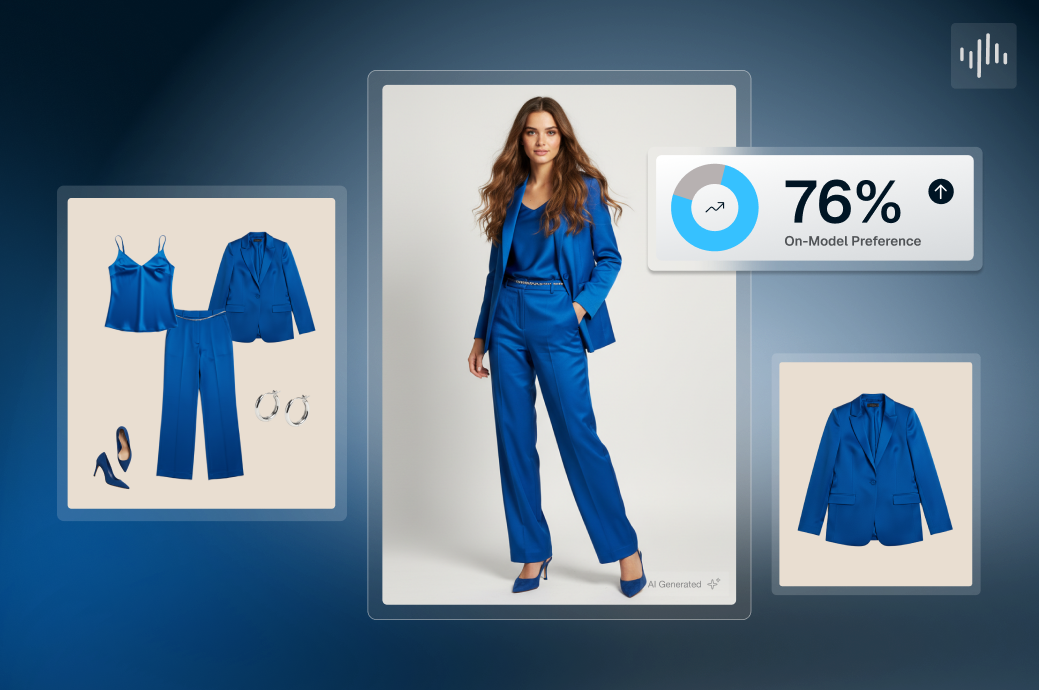
On-model imagery drives confidence: 76% of shoppers in our study said model photos are the most useful format for purchase decisions.
Accuracy is critical: While 71% couldn’t tell whether an image was real or generated by AI, shoppers quickly lost confidence when details like buttons, wrinkles, or fabric texture looked wrong.
Disclosure builds trust: 59% wanted clear labeling of AI imagery, interpreting disclosure as a sign of honesty and integrity.
Return policies help reduce anxiety: 55% of shoppers said they felt more comfortable buying from AI-generated photos if clear return policies were in place.
For many in retail, this feels like a bold step forward and a signal of how quickly experimentation with AI imagery is moving into live e-commerce environments. But it also raises a critical question: will shoppers actually believe what they see?
To explore this, Stylitics partnered with Aha Studio to survey 411 shoppers across web and social contexts. As AI product photography moves from experimentation into live fashion ecommerce, retailers are testing how AI-generated product imagery can expand visual coverage on the product page. But alongside the potential of image generation comes a core question: can shoppers trust what they see? The results reveal a clear pattern: consumers aren’t rejecting AI imagery outright, but they expect accuracy, honesty, and brand consistency before they’ll buy.
Do Shoppers Trust AI-Generated Images?
Download the full study and gain insight on how 400+ shoppers really feel about AI imagery in fashion ecommerce.
Product photography has always been central to fashion e-commerce. Shoppers rely on on-model photos, flat lays, and packshots to answer two core questions:
Information: “Will this actually work on my body?”
Inspiration: “How will this clothing item fit into my life and reflect my style?”
he study confirms that on-model photography remains the most influential format. A full 76% of shoppers said model photos were the most helpful for purchase decisions. Whether captured with human models, AI-generated models, or virtual models, the ability to show drape, proportion, and real-world styling is essential. For fashion ecommerce teams managing large catalogs, the challenge is creating enough accurate, on-brand product visualization across new drops, colorways, and seasonal assortments. AI product photography can support this visual-production workflow by expanding coverage, but every generated product image must faithfully represent the item shoppers will receive.
For retailers, this creates both opportunity and challenge. Early tests suggest AI-powered imagery could provide new ways to expand coverage and experiment with styling variety. But every generated image also carries risk: a mismatched button, an unnatural model pose, or skin that looks “too airbrushed” can quickly erode shopper confidence.
Perception vs. Reality: Can Shoppers Tell the Difference?
One of the most telling findings came from side-by-side tests. When shown a real photo and an AI-generated reference image of the same product, 71% of shoppers said the images looked the same or had only small differences.
This indicates that when quality is high, many shoppers don’t focus on whether an image is “real” or AI-generated they pay attention to execution details such as:
“The buttons on the AI version were the wrong color.”
“The vest had no wrinkles, which looked unnatural.”
“The AI model’s face was too airbrushed.”
In other words, execution matters more than the medium. High-quality visuals, whether AI-generated or photographed, can build confidence, while poor execution in either format risks breaking shopper trust. High-resolution images can make products easier to inspect, but resolution alone does not create trust. If product details, texture, proportions, or styling appear inaccurate, shoppers will still question what they are buying.
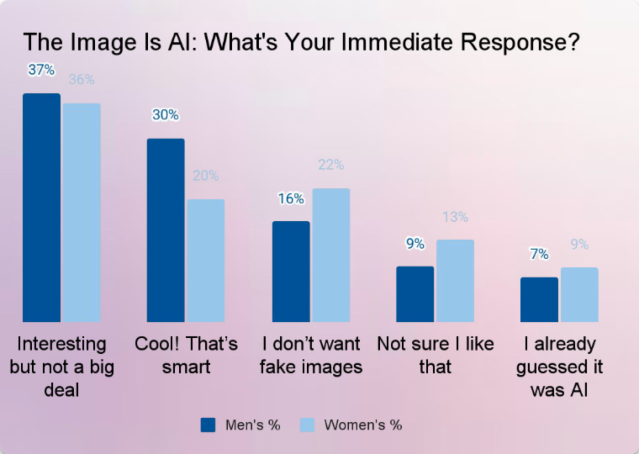
When told explicitly that they were viewing AI-generated models and scenes, shoppers showed a wide range of emotions:
60% felt neutral or positive. 36% said it was “interesting but not a big deal,” and 24% reacted with “Cool! That’s smart.”
31% reacted negatively. Concerns centered on authenticity and realism.
8% had already guessed it was AI.
Breaking this down further:
Men were more receptive (30% positive, 25% negative).
Women were more skeptical (20% positive, 35% negative).
These findings suggest that disclosure should be a clear, simple visual cue applied consistently, not a legalistic note buried in terms and conditions. When used to label AI-generated product imagery, it can signal brand integrity, preserve shopper trust, and give buyers the context they expect.
Emotional Response: Shoppers Are Split, Not Hostile
Shopper Concerns in Their Own Words
The study revealed three recurring perspectives on AI-generated product imagery:
The Enthusiast: “This saves time and money. Extremely effective!”
The Pragmatist: “As long as the clothes are accurately represented, I don’t mind.”
The Skeptic: “I want to see clothes on real people. AI makes things look too perfect.”
Across these perspectives, shoppers raised similar concerns:
AI can idealize fit in ways that do not reflect how an item will look on a real person.
Colors, fabric textures, buttons, and other design details may be inaccurate.
Shoppers may feel misled or more cautious if they are unsure whether the product will match the image—a mindset that could contribute to higher return rates.
Overall, trust rests on execution. Shoppers care less about whether an image is AI-generated than whether it accurately represents color, texture, construction, and fit. A portion of shoppers will remain skeptical regardless of execution, making transparency and brand alignment essential.
The Return Policy Effect: Reducing Perceived Risk
Trust is not just about the image, itself it’s about what happens after purchase.
In the study, 55% of shoppers reported feeling “very” or “somewhat” comfortable buying products based on AI-generated imagery when returns were allowed. A clear, customer-friendly return policy gives hesitant shoppers a tangible safety net when evaluating AI-generated product imagery, particularly if they have questions about color, texture, fit, or product details.
Transparency Builds Brand Equity
Shoppers consistently expressed a preference for transparency: they want to know when a brand is using AI-generated imagery.
59% wanted clear labeling, either through a label on each AI image or an easy-to-find note or disclaimer.
26% were comfortable with disclosure being absent altogether or buried within lengthy general policies.
15% said they would prefer brands not use AI images at all.
“Adds a level of trust for the website and the brand.”
“I feel less cheated if it’s disclosed.”
These findings suggest that disclosure should be a clear, simple visual cue applied consistently, not a legalistic note buried in terms and conditions. When used to label AI-generated product imagery, it can signal brand integrity, preserve shopper trust, and give buyers the context they expect.
Strategic Roadmap: Exploring Phased Adoption of AI Imagery
Stylitics’ research points to a phased workflow for fashion ecommerce retailers exploring AI-powered imagery. The goal is not to automate every visual decision at once, but to build shopper trust through accurate, useful, and well-governed imagery over time.
Phase 1: Establish a Visual Baseline
Research consistently shows that shoppers prefer on-model photos over other formats. The first priority is reliable on-model coverage across ecommerce catalogs: every product detail page should feature at least one image that helps shoppers assess fit and styling. AI imagery can complement human photography by filling visual gaps and extending product-image assets, but accuracy and brand alignment remain essential.
Phase 2: Experiment with Inspiration
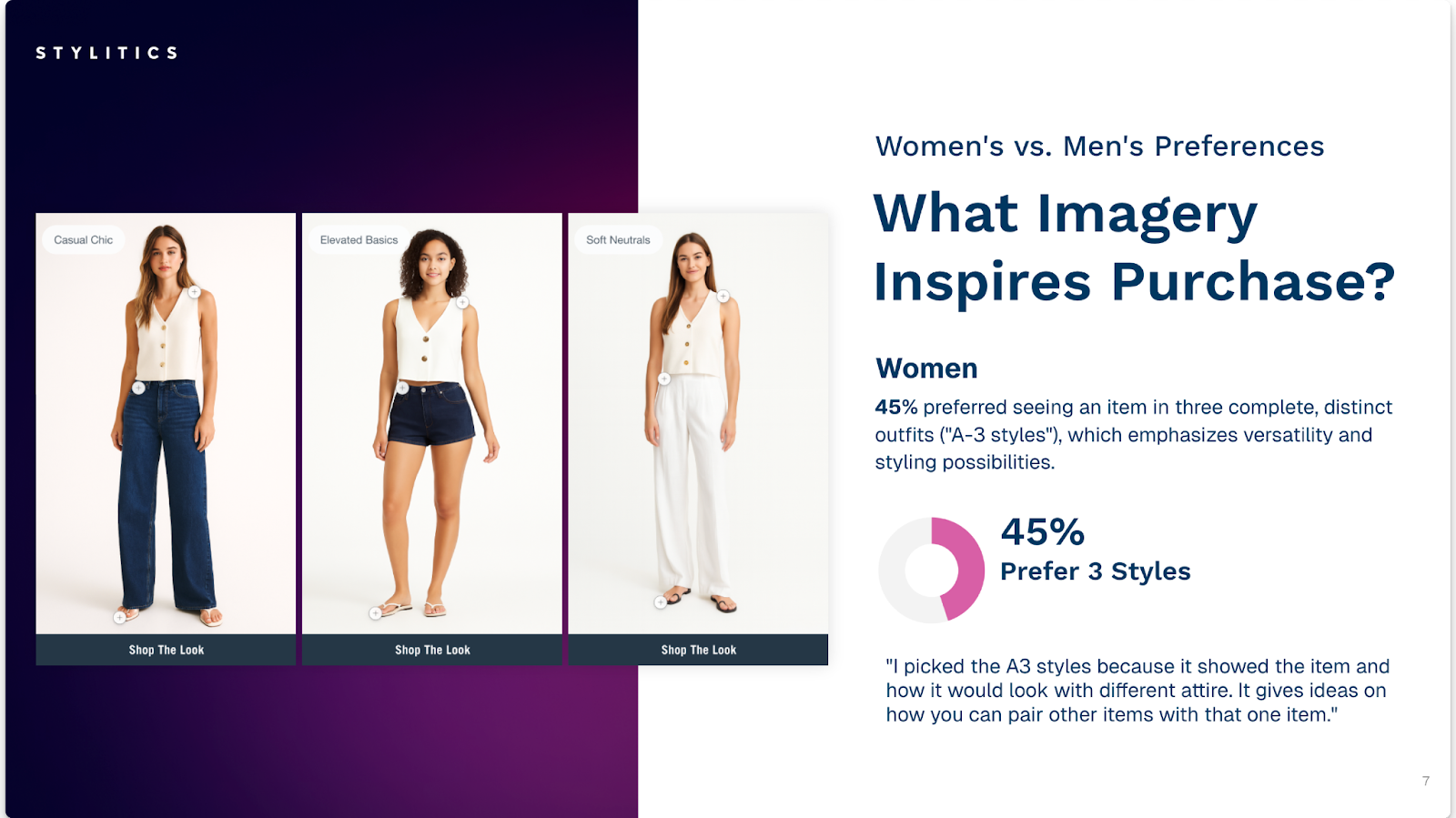
Once a visual baseline is established, retailers can test image generation in lower-risk, inspiration-led contexts. Style variations, contextual backgrounds, and multiple outfit combinations can help shoppers understand an item’s versatility and imagine it in their own lives. Because these formats sit earlier in the shopper journey, they may carry less accuracy risk than fit-focused imagery.
Phase 3: Improve Fit Accuracy and Representation
The next frontier is accurately representing fit across diverse body types. Retailers can test model diversity and inclusive imagery alongside detailed 360-degree views, but every output must be validated against the real product for color, construction, drape, and proportion. Automation can support quality control by flagging potential issues, but it should not replace human review when shopper confidence is at stake.
Implications for Marketing Content and Creative Operations
The potential role of AI imagery extends beyond PDPs. As retailers build confidence in AI-generated product imagery, they can explore ways to adapt approved product visuals for marketing content across channels.
Potential use cases include:
Social campaigns featuring virtual models wearing new drops.
Ad creative variations built from approved templates and brand guidelines.
Email content showcasing seasonal collections, styled outfits, or contextual backgrounds.
Catalog and marketing-asset automation, including batch workflows that create campaign-ready imagery across hundreds of SKUs while retaining human review for product accuracy and brand standards.
These use cases point to a more flexible content-production workflow, not a guarantee of better ad performance. AI image generation and automation can help teams adapt ecommerce and marketing assets more efficiently, but quality control remains essential. Every image should align with brand standards and accurately represent the product before it reaches shoppers.
Beyond Fashion: Expanding Use Cases
While this study focused on apparel, the lessons may extend across other verticals. Potential applications being explored include:
Jewelry: AI-generated packshot images with consistent lighting and polish.
Home décor: Virtual backgrounds or staged scenes to show furniture in aspirational settings.
Footwear and accessories: 3D models or virtual try-on experiences that help shoppers visualize complete looks.
Across these categories, the opportunity is similar: to narrow the confidence gap by providing visuals that are realistic, inspiring, and aligned with brand standards.
Conclusion: Trust Hinges on Quality, Transparency, and Utility
So, do shoppers trust AI-generated fashion product photos? Our research suggests many are open to them, if key conditions are met:
Execution quality: Shoppers lose confidence quickly when product details are inaccurate.
Transparency: Clear labeling helps build brand integrity and trust.
Risk reduction: Flexible return policies help reassure hesitant buyers.
The future of AI-generated product imagery is not about replacing human creativity. It is about combining AI product photography, quality control, and brand expertise to create richer, more versatile ecommerce assets that shoppers can trust.
Stylitics’ research indicates that phased approaches, starting with inspiration, then testing accuracy-focused applications, may offer a safer path forward. Shopper sentiment is not uniform, but the evidence shows trust is most likely to be earned when imagery is accurate, transparent, and aligned with brand standards.
FAQ
Many shoppers are open to AI imagery if it is accurate and high-quality. Our research shows trust depends more on realism and detail than on whether an image is AI or real.
In our survey, 71% said AI and real images looked the same or had only small differences. While many can’t distinguish at a glance, they quickly notice inaccuracies in details like fabric, buttons, or proportions.
60% reacted neutrally or positively, while 31% expressed skepticism. Sentiment is mixed, with some shoppers curious and others concerned about authenticity and fit.
Research suggests that clear disclosure and flexible return policies help reduce shopper anxiety. 59% of participants wanted AI labeling, and 55% said they felt more comfortable if returns were easy.



 Shop the Look Let shoppers buy the full outfit directly from any styled image.
 Styled for You Personalized outfit recommendations based on individual shopper preferences.
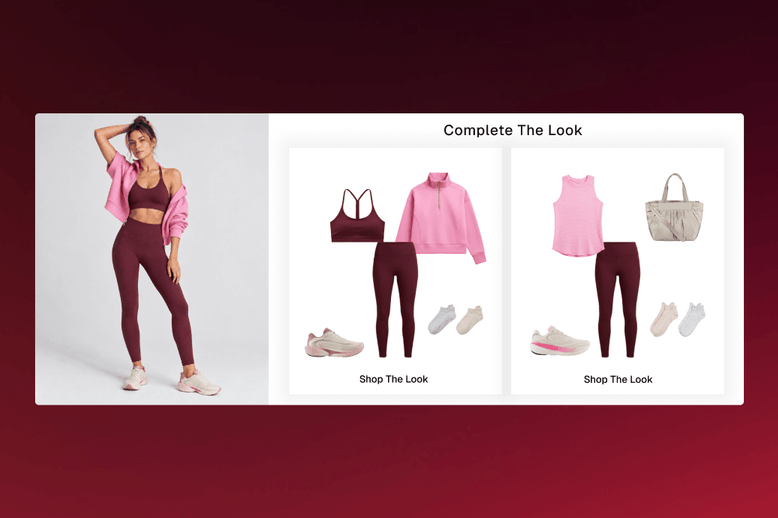
 Complete the Look Suggest complementary pieces to round out whatever a shopper is already viewing.
 Shop Similar Surface visually comparable alternatives when a specific item is out of stock or out of budget.
 Flat Lay to Model Choose from diverse models with full control over pose, crop, and framing.
 Background & Scene Swaps Place products in clean studio backgrounds, lifestyle environments, or custom lighting moods.
 AI Colorway Swaps Create photorealistic images for every colorway from a single reference shot.
 Model Diversity & Inclusive Imagery Output-ready formats for PDPs, social platforms, and campaign lookbooks.