Studio Quality Without the Studio Bill: AI-Generated PDP Imagery That Converts
Stylitics Marketing Team
The Stylitics Marketing Team explores the intersection of AI, retail, and shopper experience, sharing strategies and insights that shape the future of product discovery and visual merchandising.
You know the math doesn’t work. Your studio photography budget covers a fraction of the catalog, so the rest ships with flat lays. Or nothing at all. Entire categories of new products go live without on-model imagery because the shoot ran out of time, or the budget ran out first. And every product that launches without a real on-model shot is quietly underperforming on the PDP while no one can point to exactly why.
It’s not that the quality bar has dropped. It’s that the cost of meeting it has made full-catalog coverage impossible for most retailers. When on-model photography runs $50 to $500 per shot, “cover every SKU” stops being a goal and starts being a fantasy.
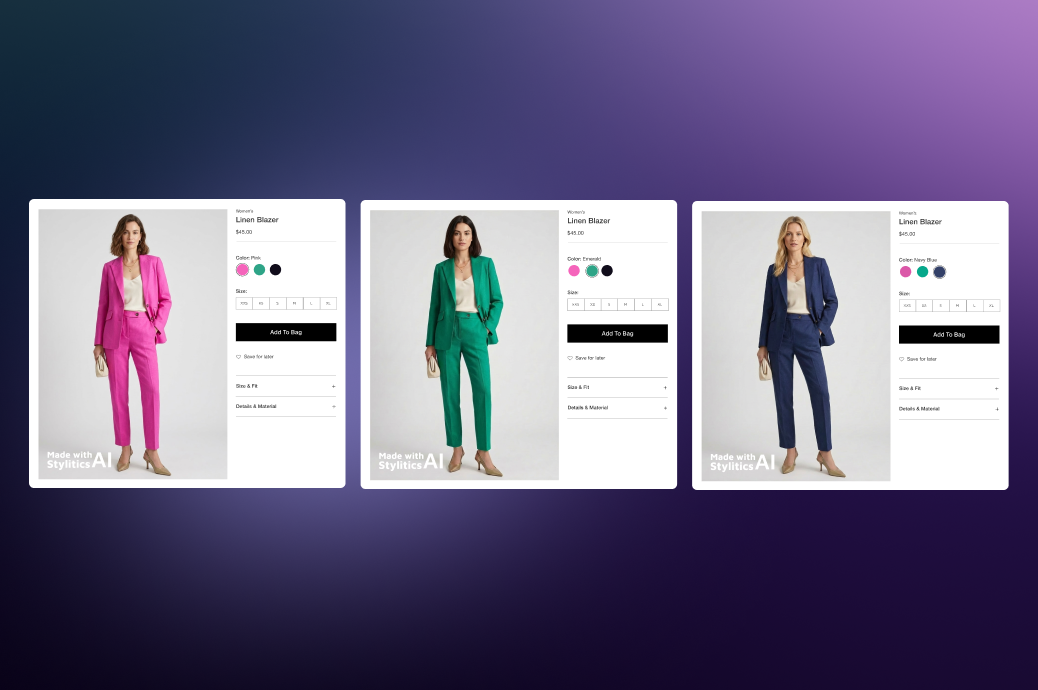
That gap is closing fast. AI-generated PDP imagery now matches studio quality on the details that actually drive conversion: fabric rendering, garment accuracy, zoom-ready resolution, and brand compliance. At 10 to 20 percent of traditional photography costs, with turnaround measured in hours instead of weeks, full-catalog on-model coverage is no longer a capital project. It’s an operational standard.
Below, we break down the real cost math, why the quality objection no longer holds, and how retailers are saving eight figures by replacing studio shoots with AI without sacrificing a single pixel of PDP quality.
Key Takeaways
AI-generated PDP imagery now matches studio quality on the metrics that matter for commerce: resolution, fabric rendering, garment detail, and brand compliance.
At 10–20% of traditional studio photography cost, full-catalog on-model PDP coverage is economically viable for the first time for most enterprise retailers.
Turnaround from product asset to live PDP image is measured in hours, not weeks — enabling faster time-to-live for new launches and seasonal updates.
A hybrid AI and human-in-the-loop quality model ensures every image meets brand standards before delivery, eliminating the manual QC burden that has derailed in-house AI attempts.
The math is not complicated, but it is brutal. Traditional studio photography for on-model PDP images runs $50 to $500 per image once model fees, studio time, styling, and post-production are fully accounted for. Retailers in Stylitics’ conversations have estimated costs ranging from $75 to $150 per shot — with the most efficient operations landing closer to $75 only by shooting 500 products a day with no room for variety. For a retailer with a 100,000-SKU catalog, comprehensive on-model coverage at those rates is a capital project, not an operational standard.
The result is always the same: coverage gaps. Prioritization by budget rather than by catalog need. Flat lays where on-model imagery should be. One apparel brand estimated that only about 20 percent of new season products were actually shot flat — and only a fraction of that made it into their commerce platform. A children’s specialty retailer described spending two weeks shooting summer, with entire categories of new silhouettes left out because budget and timing ran out. These are not edge cases. They describe how most retailers actually operate.
Stylitics AI Image Studio changes that equation. AI-generated PDP imagery now delivers studio quality — photorealistic garment rendering, accurate fabric physics, high-resolution zoom capability, and full brand compliance — at 10 to 20 percent of traditional photography costs, with turnaround measured in hours rather than weeks.
“The quality bar for AI-generated PDP imagery has crossed the threshold. Shoppers can’t tell the difference — and the conversion data reflects it.”
The Quality Objection No Longer Holds
The skepticism about AI-generated PDP imagery is understandable, and in earlier generations of the technology it was justified. It is not justified today. Retailers in Stylitics’ conversations have asked pointed questions about the QC process, product accuracy, and the quality risk before committing. These are the right questions — and the answers have changed.
Stylitics’ generation models, developed over ten years of work in retail visual production, render garments at a level of fidelity that meets the demands of high-volume commerce photography across fabric type, garment construction, and styling complexity. Outputs that demonstrate tuck and drape specifically models how different fabric types interact with the body and gravity, ensuring that garments look worn rather than digitally placed. Fabric drape, texture, sheen, hardware detail, logo placement, and garment construction are rendered with the accuracy that shoppers rely on to make purchasing decisions with confidence.
Our own shopper research conducted with Aha Studio — surveying 411 shoppers across multiple cohorts — found that 76% prefer on-model photos over flat lays because they better communicate drape, proportion, and styling context. That preference doesn’t disappear when the model is AI-generated. What shoppers respond to is the quality and accuracy of the image, not the production method behind it.
The QA model is what makes this credible at scale. Every generated image is evaluated by Stylitics’ AI QA Agent against hundreds of specific technical and brand compliance criteria. Images that pass are then reviewed by an expert, fashion-trained quality control team for the nuances that automated systems flag for secondary verification. The combined model means quality failures don’t reach delivery — and the 100 percent refund guarantee on any image that doesn’t meet standards or SLA makes that commitment contractually real.
What the Budget Math Actually Opens Up
The cost argument matters not just because it saves money, but because of what it makes possible for the first time. Full catalog on-model coverage stops being a capital decision and becomes an operational standard. Products that previously shipped with flat lays or no imagery because the budget ran out can now have on-model PDP assets from day one.
A plus-size specialty retailer in Stylitics’ conversations described wanting to show the same product across six to eight different model body types on the PDP — but acknowledged that actually executing that shoot would be “extremely expensive.” A denim brand noted they have 1,000 colorways to cover. A children’s apparel brand emphasized needing to show new silhouettes on-model so that shoppers can understand how the garment actually falls on a kid. The gap between what the catalog needs and what the photography budget can cover is not a small one for most retailers.
At Stylitics’ pricing — typically a 90% reduction in cost depending on complexity and volume — those decisions look completely different. The retailer spending $115 per image who saved over $20 million is the headline case, but the underlying logic applies at every scale. Retailers who couldn’t justify on-model coverage for their full assortment can now cover it. Retailers who could only shoot primary colorways can now cover every colorway. Retailers who could only afford one model can now show multiple body types on the same product.
The prioritization logic built into Stylitics’ production pipeline reinforces this. Inventory depth, margin, and seasonality drive which products enter the queue first, so the highest-value coverage decisions happen automatically. Client involvement across the entire system runs under two hours per month.
AI Image Studio: PDP Quality and Production Capabilities
Capability
Description
PDP Standard
High-res, zoom-capable commerce shots built to studio quality for every SKU.
Tuck & Drape
Realistic fabric physics and styling logic ensure garments look worn, not placed.
Full Outfitting
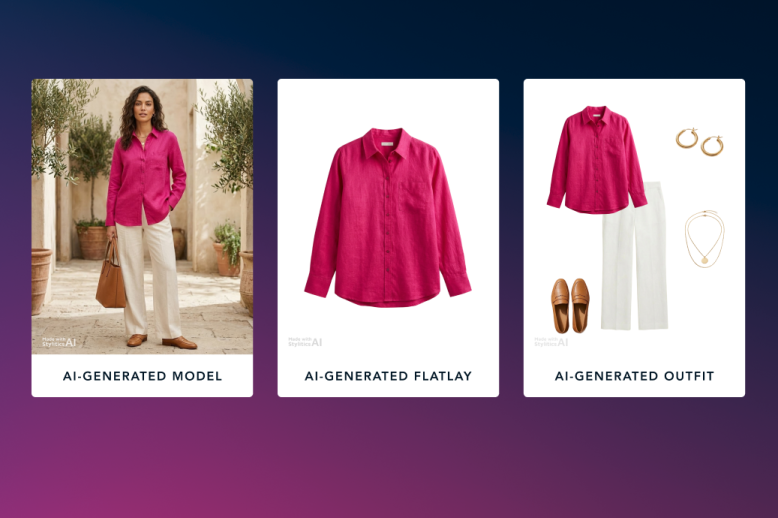
AI-paired shoes, accessories, and layers complete every look, styled to brand standards.
Model Diversity
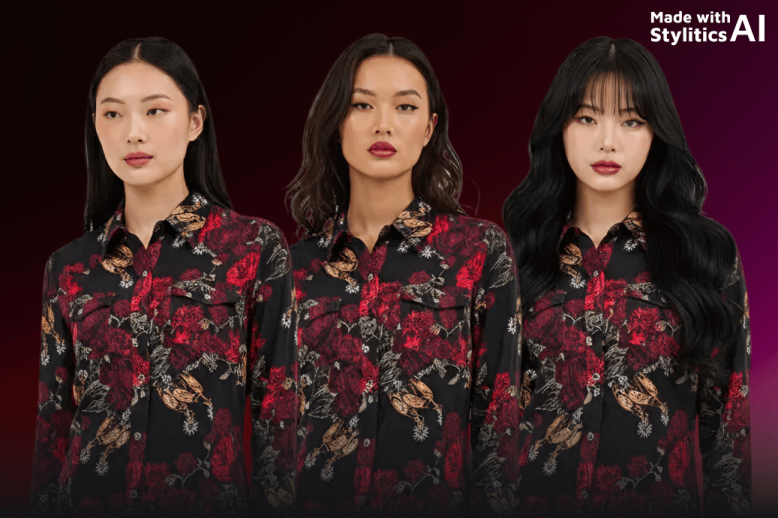
Select diverse model representations without compromising PDP image quality.
Pose Control
Standing, walking, or sitting poses optimized for PDP commerce performance.
Lighting & Mood
Soft box studio lighting for PDP-standard quality, or editorial alternatives per brand.
AI QA Agent
Automated evaluation of every image against hundreds of technical and brand criteria.
Human-in-the-Loop QC
Expert fashion-trained review paired with AI evaluation for brand-nuance verification.
Strategic Prioritization
Inventory depth, margin, and seasonality logic prioritizes high-value products first.
DAM/PIM Integration
Finished PDP-ready assets delivered directly into your commerce platform automatically.
CASE STUDY
Global Sportswear Retailer: $20M+ in Studio Photography Savings
$20M+ total savings achieved
10,000+ images delivered per week
$115/image cost reduced to a fraction via AI generation
A global sportswear retailer with a 100,000+ item catalog was spending over $115 per image on traditional studio photography for private label brands. Inconsistent vendor-supplied imagery was undermining PDP experience across a significant portion of the catalog. Internal AI pilots failed due to output quality that did not meet PDP standards and a quality control process that consumed more resources than it saved. Stylitics delivered studio-quality PDP imagery at scale, with automated QA and human review ensuring every image met commercial standards before delivery. Total savings exceeded $20 million.
The Quality Threshold Has Been Crossed. The Coverage Decision Hasn’t.
The question retailers used to ask about AI-generated PDP imagery was whether the quality was good enough. That question has been answered. As our research with real shoppers confirms, consumers aren’t rejecting AI imagery — they expect accuracy, brand consistency, and honest execution. Stylitics’ generation technology delivers on all three, meeting studio standards on every dimension that matters for commerce.
What remains is a coverage and prioritization decision. Every product that ships with high-quality on-model PDP imagery has a measurably better chance of converting than one that doesn’t. Retailers in Stylitics’ conversations have noted that when a product only looks right on a single body type and can’t show how it actually falls on a different frame, it creates a return problem before the customer even checks out. Full catalog coverage solves both sides of that equation — it improves conversion going in and reduces returns coming back.AI generation makes that standard achievable for every SKU in the catalog. Not just the ones that made the budget cut. See how Stylitics AI Image Studio works →
Frequently Asked Questions
All Stylitics outputs are delivered at high resolution with zoom capability, meeting PDP technical standards for major commerce platforms. Resolution specifications are configured to match each retailer’s platform requirements.
Stylitics offers a 100% refund guarantee on any image that does not meet agreed quality standards or delivery SLA. Images flagged by the AI QA Agent or human review are automatically queued for regeneration before delivery.
Standard production runs deliver formatted, quality-controlled PDP images within hours of asset ingestion. Turnaround SLAs are contractually guaranteed and included in the service agreement.
Yes. The generation engine is trained on a wide range of garment categories, including structured outerwear, suiting, knitwear, denim, and performance fabrics. Category-specific fabric rendering is applied to each product type.