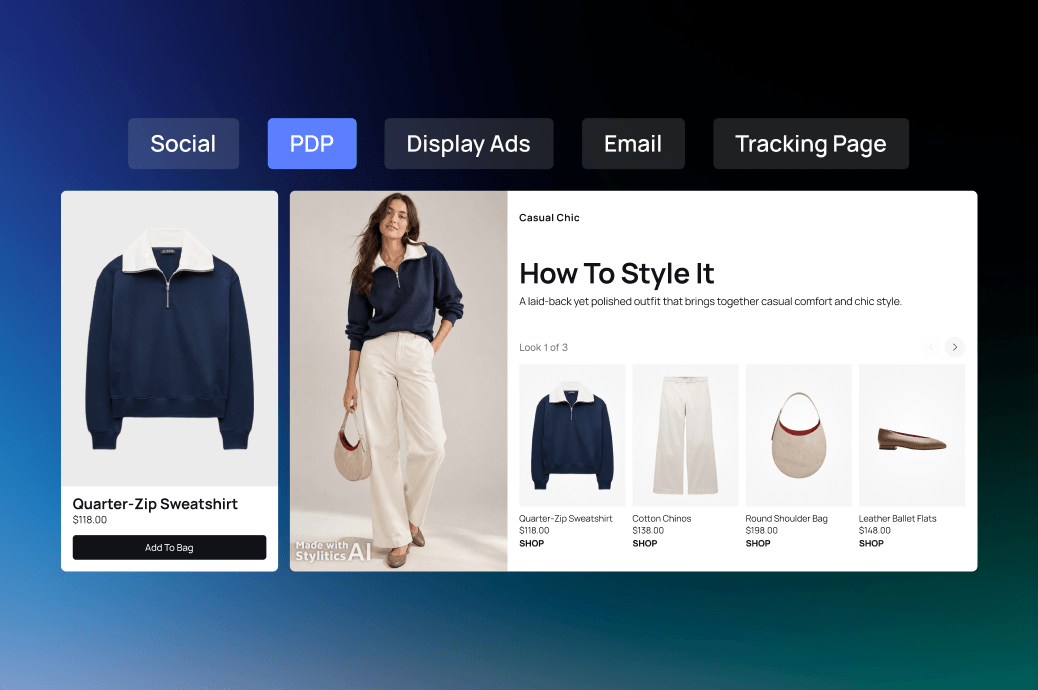
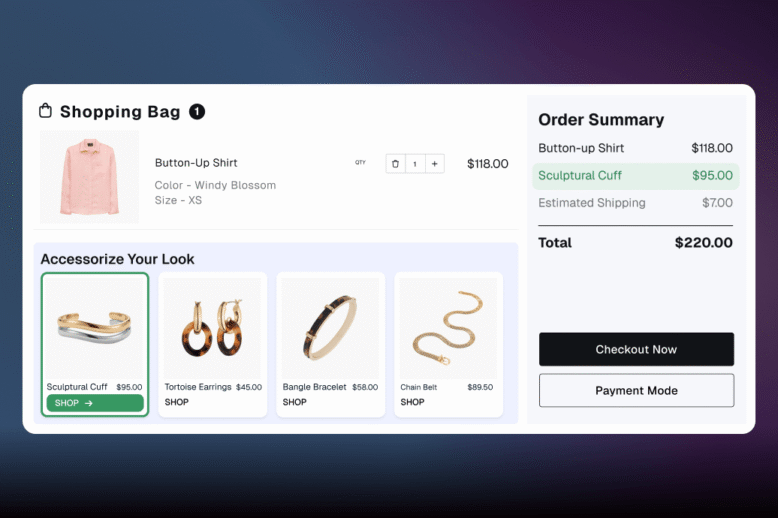
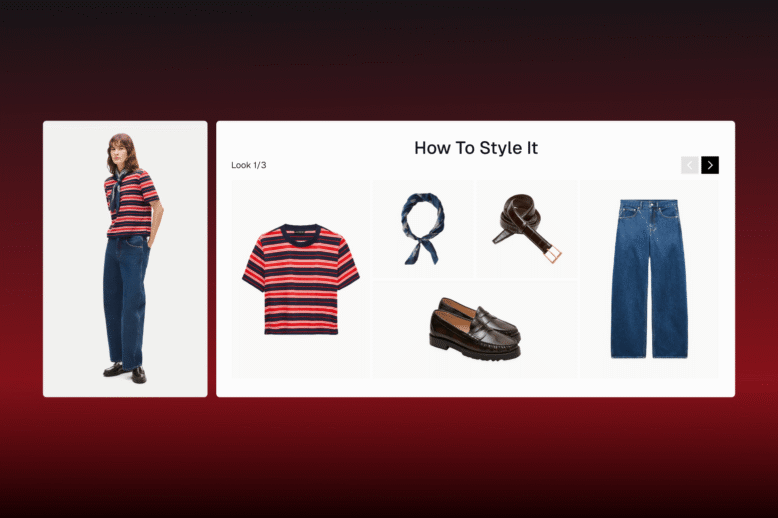
Open a product page on your own site and look at what sits under the buy button. Then check the category page above it, the seasonal gallery your team built in August, and the last triggered email that went out with that garment in it. Four different placements, one question — what does a shopper wear this with? For most fashion ecommerce software stacks the answers either disagree or three of them are blank.
Each system is doing its job with the data it has. The PDP module ranks on co-purchase history pulled from last quarter’s sales data, the gallery page on whatever a merchandiser had time to style by hand, the email on a feed export from three weeks ago. Nobody owns the answer across all four, and shoppers read the inconsistency as a reason to doubt the brand.
Forrester’s Total Economic Impact study of Stylitics put the value of getting this right at a 10% lift in average order value, $3.6M in net present value and 563% ROI over three years. That return doesn’t come from a single widget. It comes from the outfit following the shopper across every surface she touches.
This article walks the five surfaces where outfitting decisions actually get made in fashion ecommerce, what breaks at each one, and why the fix sits in your catalog rather than your carousel. It also draws the line between the three very different products sold as fashion merchandising software, because only one of them is fashion ecommerce merchandising software.
Key Takeaways
- Outfitting shows up on five surfaces: the PDP, the category page, galleries and curated collections, triggered email and SMS, and the product feeds that AI agents now read. Most stacks run a different system on each, or leave three of them empty.
- “Frequently bought together” cannot style a garment that shipped on Tuesday. Co-purchase models need behavioural history, which your newest full-price inventory doesn’t have.
- A wrong match in fashion costs twice. Around 70% of shoppers who returned clothing bought online cited size and fit, according to Coresight Research’s May 2026 study with Alvanon, which put the online return rate in the United States apparel market at 23.4% in 2025.
- Every surface is downstream of product data. Fabric weight, layer role, formality, silhouette and palette have to exist in your product hierarchy before anything can merchandise on them — and the garment needs an image before it can appear in a look at all.
- Measure the surfaces together: UPT, revenue per visitor, attach coverage and keep rate. Outfitting that lifts AOV and returns at the same time has not worked.
Why is fashion the hardest category to merchandise?
Three conditions make apparel different, and each one breaks a merchandising approach that works fine in electronics or grocery.
The catalog turns over constantly
A seasonal buy that lands in drops means your newest, full-price stock is also your least-understood stock. No behavioural signal, no reviews, no sales data to model against. Trend signals tell you what the market wants next season; they say nothing about what pairs with the jacket that landed on Tuesday. Any system that merchandises from shopper behaviour is structurally worst at exactly the inventory you most want to sell at full margin, and best at the carryover you were going to mark down anyway.
Customer demand arrives as an occasion, not an attribute
Shoppers are dressing for a wedding, a holiday, a new job, a cold commute. Your filters offer colour, size and price. Translating one into the other is the merchandising job, and a filter bar has never been able to do it. Neither has a co-purchase model, which knows what sold together but not why the pairing works.
A wrong recommendation costs twice
In most categories a bad match costs a conversion. In fashion it converts, ships, comes back, and takes the margin with it. That’s why return rate belongs in the merchandising scorecard and not just the supply chain management review, and why retailers running Stylitics outfitting typically see a 30–40% reduction in returns on outfitted orders.
Where do outfitting decisions actually get made?
1. The PDP: the question that stalls the order
The product page is where a shopper decides whether the garment solves her actual problem, and the question she is asking is rarely about the garment alone. It’s what do I wear this with.
Search that question for almost any item and page one belongs to apparel retailers’ own blogs — brands winning “what to wear with” long-tails by hand, one post at a time, for a few dozen hero products. That’s the manual version of a job that should run across the whole catalog. Complete the Look answers it on the page itself, with an outfit built from stylist-trained rules rather than last quarter’s basket data, so the newest arrival gets styled on day one instead of month four.
2. The category page: styling before the click
Some shoppers arrive knowing the garment. Most arrive knowing only the problem, and a grid of 4,000 product styles is a poor way to solve it. Showing the product in a complete look at the category level moves the styling decision upstream, before the shopper has committed to a single SKU.
The effect is not marginal. At JD Sports, the Shop the Model experience accounts for roughly half of all revenue driven through the outfitting widget. Department stores feel this hardest, because their category pages have to merchandise across brands that were never designed to sit together — one of the reasons outfitting for department stores is a distinct problem rather than apparel at a larger scale.
3. Galleries and curated collections: making editorial shoppable
Every brand already produces styling content. Lookbooks, seasonal campaigns, editorial edits, social. Most of it dies as inspiration because nothing connects the image to the SKUs inside it, and the manual tagging job never gets prioritised past the hero looks.
J.Crew and Madewell made their editorial imagery instantly shoppable by treating the gallery as a merchandising surface rather than a brand one. It also makes campaign impact measurable on the surface where it happened. The distinction matters for luxury in particular, where creative direction will not survive a grid of product tiles, and where outfitting for luxury brands has to preserve the styling point of view while still being clickable.
4. Triggered email and SMS: the outfit that leaves the site
This is the surface most outfitting vendors don’t cover, and the one where the fragmentation problem is most visible to the customer. A shopper abandons a cart, and the recovery email shows the item alone — or worse, shows a complementary product chosen by a different system than the one that styled the PDP she just left.
Outfits generated on-site should be available to the ESP as a feed, refreshed against live inventory, so the abandoned cart email, the post-purchase flow and the replenishment SMS all present the same look. Rhone saw a 39% AOV lift and 10x ROI inside 100 days running outfitting across surfaces rather than on one.
5. Feeds and agents: merchandising you don’t render
The newest surface is the one you have the least control over. Shopping feeds, marketplaces and increasingly AI agents are reading your product data and assembling their own answer to a shopper’s question, using whatever live product data you published.
This is where catalog enrichment stops being a data-hygiene project and becomes a merchandising one. Rhone’s Google Shopping performance improved on the back of catalog enrichment, and Carl’s Golfland took the same route. An agent asked to assemble a travel wardrobe can only reason over what your feed actually says. If fabric weight, layer role and occasion aren’t in there, you are invisible to the question and your competitor isn’t.
Why is every surface downstream of your product data?
None of the five work on thin data. Fabric weight, layer role, formality, silhouette, occasion and palette are what outfitting logic actually reasons about, and they are rarely structured fields in an apparel PIM or product lifecycle management system. Those were built to move a garment through its product lifecycle — designed, costed, made, shipped — not to explain it to a shopper or to an agent. The data model that gets a garment produced is not the data model that sells it.
Fashion has a second dependency that other categories don’t: the image. An outfit recommendation with no picture of the garment on a body is a list, not a look. Most retailers fill their full imagery slots for their best sellers and leave the long tail on a flat lay, and colorway parity breaks almost everywhere — five images on one colorway, one on the rest. The cause is bandwidth and budget, not taste. Generative AI on-model imagery closes that gap at 10–20% of photoshoot cost, and every asset passes fashion-trained human QC before it goes live, which is the difference between filling the gap and publishing six-fingered models on a brand site.
Enrichment and imagery together make the catalog the system of record for what a garment is and what it goes with. That shared layer is the difference between five surfaces that agree and five surfaces that argue.
One engine, or five opinions?
The case for consolidation isn’t tidiness. It’s that decisions made on different data produce visibly different answers, and shoppers read the inconsistency as doubt. Consistency across surfaces is a customer experience problem before it is a systems problem, and it turns up in customer satisfaction long before it turns up in a report.
Our own roundup of fashion ecommerce tools runs to nine vendors, which is a fair read of how the category gets bought and exactly the fragmentation this post argues against. The honest test is narrower than vendor count: do the surfaces read the same product data, and can one merchandiser change what all of them show?
That second half is where hybrid AI matters. A black-box recommender gives you an output and no steering wheel, which is fine until a brand partner objects to a pairing or a buyer needs the new collection pushed hard for two weeks. Merchandiser control over a decade of stylist-curated outfitting data, deployed across 175+ retailers reaching more than 200 million shoppers a month, is a different proposition from a model that learned styling from clickstream. If you’re weighing the alternatives, we’ve put the comparison up directly: Stylitics vs FindMine.
What actually gets called “fashion merchandising software”?
Search the term and three unrelated corners of the fashion industry come back. It’s worth separating them, because the confusion routinely lands the wrong vendor in the wrong evaluation.
Visual merchandising and planogram software run physical stores. VM managers use it to publish visual merchandising guidelines, brief store teams on shelf strategy and confirm in-store task execution across a retail network, fixture by fixture, through photo review and digital checklists. AI planogram software adds image recognition against shelf space optimization targets, and store layout management tools turn a floor plan into something head office can audit for in-store revenue. Search “shoe merchandising” and you’ll get fixture suppliers and display racks, not ecommerce at all.
Merchandise planning tools and connected planning platforms sit upstream: an assortment plan, buy planning, seasonal range planning, line architecture, and demand forecasting run against inventory balance data and last year’s sales analytics. The better ones add scenario modeling and AI-driven forecasts against assortment targets. Real software, real budget, different buyer — whatever the retail suites claim, the ecommerce VP is not the merchandise planner.
Fashion ecommerce merchandising software is the third, and the subject of this article: what an individual shopper sees once that stock is live. Note that “fashion merchandising” on its own mostly returns university degree programs, and that “retail merchandising software” and “apparel merchandising software” both resolve to the first two categories, which tells you something about how contested the digital term isn’t.
They meet at brand consistency, which is where brand strategy becomes visible to a customer. A campaign that runs one way in the window and another way on the PLP reads as two brands. The mechanics don’t overlap, though. No outfitting engine runs your store rollouts, no store execution platform styles a PDP, and no planning tool decides which of two in-stock dresses appears in the look. Visual merchandising teams and ecommerce teams should share a calendar and a brief, not a system.
How do you measure fashion ecommerce merchandising?
Four numbers, read together, and ideally on the same real-time dashboards rather than in four vendor portals:
- Units per transaction — the cleanest read on whether outfitting is adding a unit or moving one.
- Revenue per visitor — protects against the AOV vanity trap, where a higher basket masks a lower conversion rate.
- Attach coverage — SKU-level insights into what share of your live catalog can actually be outfitted today. Coverage is the constraint nobody reports and everybody feels.
- Keep rate — returns on outfitted orders specifically. This is the number that separates fashion from every other category, and the one most teams skip.
Frequently asked questions
Where to start
Pick the surface where intent is highest and outfitting is weakest, which is usually the PDP, and instrument keep rate alongside AOV before you change anything. Then check whether the next surface agrees with it. The audit takes an afternoon and it tends to settle the vendor conversation faster than a feature matrix does.
Request a demo to see the five surfaces running on one engine.



 Shop the Look Let shoppers buy the full outfit directly from any styled image.
 Styled for You Personalized outfit recommendations based on individual shopper preferences.
 Complete the Look Suggest complementary pieces to round out whatever a shopper is already viewing.
 Shop Similar Surface visually comparable alternatives when a specific item is out of stock or out of budget.
 Flat Lay to Model Choose from diverse models with full control over pose, crop, and framing.
 Background & Scene Swaps Place products in clean studio backgrounds, lifestyle environments, or custom lighting moods.
 AI Colorway Swaps Create photorealistic images for every colorway from a single reference shot.
 Model Diversity & Inclusive Imagery Output-ready formats for PDPs, social platforms, and campaign lookbooks.