Accessories Cross-Selling for Ecommerce: Turning the Add-On Into the Margin
Stylitics Marketing Team
The Stylitics Marketing Team explores the intersection of AI, retail, and shopper experience, sharing strategies and insights that shape the future of product discovery and visual merchandising.
Tapestry, the house behind Coach and Kate Spade, closed fiscal 2025 with a 75.4% gross margin (Tapestry, 2025). The average US apparel company sits near 57% (NYU Stern, 2026). That gap is what makes accessory cross-selling for fashion ecommerce worth getting right. Every bag, belt and pair of earrings you attach to an apparel order lifts the margin on that order, not just its average order value.
Most retailers still treat fashion accessories as a checkout afterthought: a row of socks and sunglasses shoppers scroll past on the way to pay. That’s the least profitable way to sell the most profitable line you carry. This guide covers where accessories earn their margin, why generic tools miss them, and how to show them inside a finished outfit so shoppers actually buy.
Accessory-led fashion houses run gross margins near 75%, against roughly 57% for US apparel (NYU Stern, 2026).
Accessories sell when shown inside a complete outfit. Rhone lifted AOV 39% with curated outfit recommendations (Stylitics).
Cart-only placement reaches the fewest shoppers, since 70.19% of carts are abandoned (Baymard Institute, 2025).
Co-purchase algorithms pair accessories badly because they can’t read style.
Measure margin per order, not just AOV.
Why are accessories the most profitable line in a fashion basket?
Accessory-led businesses consistently out-earn apparel at the gross margin line: Tapestry reported 75.4% for fiscal 2025, while NYU Stern’s January 2026 dataset puts the US apparel industry average, across 35 firms, at 56.88%. Accessories carry a low wholesale cost relative to their retail price, rarely need markdowns to clear, and carry fewer return risks than garments. That low cost base gives the markup strategy room to hold full price.
Returns widen the gap further. The NRF expects 19.3% of online sales to come back in 2025 (NRF, 2025). Garments come back when they don’t fit. A tote has no size chart to get wrong, and neither does a scarf.
Run the math on a single order. Take a $120 dress at a 57% margin, which earns $68.40 in gross profit. Add a $45 bag at 75% and the order earns another $33.75. Revenue went up 37.5%. Gross profit went up 49%. That’s the add-on turning into margin, and it’s why accessory placement deserves the same attention as the hero product. (Illustrative figures, using the benchmark margins above.)
Growth is moving in the same direction. BoF and McKinsey forecast jewelry as the fastest-growing category in the fashion industry by unit sales, at nearly four times the rate of clothing (BoF, 2025). For more on protecting margin without discounting, see how smarter outfitting increases gross margin.
Why doesn’t the checkout add-on move the needle?
Baymard Institute puts the average cart abandonment rate at 70.19% across 49 studies (Baymard Institute, 2025). Seven in ten shopping carts never convert, so accessories placed only on the cart page reach the smallest, most hesitant audience on your site. On the checkout page, shoppers are thinking about shipping costs, not style.
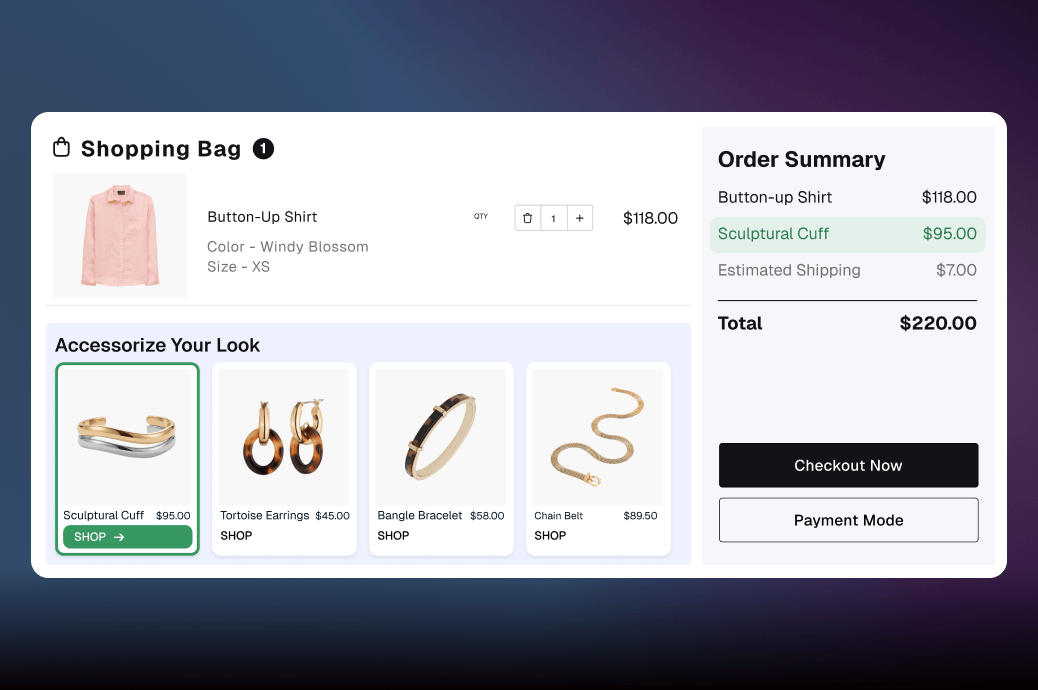
As a sales tactic, the checkout add-on also fails on context. A generic recommendation section under a cart says “you might also want this.” It never says “this finishes what you’re wearing.” Shoppers can’t picture a belt against a dress they’ve already scrolled past, so the add-on gets judged on price alone.
Think about how good in-store customer service sells the same belt. Strong sales associates don’t wait for the register. They pull the belt while the shopper is still in front of the mirror, when the outfit is the question. Online, that moment happens on the product page, not the cart. The cart can still carry an accessory, but it should echo a look the shopper already saw, not introduce a stranger.
Why does “frequently bought together” miss on accessories?
McKinsey found that 76% of consumers get frustrated when experiences aren’t personalized (McKinsey, 2021). Co-purchase widgets are where that customer experience breaks down most visibly in fashion. They mine customer data for what other people bought, not what goes with this piece.
That logic works for product bundles like batteries and phone chargers. It breaks down on accessory sales for three reasons.
First, co-purchase data ignores style. Two items bought in the same order may have been gifts for different people. Recommendation engines trained on that signal will happily pair a black leather belt with a linen beach dress.
Second, accessory new arrivals land every season with no purchase history. A “frequently bought with” module has nothing to show beside a new earring, so it gets left out exactly when it most needs exposure.
Third, the tools can’t tell occasion. A crossbody bag suits a weekend look. A structured clutch suits a wedding guest look. Nothing in basket data explains the difference.
Where should accessories appear in a complete outfit?
Rhone saw a 39% increase in average order value from curated outfit recommendations (Stylitics). The lift comes from placing complementary products inside styled looks across the customer journey, not from one widget. Each of those display locations gives the accessory a different job.
Placement
Shopper moment
The accessory’s job
Metric to watch
Complete the Look on apparel PDPs
Deciding on a garment
Finish the outfit the shopper is picturing
Attach rate, units per transaction
Shop the Model on imagery
Reacting to a styled photo
Make the bag or sunglasses in the frame buyable
Clicks per look, widget revenue
Mix & Match on accessory PDPs
Comparing options
Show five earrings against one outfit
Accessory conversion rate
Galleries on category pages
Browsing for ideas
Turn a filtered grid into styled looks
Revenue per session
Post-purchase email and SMS
Just bought, still excited
Style the new garment into a look with the missing pieces
Repeat purchase rate
Cart
About to pay
Echo a look the shopper already saw
Margin per order
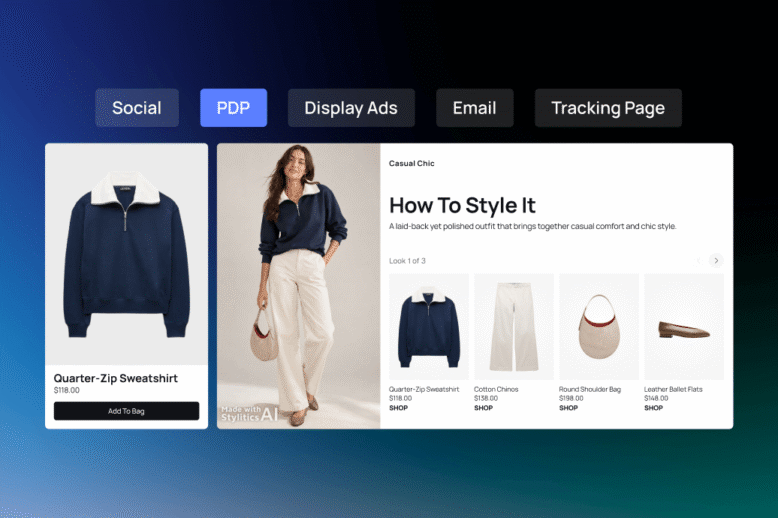
Complete the Look belongs on every apparel PDP. When a shopper lands on a blouse, the look should pair it with jeans, flats and gold hoops. The accessory arrives as part of an answer, and the shopper can add to cart without leaving the page. See how retailers build these in Complete the Look recommendations.
Shop the Model turns campaign and editorial images into buyable looks. At JD Sports, the on-model experience drives 50% of all revenue that runs through the Stylitics widget, and on-model outfits get 2.87x more clicks than other outfits in the same carousel (Stylitics). The sunglasses and bag in the frame stop adding visual appeal and start adding revenue.
Mix & Match flips the logic for accessory pages. Hold the outfit steady and swap the accessory, so a shopper can compare earrings in context. Choosing an accessory is a comparison, and good UI/UX design makes that comparison visible.
Galleries bring visual merchandising to small items by giving them a destination. A themed page of styled looks or holiday gift sets lets a gold hoop read as something to buy rather than something to sort past.
Triggered email and SMS marketing reach the shopper after they buy. The order confirmation email is the message they’re most likely to open, so style the garment they just ordered with the belt and bag they didn’t. Stylitics builds those looks at send time against live inventory, so nothing arrives sold out.
How do you choose the right accessory for each look?
Before AI-powered recommendations, retailers in Forrester’s study could only style 5–10% of their catalog by hand (Stylitics / Forrester). Accessories are usually the first thing cut from that small slice. The fix isn’t more stylists. It’s encoding stylists’ product knowledge into rules that run across the whole assortment.
Start with occasion
A look built for the office wants a structured tote and minimal jewelry. A look for weekend social settings wants a crossbody and sneakers. Occasion tags on your product data do more for accessory relevance than any co-purchase signal in your sales data.
Then color and material, the basics of matching accessories
Leather should match leather. Metals should agree within a look. These rules sound obvious, but they’re exactly what generic algorithms break.
Then price
An accessory that costs more than the garment it’s styled with reads as a mismatch and gets ignored. One at a fraction of that price point reads as an easy yes. Set a ceiling, such as accessories under half the anchor item’s price on PDP looks, and test it against your own numbers.
Finally, margin and inventory management
Stylitics Boosts let merchandising teams push high-margin categories or overstocked pieces into looks without breaking style rules. The recommendations stay inventory-aware, so a sold-out bag drops out on its own.
None of this works without clean attributes. If your product descriptions and attributes don’t say “gold-tone” or “evening,” no system can use them. Our guide to fashion product attributes covers what to capture. And keeping stylists in the review loop is what keeps automated looks on-brand and protects customer trust, as we explain in human-in-the-loop AI.
What results does outfit-led accessory selling deliver?
Forrester’s Total Economic Impact study found that Stylitics customers moved from styling 5–10% of their catalog to 100% with no added staff, and earned more than 6x net ROI over three years (Stylitics / Forrester). For any retail business, scale matters because accessories only earn margin when they appear in enough looks to be seen.
The brand results point the same way.
Rhone reported a 39% AOV lift and 10x ROI within 100 days of launching Shop the Model, plus conversion gains of 13% on men’s and 8% on women’s collections (Stylitics).
JD Sports shows the cross-category effect
Most of its sessions started on footwear, which left apparel underexposed in product discovery. Styling apparel into every shoe PDP changed that, and clothing now accounts for 88% of the revenue the widget drives (Stylitics). Swap “shoes” for “dresses” and “apparel” for “accessories,” and the same pattern applies.
McKinsey’s research backs the direction too. Personalization most often drives a 10–15% revenue lift (McKinsey, 2021). Outfit-led accessory selling is a form of personalized recommendations with a style point of view attached.
How should you measure accessory cross-selling?
BoF and McKinsey expect margins to stay under pressure through 2026 as competition intensifies (McKinsey, 2025). So report accessory performance in margin terms. AOV alone can rise while margin per order falls, if the add-ons are discounted or low-margin.
Track five numbers at the category level. Attach rate is the share of apparel orders that include at least one accessory. Margin per order compares gross profit dollars on orders with and without an accessory. Units per transaction gives a direct read on whether looks are adding sales volume to each basket. Accessory return rate should sit below your apparel rate, and if it doesn’t, check your imagery. Repeat purchase rate is an early read on customer lifetime value for shoppers who received styled post-purchase messages.
Use your merchandising software to test placements rather than assume them. Run A/B tests on price ceilings, look count per PDP, and whether accessories lead or trail in the carousel. The answers differ across fashion and apparel categories, and by audience.
If you’re rebuilding the plan from the basket up, our guide on how to increase ATV in retail fashion lays out a 90-day sequence. And if you want to see what outfit-led accessory selling would look like on your own catalog, request a Stylitics demo.
Frequently Asked Questions
Accessory cross-selling uses product recommendations to put bags, belts, jewelry, and similar items alongside the apparel a shopper is already considering. Done well, it shows the accessory inside a finished outfit. It matters because accessory-led fashion businesses run gross margins near 75%, against about 57% for US apparel (NYU Stern, 2026).
Yes, when the accessory appears inside a styled look. Rhone saw a 39% increase in AOV from curated outfit recommendations on Stylitics. Placement matters: an accessory shown on the PDP as part of a complete outfit gets considered earlier than one shown only at the cart.
Put them where shoppers decide on garments: Complete the Look on apparel PDPs, Shop the Model on imagery, and galleries on category pages. Add post-purchase email marketing that styles what they just bought. The cart is a weak primary spot, since Baymard puts average cart abandonment at 70.19%.
They rely on co-purchase history, which carries no information about style, color, or occasion. New accessories also have no history at all. McKinsey found 76% of consumers get frustrated by experiences that don’t feel personal, and mismatched pairings are one of the fastest ways to cause that.
Divide the number of apparel orders containing at least one accessory by total apparel orders. Track it alongside margin per order and units per transaction. Forrester found Stylitics customers moved from styling 5–10% of their catalog to 100%, which widens how many orders an accessory can reach.



 Shop the Look Let shoppers buy the full outfit directly from any styled image.
 Styled for You Personalized outfit recommendations based on individual shopper preferences.
 Complete the Look Suggest complementary pieces to round out whatever a shopper is already viewing.
 Shop Similar Surface visually comparable alternatives when a specific item is out of stock or out of budget.
 Flat Lay to Model Choose from diverse models with full control over pose, crop, and framing.
 Background & Scene Swaps Place products in clean studio backgrounds, lifestyle environments, or custom lighting moods.
 AI Colorway Swaps Create photorealistic images for every colorway from a single reference shot.
 Model Diversity & Inclusive Imagery Output-ready formats for PDPs, social platforms, and campaign lookbooks.