Activewear Ecommerce Merchandising: Selling the Set, Not the Legging
Stylitics Marketing Team
The Stylitics Marketing Team explores the intersection of AI, retail, and shopper experience, sharing strategies and insights that shape the future of product discovery and visual merchandising.
A shopper sees a matching sports bra and legging in a creator’s video, taps through to your site, and lands on the legging. The bra lives in another category, three taps away, under a color name she has to guess. So she buys the legging, or she buys nothing.
By every normal measure that page works. It loads fast and the reviews are strong. It was simply built for someone who shops one item at a time, and activewear shoppers mostly don’t. Every session that ends with half a set is revenue you paid to acquire and then left behind.
This guide shows what activewear ecommerce merchandising looks like when the set is the thing you sell. You’ll see where single-item pages leak the sale, four levers that rebuild the set on pages you already own, and the metrics that prove it’s working.
Key Takeaways
Activewear is bought as a coordinated set, yet most product pages and category grids still sell one SKU at a time, which caps the basket before the shopper decides.
90% of apparel sites fail to let shoppers properly judge appearance, size, or fit (Baymard Institute, 2025), and a set doubles that problem.
Rhone grew average order value 39% with curated outfit recommendations and saw 10x ROI in the first 100 days of Shop the Model (Stylitics).
Judge set merchandising on AOV, units per transaction and set-level returns, not on widget clicks.
What is activewear ecommerce merchandising?
Activewear ecommerce merchandising is how a brand presents, groups, sorts and cross-sells performance and athleisure apparel online so each visit turns into a bigger basket. Grand View Research values the activewear market at $440.4 billion in 2025, with in-store sales still holding 70.9% of revenue (Grand View Research, 2026).
That second number matters more than the first. Online is still the minority channel for a category whose shoppers live on their phones, which tells you most activewear brands haven’t rebuilt their merchandising strategy around how the product is actually bought. In a store, a merchandiser hangs the sports bra, the legging and the zip-up on one fixture. Online, the product catalog files them under three categories and three product pages, and the shopper has to rebuild the outfit herself.
Market size estimates vary widely depending on who’s counting, from roughly $346 billion to $518 billion for 2025. The spread reflects definitions more than demand. Every firm agrees the category is growing, and none of them measures the part an ecommerce team controls, which is how much of that demand leaves your site as a full basket.
Online merchandising for activewear comes down to four surfaces that decide basket size, which are the product page, the category grid, the imagery and the outfit content you send off-site. Getting fitness clothing onto a page is a solved problem. Getting a shopper to buy the whole kit is where most sites still fall short, and it’s the thread running through our guide to ecommerce visual merchandising.
Why do activewear shoppers buy the set, not the legging?
Activewear is an identity purchase, and identity gets bought as a look. McKinsey’s 2025 sporting goods survey found 48% of active consumers call fitness a core part of their identity, rising to 55% among millennials and Gen Z (McKinsey & Company, 2025). Nobody expresses an identity with half an outfit.
The same survey shows where the look comes from. Among millennial and Gen Z active consumers, 27% started a new sport in the past year because they saw people doing it on social media. That’s consumer behavior shaped by TikTok videos and influencer campaigns, and the thing on screen is almost never a lone pair of yoga pants. It’s the matching sports bra, the legging in the same colorway, the cropped layer and the trainers, styled together and shot in motion. The shopper arrives with that picture in her head.
A single-item product page answers a question she didn’t ask, handing her a SKU when she wanted the set and leaving her to hunt through two other categories to finish the outfit.
There’s a brand building argument here too, and it favors the challengers. McKinsey reports Nike and Adidas together ceded three points of market share between 2019 and 2024, largely to specialists that feel “for me” rather than “for anyone.” A curated set is the most concrete way a brand shows its point of view. Sell a legging and you compete on price and fabric specs against every other legging. Sell a look and you compete on taste, which is where brand loyalty in this category gets built.
Where does the single-SKU product page lose the sale?
The product page loses the sale when the shopper tries to judge the second piece. Baymard Institute’s 2025 apparel research found 90% of apparel sites fail to let users properly assess the appearance, size or fit of their products (Baymard Institute, 2025). A set asks the shopper to make that judgment twice, usually with half the information.
On a typical activewear PDP, the product descriptions cover moisture-wicking fabric, compression fabric and a squat-proof claim in detail. They rarely say which bra the legging was designed alongside, how the two colors read together in daylight, or whether the waistband sits under or over the bra’s band. The page was built to sell one item well, and it does. It just wasn’t built for how the item gets bought.
Fit notes, size guides and reviews that cover both pieces
A set is two sizing decisions with two different logics, since sports bras size by support level and band while leggings size by waist and inseam. When the page only helps with one, shoppers hedge, and the NRF expects 19.3% of online sales to be returned in 2025 (National Retail Federation, 2025). Free and fast shipping trained shoppers to bracket sizes, and an unclear set gets bracketed twice. That’s four items shipped for two kept.
Most of the fix is ordinary work that sites skip, starting with fit notes for both pieces on each page, such as the model’s height and the size she wears in each item. Link size guides beside every size selector, not in a tab below the gallery. Pull fit comments from customer reviews into a fit summary per piece, since Baymard found 33% of sites don’t aggregate fit information at all. Reviews that mention the set itself are the strongest social proof you have, so surface them on both product pages. For more on how imagery affects the same problem, see why AI-generated imagery reduces returns.
Variant-level stock that keeps the set whole
A set recommendation is only as good as the scarcest size in it, so if the legging is in stock in medium and the matching bra sold out in medium last week, showing the pair as a look is a broken promise that ends in a bounce.
Outfitting logic has to read variant-level stock, not style-level stock. When one half of the set is gone in the shopper’s likely size, the right move is to swap in the next-best coordinating piece, a different bra in a matching neutral, rather than show a look nobody can buy. Most basic recommendation widgets check whether a style exists. Very few check whether the outfit is buyable in a size someone actually wears.
How do you merchandise activewear as a set?
Put the set in front of the shopper everywhere she has already committed to one piece. Rhone did this with curated outfit recommendations and grew average order value 39%, with 10x ROI in the first 100 days of launching Shop the Model and conversion lifts of 13% on men’s and 8% on women’s collections (Stylitics, 2025).
Emily Heger, Director, Digital Product at Rhone, said, “Stylitics has helped us bridge the gap between our online and in-store experience, creating a path to product discovery and inspiring our customers with premium, curated looks.” Four levers do most of the work across the customer journey, and each one has a place where it earns more than the others. The full rollout is in the Rhone case study.
Complete the Look on every product page
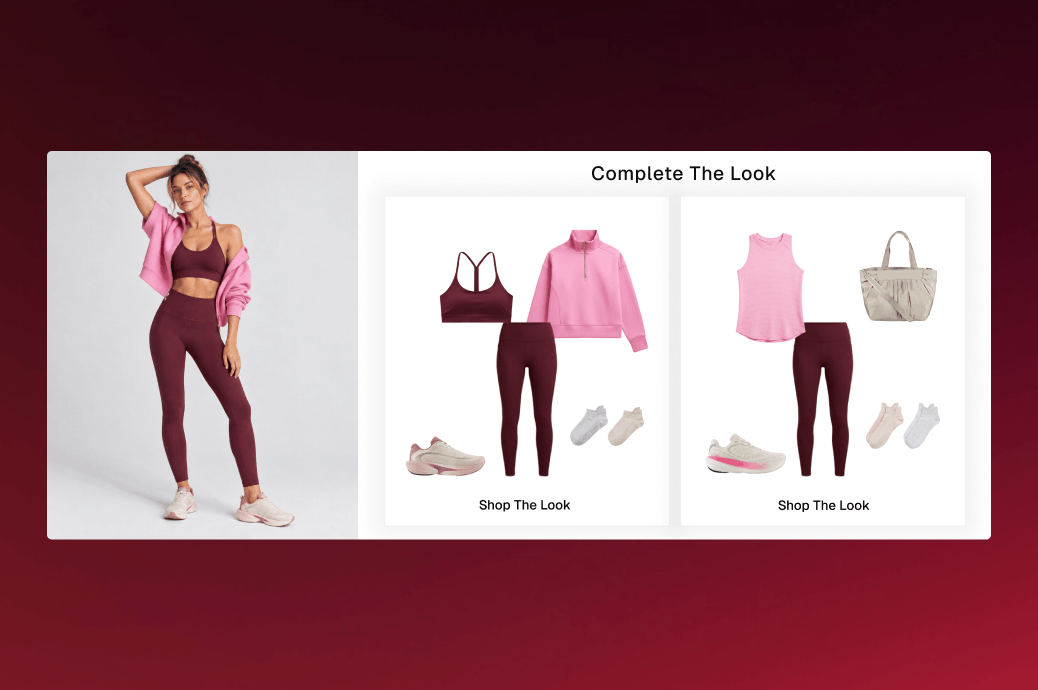
Complete the Look builds the rest of the kit around whatever the shopper is viewing. Someone on a training top is putting a session together, so the module should offer the shorts, the running belt and the shoes, with more looks behind the first one. Low-consideration items like socks, headbands and a water bottle do real work here, because they lift units per transaction and nobody navigates to them on purpose.
Product placement matters as much as the recommendation, because on mobile shopping sessions a module buried below reviews and shipping details barely gets seen. Put it directly under add-to-bag, where the shopper’s decision is fresh.
Make every model image shoppable
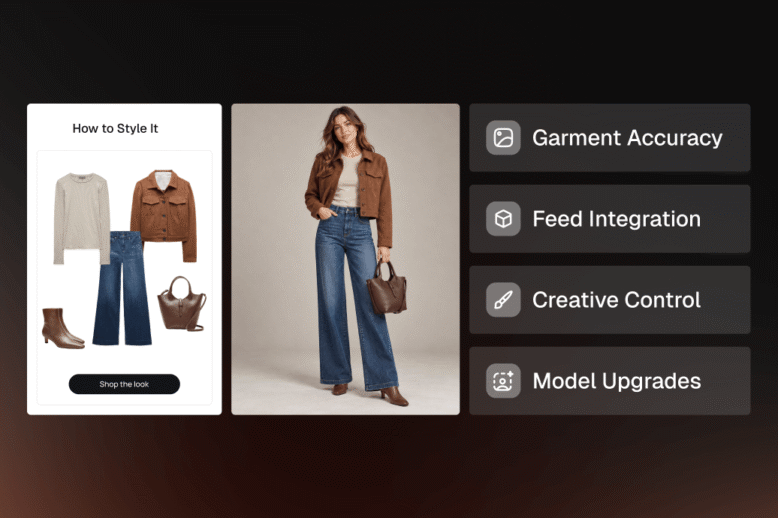
The model image is already the best visual presentation of the set, so make it buyable. At JD Sports, Shop the Model drives 50% of the revenue generated through the Stylitics widget, and on-model outfits get 2.87 times more clicks than other outfits in the same carousel (Stylitics). Shoppers trust what they see worn. A button on the image that opens every piece in it, sized and in stock, turns that trust into a basket. Shop the Look applies the same idea to campaign and editorial images.
Set-aware product sorting on category pages
Default product sorting ranks SKUs by best-seller score or newest arrival, which is exactly how a set gets scattered. The top-selling legging lands in row one and its matching bra lands in row seven, next to an unrelated tank. Data-driven sorting should know that pieces belong together and keep them close, or give shoppers a set-first way to browse.
Galleries solve this by making the complete outfit the browsing unit. A page of complete looks, each shoppable in place, turns five separate decisions into one. Baymard’s apparel research makes the same point from a usability angle, recommending that apparel sites invest in category navigation and curated paths ahead of search.
Outfit content in email, social and shoppable posts
Most off-site traffic lands on a single product, because shoppable posts and influencer campaigns send people to the legging page even when the creator wore the full set. Send that traffic to a set destination instead, so the visual content that earned the click matches the page it lands on.
Triggered email is the most overlooked surface, since a low-stock alert almost always asks for one item. Generate the full outfit at send time against live inventory and the same message can recover the set, not just the piece. The outfitting page for athletic brands shows how that plays out in practice.
What product photography does an activewear set need?
An activewear set needs to be seen worn together, and each piece needs to be seen up close. Baymard found 21% of apparel sites show one human-model image or none at all (Baymard Institute, 2025). For a category sold on fit and movement, that is not enough to justify the price of either piece.
Shoppers judge product quality from fabric texture, so a close crop of the knit shows whether a compression legging is opaque, a detail shot of mesh panels backs up the moisture-wicking claim, and a macro of recycled yarn makes a sustainable materials story believable. High-performance materials are hard to sell with a front-and-back flat lay. Lifestyle imagery then puts the set in context, on a run or in a studio, so the shopper sees it the way she saw it on her feed.
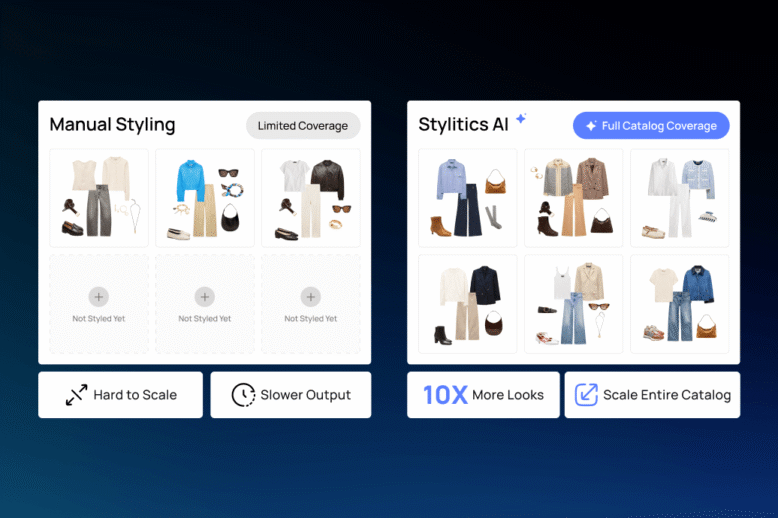
Volume is the bottleneck, because most brands shoot the hero colorway properly and leave the rest of the assortment on a flat lay, because photographing every piece in every color on a model costs more than the long tail earns. Generative AI on-model imagery closes that gap. With AI Image Studio, brands turn existing flat lays into AI-generated on-model images and fill colorway gaps at 10 to 20% of the cost of a photoshoot, with every image passing fashion-trained human QC before it goes live.
Virtual try-on and augmented reality answer a different question, which is whether an item fits my body. They typically require 3D assets for every SKU and say little about what to wear with the item. For an activewear set, outfitting and on-model imagery earn their keep first, because the purchase starts with the look, not the measurement.
The metrics that prove set merchandising works
Set merchandising should be judged on basket metrics, not engagement. In Forrester’s Total Economic Impact study of Stylitics, a composite retailer saw a 10% lift in average order value and a 563% ROI (Forrester TEI study). Those are the numbers that belong in a quarterly review, well ahead of widget clicks.
For activewear e-commerce specifically, the six metrics below give a complete read, and each one catches a different failure.
Metric
What it tells you
What to watch for
Average order value
Whether shoppers leave with more than the piece they came for
Compare sessions that saw a set module with those that didn’t
Units per transaction
Whether the set is actually selling as a set
A rise in units with flat AOV means small add-ons are carrying it
Set completion rate
How often a shopper who buys one half buys the other
Low completion on a best-selling legging usually means a stock or sizing gap
PDP conversion rate
Whether the set helps or distracts on the product page
Conversion rates should hold or rise, not dip, when the module appears
Return rate by order
Whether set buyers bracket less
Compare returns on set orders with single-item orders
Revenue per session
The combined effect on traffic you already pay for
The metric to report upward, since it ignores traffic swings
Run the comparison against a holdout rather than last year, since seasonal drops in this category move every number on the list.
What should activewear brands look for in AI-powered merchandising?
Activewear brands should look for styling intelligence trained on apparel, merchandiser control over every look, and recommendations that respect live stock. Stylitics runs on a decade of stylist-curated outfitting data across 175+ retailers reaching 200M+ shoppers a month, which is the difference between an outfit engine and a co-purchase widget.
That distinction matters more in activewear than almost anywhere, because generic AI-driven recommendations built on “frequently bought together” learn from basket history, and in apparel that history pairs a legging with another legging in a different color. It can’t tell a studio set from a trail kit. An outfitting engine knows which bra was designed with which legging, which tones read as a match, and which accessories complete a training look.
The platforms separate on four questions, and the first is whether your merchandisers can approve, edit and pin looks (the hybrid AI model) or are handed a black box. The second is whether it checks variant-level stock before showing a set. The third is whether it covers imagery as well as recommendations, so the long tail gets on-model coverage. The fourth is whether it plugs into your e-commerce platforms without a rebuild. Multi-brand and online sporting goods retailers should add a fifth, which is whether it can style across labels in one look.
For a side-by-side on those criteria, see our Stylitics vs FindMine comparison. If you’d rather see your own catalog merchandised as sets, request a demo and the team will build looks from your assortment.
FAQs
Pricing depends on catalog size, traffic and which surfaces you deploy, so enterprise platforms quote per retailer, but ROI is easier to pin down. Forrester’s Total Economic Impact study of Stylitics found a 10% AOV lift and a 563% ROI for a composite retailer, and Rhone reported 10x ROI within 100 days of launching Shop the Model.
Set orders don’t raise returns when fit information covers both pieces. Returns climb when shoppers are unsure of size, and the NRF expects 19.3% of online sales to be returned in 2025. Clear fit notes, a size guide beside every selector and on-model imagery for each piece cut the guesswork that drives bracketing, which is where set orders would otherwise lose money.
Keep the set within one thumb scroll of add-to-bag, because on a phone a complete-the-look module placed below reviews rarely gets seen. Use a horizontal carousel of looks directly under the buy button, make the main model image tappable to open every piece in it, and let shoppers pick sizes for each piece without leaving the page.
For most brands outfitting comes first, because virtual try-on needs 3D assets for every SKU and answers a fit question, while outfitting answers what to wear with it, which is how activewear gets bought. Rhone’s 39% AOV lift came from curated outfit recommendations on pages it already had, with no new traffic or 3D pipeline required.
Refresh looks whenever the assortment turns, and at minimum with each seasonal drop and colorway launch. An automated outfitting engine regenerates looks as products arrive and sell out, while merchandisers pin the hero sets. Stale outfits that point to sold-out sizes do more damage than no outfit, since they send the shopper to a page she can’t buy from.
Hero campaigns still need a shoot. For long-tail colorways, missing angles and fabric detail shots, generative AI on-model imagery fills gaps a photoshoot never reaches, at 10 to 20% of the cost. The standard that matters is control, so look for fashion-trained human QC on every image and brand rules applied before anything goes live.



 Shop the Look Let shoppers buy the full outfit directly from any styled image.
 Styled for You Personalized outfit recommendations based on individual shopper preferences.
 Complete the Look Suggest complementary pieces to round out whatever a shopper is already viewing.
 Shop Similar Surface visually comparable alternatives when a specific item is out of stock or out of budget.
 Flat Lay to Model Choose from diverse models with full control over pose, crop, and framing.
 Background & Scene Swaps Place products in clean studio backgrounds, lifestyle environments, or custom lighting moods.
 AI Colorway Swaps Create photorealistic images for every colorway from a single reference shot.
 Model Diversity & Inclusive Imagery Output-ready formats for PDPs, social platforms, and campaign lookbooks.