Fashion Ecommerce Merchandising: Sell the Outfit, Not the Item
Stylitics Marketing Team
The Stylitics Marketing Team explores the intersection of AI, retail, and shopper experience, sharing strategies and insights that shape the future of product discovery and visual merchandising.
Your product pages probably already have a recommendation row. Look at what it’s suggesting. A second black tee next to the first one. A wool coat beside a swimsuit because both sold in the same holiday sale. The shopper who wanted to know what goes with the trousers in their cart is still guessing, and guessing is how a dress gets ordered in two sizes and sent back in one.
Most fashion ecommerce merchandising advice comes from playbooks written for every category at once, so it ranks single items and calls that a strategy. Clothing doesn’t sell that way. It sells as an outfit, and the payoff shows up in returns as much as in basket size.
This guide covers why co-purchase logic fails apparel, five levers that sell the look on product and category pages, how merchandising cuts returns, and the metrics that prove it worked.
Key Takeaways
US shoppers returned 19.3% of online sales in 2025, so apparel merchandising has to cut returns as well as lift basket size (NRF, 2025).
Co-purchase widgets pair items that sold together, not items that look right together. Outfit logic fixes that.
Forrester’s TEI study found a 10% AOV lift from automated outfitting across the full catalog.
What is fashion ecommerce merchandising?
Fashion ecommerce merchandising is the practice of presenting, pairing and picturing apparel online so shoppers buy complete looks and keep them. With 19.3% of online sales returned in 2025 (NRF, 2025), the job covers what happens after checkout as much as the basket itself.
In brick-and-mortar stores, merchandising lives on shelves, mannequins, signage and the arrangement of a front table. A stylist dresses the mannequin, and the shopper sees the jacket with the trousers and the boots it was meant for. Online, that context disappears. The same jacket becomes one tile in a grid of 400, shot on a white background, next to a “you may also like” row of five more jackets.
Closing that gap is the whole job online. Buyers choose the assortment, pricing and promotions set the terms, and merchandising decides whether the shopping experience feels like a styled floor or a warehouse list. It’s also why this is a different discipline from ecommerce visual merchandising in general. Visual polish matters, but the unit that sells clothing is the outfit, not the SKU.
In-store lever
Online equivalent
Dressed mannequin
Complete-the-look module on the product page
Front-table story
Styled tiles and curated collections on category pages
Fitting room
On-model images that show fit and drape
Sales associate’s “this goes with that”
Outfit recommendations that update as stock moves
Why does frequently bought together logic fail clothing?
Co-purchase algorithms recommend what sold together, not what looks good together, and that distinction breaks apparel. Forrester’s TEI composite retailer could style only 5% to 10% of its catalog by hand before automating outfits (Stylitics / Forrester TEI), so most pages fall back to that sales-driven logic.
Frequently bought together was built for grocery and electronics, where co-purchase is a decent proxy for fit. Someone buying a camera needs a memory card. Someone buying a linen shirt doesn’t need whatever other shoppers happened to put in the same cart. In practice, sales correlation in fashion surfaces three kinds of nonsense. The first is duplicates, like a second black tee in a slightly different cut. The second is accidental pairs, where a swimsuit gets recommended next to a wool coat because both sold in a holiday promotion. The third is size-run noise, where the same item in the next size up shows up as a “recommendation.”
Machine learning on customer behavior doesn’t rescue this on its own. The model learns from past baskets, and past baskets in apparel are full of gifts, bracketing and items bought for different occasions. It also has a cold-start challenge. A new-season item has no sales history, so the algorithm has nothing to pair it with exactly when merchants most need it styled.
Good cross-selling and upselling in fashion start from a different question. What would a stylist put with this? That’s a judgment about silhouette, color, formality and occasion, the kind of intuition that sits with merchants and stylists, not in a transaction log. Stylitics trains its AI outfitting on a decade of stylist-curated outfit data for exactly this reason. The recommendations are complementary products that make sense as a look, and merchandisers can still review and override them.
Generic product recommendations engines still have a place. They’re good at “customers who viewed this also viewed.” They just shouldn’t be the thing that tells a shopper what to wear with their new trousers. If you’re comparing outfitting approaches, our breakdown of Stylitics vs. FindMine covers how the two handle this.
Which fashion merchandising strategies raise AOV?
The strategies that raise average order value in fashion all sell a look instead of an item. Forrester’s TEI study of Stylitics found a 10% increase in AOV and a 15% lift in conversion rate once outfitting covered the full catalog (Stylitics / Forrester TEI). Five levers do most of that work.
Complete the look on product pages
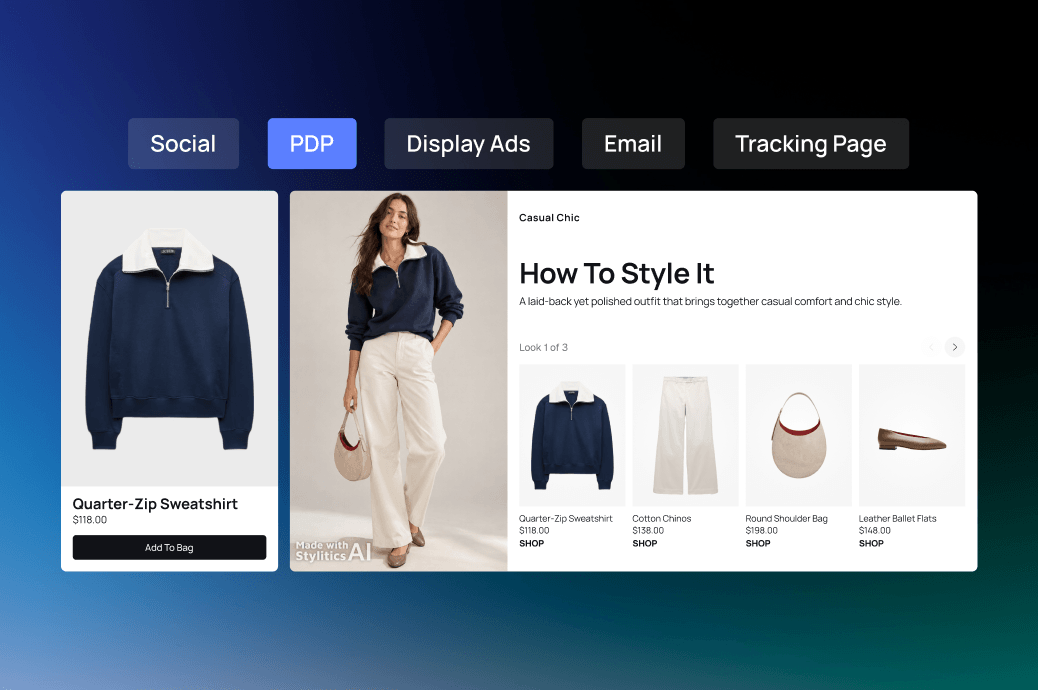
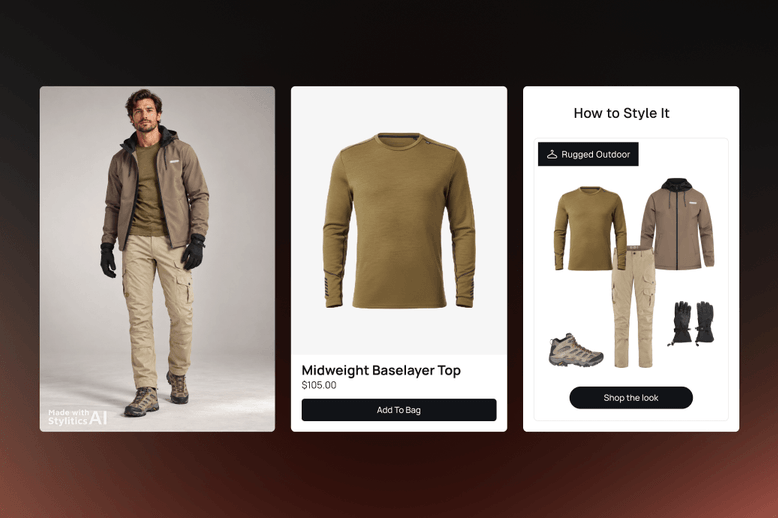
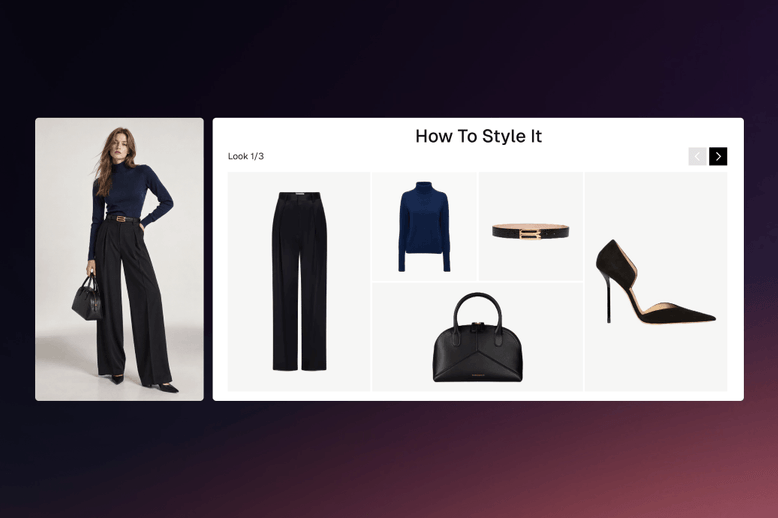
The product page is where the “what do I wear this with?” question stalls an order. A complete-the-look module answers it with two or three styled outfits built around the item the shopper is already looking at. It sits near the add-to-cart button, not buried under reviews.
Strong modules do a few things well. They show the hero item in each outfit so the shopper sees it in context. They vary the styling, so one look dresses the item up and another dresses it down. They let the shopper add a single piece without leaving the page. They also work on mobile, where screen space is tight and a swipeable carousel beats a grid. Product descriptions can do some of the styling work too, but colors and proportions read faster in an outfit than in a paragraph. For a deeper look at this lever, see our guide to complete the look recommendations.
Style category pages, not just sort them
Most category pages are a sorted list with filters. That’s fine for a shopper who knows exactly what they want, and weak for one who’s browsing. Styled tiles change the layout by placing a full outfit every few rows among the single products, so product discovery happens before the click.
Page design and navigation should support the same idea. A “build the look” entry point in the main menu, or outfit results that appear alongside items in site search, turns a category page into something closer to a store floor. Rather than replacing filters, styled tiles give the shopper another reason to keep scrolling.
Use on-model images that show fit
Shoppers can’t judge fit from a flat lay, and plenty of sites still ask them to. Baymard Institute found that 21% of apparel sites offer no on-model images or only one (Baymard Institute, 2025), and test participants left some sites to look for model photos elsewhere.
On-model and in-scene images do two jobs at once. They show how a garment hangs on a real body shape, and they carry the outfit storytelling that a white-background packshot can’t. JD Sports saw this directly. Shop the Model, the on-model outfitting experience in its Stylitics widget, drives 50% of the revenue generated through that widget (JD Sports case study). Product photography budgets rarely stretch to shooting every SKU on several models, which is where generative AI on-model imagery with fashion-trained human QC fills the gap.
Bundle by occasion, not by co-purchase
Curated collections built around occasions and events outperform lists built around sales data, because that’s how people actually shop for clothes. “Wedding guest,” “first week at a new job” and “long weekend away” are themes a shopper recognizes. A department store can run dozens of these at once, each one rebuilt as seasonal trends and holidays shift what people need.
Personalization belongs here too. A shopper whose browsing history leans toward relaxed tailoring should see the weekend outfit before the black-tie one. The occasion stays the organizing idea, and the shopper’s own signals decide which version comes first. For more bundle formats, our post on fashion product bundling strategies goes further.
Keep outfits shoppable as inventory moves
An outfit with a sold-out piece is a dead end. Outfit recommendations have to watch inventory in real time and swap in an available alternative before the shopper ever sees the gap. This matters most during seasonal transitions, when half the catalog is arriving and the other half is selling through.
Manual styling can’t keep up with that pace. The same Forrester composite retailer went from styling a small slice of its catalog to 100% without adding staff (Stylitics / Forrester TEI). That coverage is what lets these levers stack. Rhone, the performance apparel brand, saw a 39% increase in AOV from curated outfit recommendations and 10x ROI within 100 days of launching Shop the Model (Rhone case study). If you sell apparel, our page on AI outfitting for apparel brands shows what this looks like across a full catalog.
How does merchandising reduce apparel returns?
Merchandising reduces returns by fixing the expectation gap before checkout. In a 2023 PowerReviews survey of 25,452 US shoppers, 39% of apparel returns came down to size or fit and 28% to the item not looking as expected (PowerReviews, 2023). Both are merchandising problems.
Returns are the real ROI of fashion ecommerce merchandising, and most teams undercount them. A shopper who sees a dress on one flat lay, guesses at the fit and orders two sizes has already planned a return. Consumers are also paying attention to how returns are handled. 71% say they’re less likely to shop with a retailer again after a poor returns experience (NRF, 2025). Every return the product page prevents protects margin and customer satisfaction at the same time.
Return reason
Merchandising fix
Size or fit didn’t suit
Clear size guide, button-based size selection, on-model images across body types
Didn’t look as expected
Multiple on-model and in-scene shots, true-to-life colors
Bought several sizes to compare
Fit summary drawn from customer reviews
Didn’t match the description
Outfit context that shows scale, drape and how pieces pair
Baymard’s testing backs this up. 82% of apparel sites don’t give shoppers enough sizing information (Baymard Institute, 2025), and 90% don’t let shoppers browse reviews by reviewer photos. User-generated content is often the most trusted picture of how the merchandise looks on someone ordinary. Our article on why AI-generated imagery reduces returns covers the imagery side in more depth.
How do you measure fashion ecommerce merchandising?
Measure fashion ecommerce merchandising on outfit-level outcomes, not widget clicks. The Forrester TEI study measured AOV and conversion together, finding a 10% AOV lift and a 15% conversion increase (Stylitics / Forrester TEI). Pair those with units per transaction and return rate, and the decisions get clearer.
Metric
What it tells you
What to change if it slips
Average order value
Whether outfits are adding pieces to the basket
Move complete-the-look higher on the product page
Units per transaction
Whether shoppers buy the look or just the hero item
Add single-click “add this piece” to outfit modules
Conversion rate on styled PDPs
Whether outfits help a hesitant shopper decide
Vary styling and add on-model images
Return rate by product
Whether imagery and fit info set the right expectation
Fix sizing info and add on-model shots for high-return items
Catalog coverage
Share of products with at least one styled outfit
Automate styling for new arrivals first
Your analytics stack probably tracks AOV already. Units per transaction and catalog coverage are the two most teams miss, and they explain most of the movement in the others. Run A/B testing on the outfit module against your current recommendation widget, on the same pages and the same traffic, for at least two full weeks. A test that only counts clicks will flatter the wrong option.
Where should a fashion merchandising team start?
Start with the product pages that already get the most visits and send back the most returns. Stylitics runs outfitting for 175+ retailers reaching 200M+ shoppers a month, and those high-traffic, high-return pages are where styled outfits show their effect on AOV and returns fastest.
From there, the rollout process has three steps. Put styled outfits onto your top 200 product pages, then measure AOV, units per transaction and return rate against the pages without them. Next, extend outfits to category pages and site search so styling happens earlier in the customer journey. Last, carry the same looks into email and onsite campaigns, so merchandising and marketing work from one set of outfits instead of two. Automation is what keeps this sustainable as new arrivals land every week. When you’re ready to compare tools, our guide to fashion ecommerce merchandising software walks through the options, and the same thinking applies to footwear ecommerce merchandising. Inspirational commerce works best when the outfit is the default, not the exception.
Request a demo to see AI outfitting styled on your own catalog.
FAQs about fashion ecommerce merchandising
The most reliable way is to sell outfits instead of single items. Complete-the-look modules, styled category tiles and occasion-based collections all add pieces to the basket. Forrester’s TEI study found a 10% AOV lift from automated outfitting, and Rhone saw a 39% AOV increase from curated outfit recommendations.
Yes, because most apparel returns trace back to fit or to an item not looking as expected, and both are set on the product page. On-model images, clear sizing information and outfit context reduce that uncertainty. Baymard found 82% of apparel sites still don’t give enough sizing detail.
Complete the look builds outfits around the item a shopper is viewing. Shop the look starts from a styled image, often on a model, and lets the shopper buy every piece in it. Most fashion sites benefit from both. Our post on shop the look vs. complete the look compares them in detail.
Outfitting needs more catalog coverage than most teams expect. Forrester’s TEI composite retailer had styled only 5% to 10% of its catalog by hand, which left most product pages with no outfit at all. Automated outfitting took coverage to 100% without new staff, and the AOV gains followed the coverage.
It should, and that’s where it beats co-purchase logic. A new item has no sales data, so frequently bought together has nothing to work with. Outfitting trained on stylist-curated looks pairs items by silhouette, color and occasion, so a garment can be styled the day it goes live.
Track average order value, units per transaction, conversion rate on styled product pages, return rate by product and catalog coverage. AOV and conversion show the revenue effect. Return rate and coverage show whether the merchandising is setting the right expectations and reaching enough of the catalog.
Stylitics works with 175+ retailers, from department stores to brands like Rhone and JD Sports. Its AI outfitting, generative AI on-model imagery and fashion-trained human QC suit apparel brands that want styled outfits across the whole catalog without building a styling team. See AI outfitting for apparel brands for details.



 Shop the Look Let shoppers buy the full outfit directly from any styled image.
 Styled for You Personalized outfit recommendations based on individual shopper preferences.
 Complete the Look Suggest complementary pieces to round out whatever a shopper is already viewing.
 Shop Similar Surface visually comparable alternatives when a specific item is out of stock or out of budget.

 Flat Lay to Model Choose from diverse models with full control over pose, crop, and framing.
 Background & Scene Swaps Place products in clean studio backgrounds, lifestyle environments, or custom lighting moods.
 AI Colorway Swaps Create photorealistic images for every colorway from a single reference shot.
 Model Diversity & Inclusive Imagery Output-ready formats for PDPs, social platforms, and campaign lookbooks.