Manual Styling vs. AI: What Happens When Your Stylists Can’t Cover the Catalog
Stylitics Marketing Team
The Stylitics Marketing Team explores the intersection of AI, retail, and shopper experience, sharing strategies and insights that shape the future of product discovery and visual merchandising.
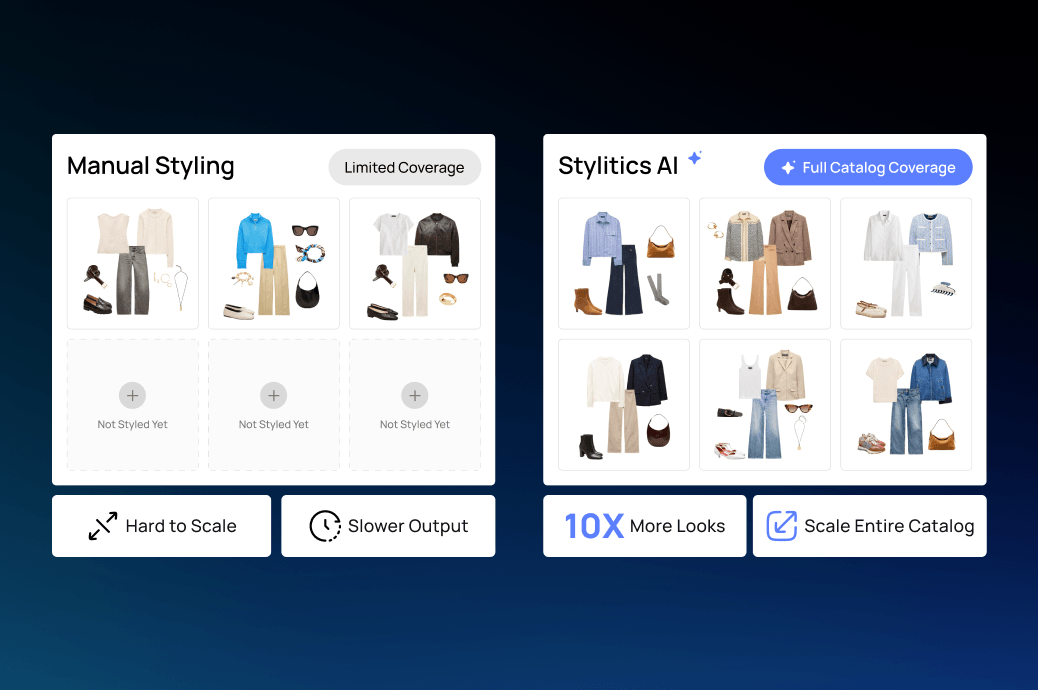
Your stylists are probably doing excellent work on about one product in twenty. Retailers in a Forrester TEI study commissioned by Stylitics styled just 5-10% of their catalog by hand before they automated. The hero PDPs get complete looks, and in a 20,000-SKU catalog the other 19,000 products go live on their own.
That isn’t a talent problem, and hiring two more stylists won’t solve it. Every season adds SKUs faster than any team can pair them, while the unstyled long tail drags down basket size and pushes up returns.
AI styling for fashion ecommerce changes the potential scalability of merchandising efforts without handing your brand to a black box. Below, we run the coverage math, compare manual and AI styling line by line, show how the hybrid model keeps stylists in charge, and list the questions worth asking any vendor.
Key Takeaways
Retailers style only 5-10% of their catalog by hand, and automation took that to 100% with no added staff (Forrester TEI study commissioned by Stylitics).
The unstyled long tail pays for it in smaller baskets, choice overload and returns. Online returns hit 19.3% of sales in 2025 (NRF).
The winning model is hybrid. Stylists write the rules, AI applies them to every SKU, and fashion-trained people review the output.
What Is AI Styling for Fashion Ecommerce?
More than 35% of fashion executives already use generative AI in areas that include consumer search and product discovery, according to the BoF-McKinsey State of Fashion 2026 report. AI styling is the discovery use that matters most to apparel retailers. It builds complete outfits and bundles from your own catalog, following your stylists’ rules.
That definition needs guarding, because the search results for this topic mix three different things. Consumer apps call themselves AI stylists and suggest what to wear from a user’s closet. Generative AI design platforms turn sketches into garments. Virtual try-on tools put a product on a shopper’s photo. None of those decide which jacket belongs with which trousers on your product page, and that’s the job retail AI styling does.
AI styling for a retailer is closer to a merchandising system than a chatbot. It reads your product attributes, inventory and imagery, then uses artificial intelligence to assemble looks that follow your brand’s styling logic and publish to product pages, email and ads. It sits next to adjacent tools like visual search, on-site search and demand forecasting, but it does a different job. Those help shoppers find one item. Styling helps them buy the second, third and fourth.
For an e-commerce leader in fashion retail, the useful question is not whether AI can style. Stylitics alone recommends more than 25 billion outfits and bundles to shoppers a year. The useful question is how much of your catalog your team styles today, and what happens to everything it doesn’t reach.
How Much of Your Catalog Can Manual Styling Actually Cover?
Retailers in a Forrester TEI study commissioned by Stylitics could style only 5-10% of their catalog before automating. The study’s composite retailer carried 20,000 SKUs and had hand-outfitted just 5% of them. After adding Stylitics, those retailers styled 100% of their assortment without adding staff, resources or labor hours.
Five percent of 20,000 SKUs is 1,000 styled products. The other 19,000 go live with no outfit, no “wear it with” and no bundle. Most fashion brands would call a team that styles 1,000 products a season productive, and they’d be right.
You can run the same check on your own catalog in an afternoon. Count the PDPs that carry a styled look today, divide by active SKUs, and you have your coverage rate. Then count how often those looks change when a paired item sells out. For most teams, both numbers are lower than leadership assumes.
Why Manual Styling Tops Out at the Hero PDPs
Stylist hours go where the revenue is most visible. Best sellers, campaign pieces and new arrivals get shot on model and paired with care, and those hero PDPs look the part. Everything else ships on flat lay images and plain product photos with nothing next to them.
Hand-built outfit guides and editorial looks make the gap worse over time. Each look is a one-off decision, so it can’t adapt when inventory moves. JD Sports described its own in-house process as labor-intensive and limited to static matching sets that couldn’t keep up with inventory changes. The number of possible outfit combinations in a large catalog grows far faster than any team’s calendar.
What the Uncovered Catalog Costs in Average Order Value and Return Rates
Basket size takes the first hit, because a product page with no complete look gives the shopper one item to buy. Average Order Value on that page depends entirely on the shopper building the outfit alone. Most won’t. In a 2025 Criteo survey reported by Chain Store Age, 78% of consumers said they feel overwhelmed by too many product choices. That’s decision fatigue, and an unstyled grid feeds it.
Returns take the second hit. Retailers expected 19.3% of online sales to come back in 2025, per the NRF and Happy Returns 2025 Retail Returns Landscape. Fit questions drive a large share of size-related returns, and a shopper who can’t see how a piece is worn with the rest of an outfit is guessing on proportion and length. Styled looks don’t fix sizing charts, but they remove some of the guesswork that turns into a return.
Manual Styling vs. AI Outfitting Compared Side by Side
Manual styling and AI outfitting differ most on coverage, freshness and cost per look, and least on taste. The Forrester TEI composite went from 5% coverage to 100% with no new headcount, which is the whole comparison in one line. Taste stays close because good AI styling starts from your stylists’ rules.
Score your current operation against the table below. Any row where the manual column describes you today is a place the catalog is leaking revenue.
Factor
Manual styling
AI outfitting with stylist rules
Catalog coverage
5-10% of SKUs, weighted to hero products
Every SKU, including the long tail
Inventory changes
Looks break when a paired item sells out
Same-day refresh and automatic substitutions
Consistency
Varies by stylist and season
The same brand rules applied to every look
Personalization
One look per product for every shopper
Looks that adapt to browse and purchase history
Brand control
High on the looks that exist
High, if stylists set the rules and review output
Cost as the catalog grows
Rises with headcount
Grows far slower than the catalog
Planning signal
Gut feel on what to feature
Predictive analytics on which looks sell
Manual styling still earns its place in the work that defines the brand. Campaign imagery, seasonal editorial and the handful of looks that define a collection deserve a stylist’s full attention. The mistake is asking that same team to hand-build the other 90% of the catalog. AI Outfitting & Bundling exists for that 90%.
Does AI Styling Replace Your Stylists?
AI styling doesn’t replace stylists, and the retailers getting results don’t try to. They use hybrid AI, where stylists set the rules and the software applies them at scale. Rhone, a Stylitics customer, saw a 39% increase in average order value and 10x ROI within 100 days of launching Shop the Model, according to its case study. Its stylists didn’t disappear. Their judgment reached further.
Here’s how the hybrid model works in practice. Stylists and merchandisers define what “on brand” means, from which colors pair to which categories never share a look. An AI outfitting engine then uses machine learning to apply those rules across every SKU, trained on a decade of stylist-curated outfitting data rather than on generic purchase patterns. Fashion-trained people review what goes live, the same approach Stylitics uses for human-in-the-loop QC on its imagery.
Compare that with a black-box recommendation engine. Co-purchase algorithms learn from what people bought together, which works for batteries and remotes. In apparel it produces pairings that sold together once, like a swimsuit and a winter hat bought in the same January order. Nobody on your team would style that look, and nobody on your team can override the model that made it.
The real risk in AI styling isn’t that the machine lacks taste. It’s that nobody at the retailer can see or change the rules it follows. Choose a system whose rules your stylists can read and edit. Ask, too, whether the underlying AI models can be upgraded as better ones arrive without rebuilding your styling logic each time.
Rhone’s result shows what that control buys. Conversion rates rose 13% on its men’s collections and 8% on women’s. “Stylitics has helped us bridge the gap between our online and in-store experience, creating a path to product discovery and inspiring our customers with premium, curated looks,” said Emily Heger, Director, Digital Product at Rhone.
Where Do Personalized Outfit Recommendations Show Up in the Customer Journey?
Coverage matters beyond the product page, because AI now sends shoppers to retail sites who arrive ready to buy. Traffic from generative AI sources converted 42% better than non-AI traffic in March 2026, according to Adobe. Every surface those shoppers land on needs a styled answer, not only the hero PDPs.
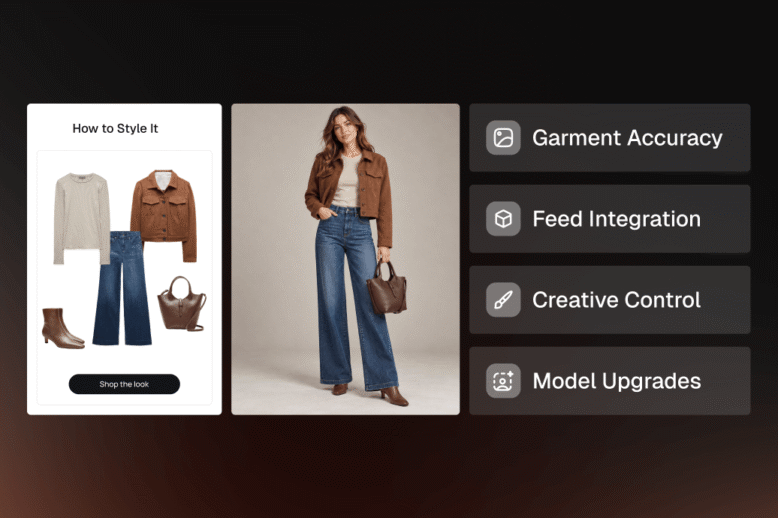
Shop the Look and Outfit Completion on the PDP
The product page is where outfit completion earns the most. Complete the Look suggests pieces that finish whatever the shopper is viewing. Shop the Look lets them buy the full outfit straight from a styled image. Both sit alongside outfit builders and galleries in the same AI Outfitting & Bundling product, so one set of stylist rules drives every format. At JD Sports, the Shop the Model format drove 50% of all revenue generated through the Stylitics widget, and clothing made up 88% of that widget revenue on a site where most journeys start with footwear.
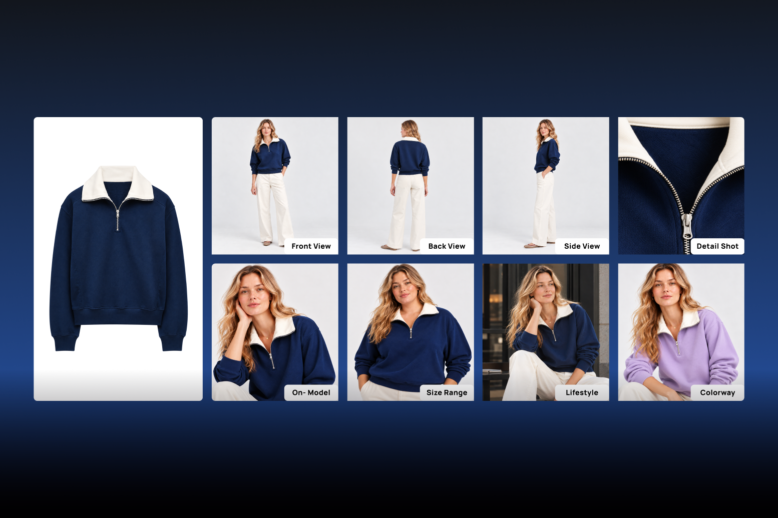
Imagery limits this on the long tail, since a product shot only as a flat lay can’t anchor an on-model look. Flat Lay to Model in AI Image Studio closes that gap with generative AI on-model imagery, shown on a range of body types and reviewed by fashion-trained QC before it publishes.
Email, Social and Personalized Feeds
Looks built for the PDP don’t have to stay there. Triggered and post-purchase email can show outfits built around what a shopper just bought, and social media ads can carry complete looks instead of single products. Styled for You goes further, using consumer data such as browse and purchase history to deliver personalized fashion recommendations matched to each shopper’s style. This is where customer engagement compounds. One styled look, built once, works on the PDP, in the inbox and in the feed.
AI Shopping Assistants and Agents
Any AI shopping assistant, on your site or an outside one, can only recommend outfits that exist as structured looks. A SKU with no styled look is close to invisible when a shopper asks an assistant what to wear with it. The coverage gap follows the shopper off your site.
How Do You Evaluate AI Styling Assistants?
Start by confirming you’ve outgrown manual styling, then test vendors on control, not demos. Forrester’s composite retailer had styled 5% of 20,000 SKUs before automating. If your coverage rate sits anywhere near that, the evaluation is about which system fits, not whether you need one.
A few signals tell you the team has hit its ceiling. Styled looks cluster on new arrivals and best sellers. Looks go stale or break when inventory moves. Merchandisers spend more time rebuilding outfits than planning them. And nobody can say what share of PDPs carry a complete look.
When you talk to vendors, take these questions into the room.
Can our stylists read, edit and override the styling rules, or only the outputs?
Was the engine trained on stylist-curated outfits or on co-purchase data?
How fast do looks refresh when a paired item sells out?
Who checks output before it goes live, and are they fashion-trained?
Can you show AOV and conversion results from a retailer our size?
Styling AI that can’t answer the first question well is a black box, however good the demo looks. For a longer checklist, the automated outfitting and bundling buyer’s guide covers integration and measurement in more depth.
How Do You Move From Manual to AI Styling?
The fastest path starts with the long tail of one category. Rhone reached 10x ROI within the first 100 days of launch, which shows how quickly the uncovered part of a catalog can pay back once it’s styled. Pick a category where coverage is lowest and the basket-building opportunity is clear.
Have your stylists write down the rules they already apply in their heads, then run them through the engine on that category. Stylitics is built to deploy with minimal IT involvement on existing e-commerce platforms, so most of the work sits with merchandising, not engineering. Measure Average Order Value, units per transaction and returns on styled versus unstyled PDPs for the same period.
Once the numbers hold, expand category by category until every product on your digital storefront carries a look your stylists would sign off on. That’s the version of digital shopping your stylists always wanted to build and never had the hours for.
If you want to see what your own catalog looks like fully styled to your rules, request a demo and the Stylitics team will walk you through it.
FAQs
Retailers use AI to build complete outfits and bundles from their own catalog and publish them to product pages, email and ads. More than 35% of fashion executives already use generative AI in areas including product discovery, per the BoF-McKinsey State of Fashion 2026. Styling differs from try-on because it recommends what to buy together.
AI shouldn’t replace stylists, and the best results come when it doesn’t. In a hybrid setup, stylists define the brand’s styling rules, AI applies them across every SKU, and fashion-trained reviewers check output. Forrester’s TEI composite went from 5% to 100% catalog coverage without adding staff, so stylists spend time on rules and campaigns.
Hand-styling scales with headcount, while AI outfitting cost stays close to flat as the catalog grows. Retailers in the Forrester TEI study commissioned by Stylitics styled 100% of their catalog without additional staff, resources or labor hours. Pricing depends on catalog size and surfaces, so ask vendors for a quote tied to your SKU count.
It can, by showing shoppers how a piece is worn before they buy. Online returns reached an estimated 19.3% of sales in 2025, according to NRF and Happy Returns. Styled looks help with proportion and pairing questions that lead to returns, though fit data and accurate sizing still carry most of the load on size issues.
Timelines depend on catalog data quality and how many surfaces you launch, but results can arrive fast. Rhone reached 10x ROI within the first 100 days after launching Shop the Model. Starting with one category and clean product attributes shortens the path more than any other single decision.
It needs a reliable product feed with images, inventory and attributes such as category, color, fit and occasion. Thin or inconsistent attributes produce weaker looks, which is why catalog enrichment often runs alongside outfitting. Stylitics recommends more than 25 billion outfits and bundles a year, all built on structured product data.
Stylitics uses hybrid AI. Your stylists and merchandisers set the styling rules, the engine applies them using a decade of stylist-curated outfitting data, and fashion-trained people review output. Stylitics runs outfitting for 175+ retailers reaching 200M+ shoppers a month, and each program runs on that retailer’s own rules.



 Shop the Look Let shoppers buy the full outfit directly from any styled image.
 Styled for You Personalized outfit recommendations based on individual shopper preferences.
 Complete the Look Suggest complementary pieces to round out whatever a shopper is already viewing.
 Shop Similar Surface visually comparable alternatives when a specific item is out of stock or out of budget.
 Flat Lay to Model Choose from diverse models with full control over pose, crop, and framing.
 Background & Scene Swaps Place products in clean studio backgrounds, lifestyle environments, or custom lighting moods.
 AI Colorway Swaps Create photorealistic images for every colorway from a single reference shot.
 Model Diversity & Inclusive Imagery Output-ready formats for PDPs, social platforms, and campaign lookbooks.