Look at your ecommerce dashboard right now. Conversions down, cost per visit up? You’re not the only retailer feeling it. The 2026 Contentsquare benchmark, drawn from 99 billion sessions across 6,500 sites, shows conversions falling 5.1% year over year while the cost of an online visit climbed 9%, and 30% over three years (Contentsquare). The one number moving your direction is average order value, up 6%.
Retailers feel the squeeze even harder. Traffic down 2.6%, conversions down 5.5%, and over half of retail traffic, 50.6%, is now paid. You’re paying more for visitors and converting fewer of them into customers.
That leaves one lever with room to improve: you need bigger baskets from the traffic you’ve already paid for, not more traffic.
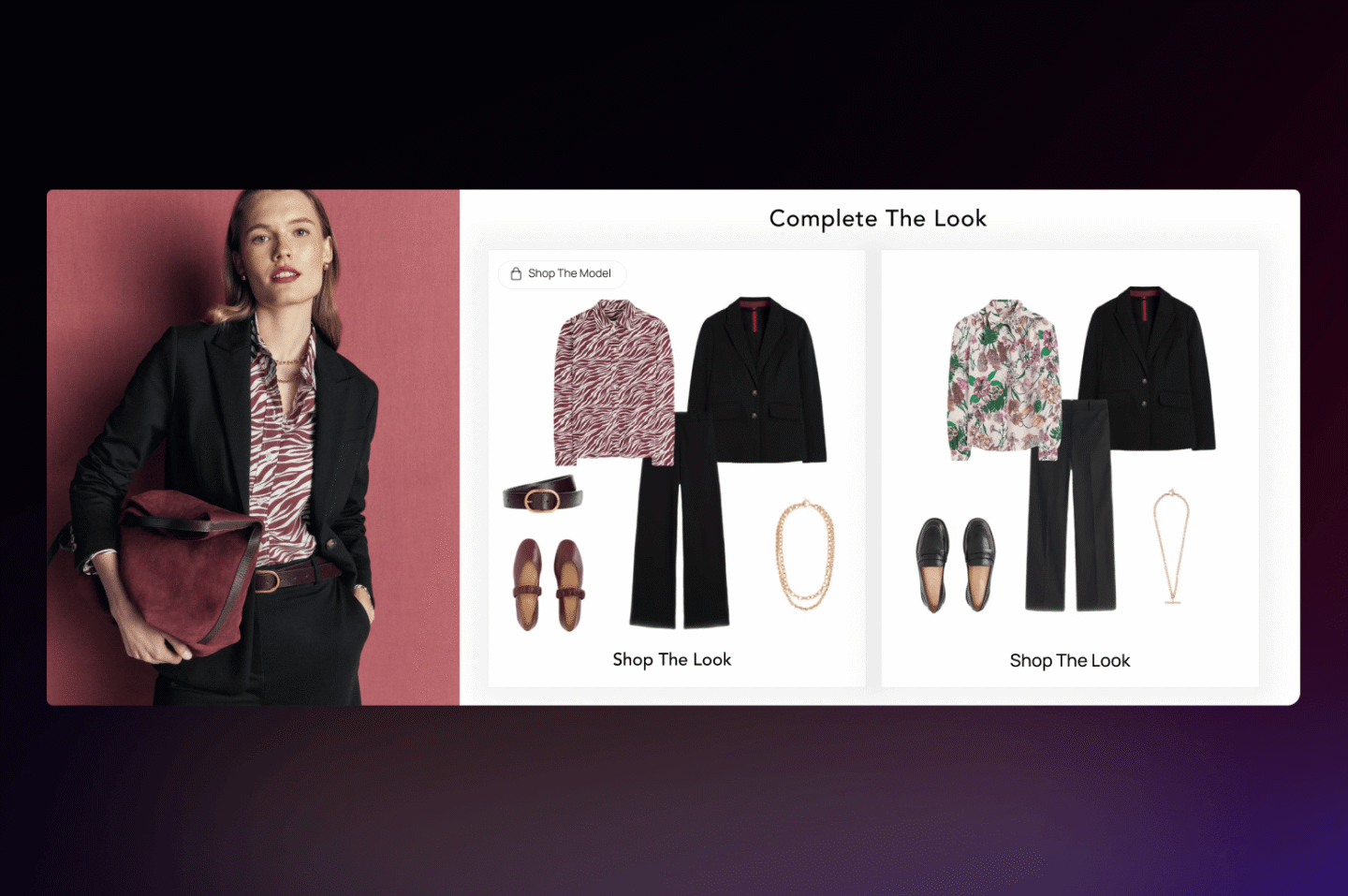
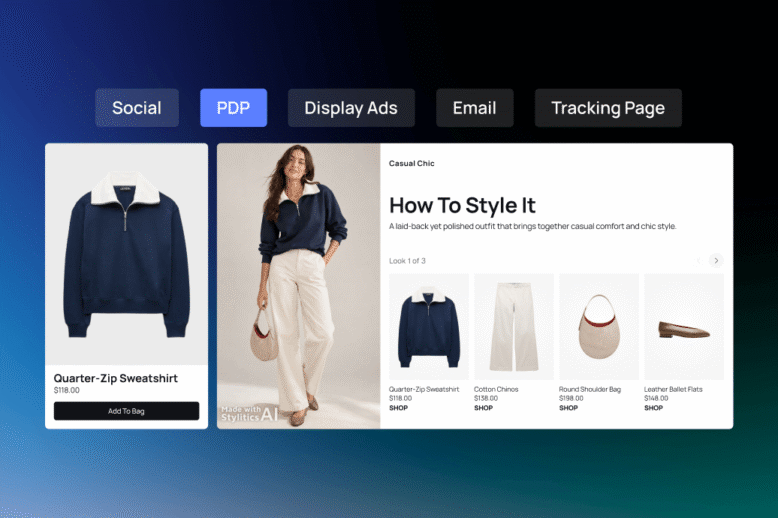
For fashion, the fastest way to grow that basket isn’t a discount threshold or a cart popup. It’s answering the question already forming in the shopper’s mind on the product page: what do I wear this with? Sandals with the dress. A jumper for when the season turns. New sporty shoes next to the leggings. That question hits at peak intent, on the page with the price, the size, and the stock, and most retailers answer it with a generic “you might also like” carousel, or nothing at all.
This article covers how your PDP can cross-sell more effectively by merchandising complete outfits instead of leaving that margin to chance.
Why is basket size the lever that’s still available?
Because the other two are being taken away. Traffic is getting more expensive and conversions are drifting down, and neither trend is inside your control.
Across two consecutive years of the same benchmark. In 2024, ad spend rose 13.2%, the cost of an online visit rose 9%, and conversion fell 6.1%. In 2025, cost per visit rose another 9%, conversion fell 5.1%, and 59% of sites saw traffic decline outright. Organic search fell 9% as AI answers absorbed clicks. Paid now accounts for 42% of all traffic and over half of retail traffic.
Set against that, AOV rising 6% is not a footnote. It’s the one metric that responds to merchandising decisions you can make this quarter without allocating more ad spend.
And there’s a margin argument sitting underneath the revenue one. A second item added to an existing order carries no incremental acquisition cost. If you paid to acquire the session anyway, the styled add-on is close to pure contribution — which is why a 3-point AOV lift usually beats a much louder conversion headline once both are on the same slide.
Why does the product page carry the most weight?
Because it’s where shoppers now arrive, and because it’s where intent is highest at the moment the question gets asked.
Contentsquare’s 2026 engagement data shows one in three visits starting on a PDP, product pages accounting for roughly 40% of all page views, and 61% of PDP visits bouncing. The classic marketing funnel from 2016 — home, category, subcategory, product — describes a minority of sessions. Search, social, paid, and AI assistants send shoppers directly onto a product page with no context about the outfit around it.
That inverts the merchandising job. A category page can only merchandise to shoppers who see it. The PDP reaches nearly everyone, and it reaches them holding a specific item, in a specific mood, at the specific second they’re deciding whether one thing is enough.
It’s also the only page that can answer and transact. Editorial content can show a shopper how to wear a trench coat. It can’t show them that the coat is in stock in their size at the current price, with the boots that finish it one tap away. Every handoff between inspiration and inventory is somewhere to lose the sale — and a styled PDP has no handoff. For a wider view of the page beyond the styling module, our PDP optimization guide and fashion PDP examples cover the rest.
What does a shopper actually mean by “what to wear with”?
Something more specific than “show me related products.” They are asking a styling question with four constraints stacked inside it, and a recommendation that misses any one of them reads as noise.
Category logic
A summer dress needs a shoe, and it needs a sandal or an espadrille rather than a boot. Leggings need a top and a trainer, not a second pair of leggings. This is the layer most modules get half right: they understand that a dress and a shoe are different categories, and nothing about which shoe.
Occasion and formality
The same slip dress pairs with a flat sandal for a summer lunch and a heeled mule for an evening. The jumper thrown over it moves the whole look into autumn. Occasion is the attribute that turns a category match into a wearable outfit, and it’s the one most catalogs don’t carry.
Season and weather
A sandal recommendation on a January PDP is technically valid and commercially useless. Styling logic has to know what season the shopper is dressing for, not just what season the item belongs to.
Color, proportion, and fabric
Whether the pieces actually work together — tonal harmony, hem length against boot height, a chunky knit over a fine-gauge base. This is the layer that separates an outfit from a list, and it’s the hardest to encode because it’s the part human stylists do by eye.
Get all four right and the shopper sees a look they can picture themselves in. Get one wrong and they see a machine guessing — which, as the next section covers, costs more than the missed add-on.
Why doesn’t “frequently bought together” solve this?
Because co-purchase data describes what happened to land in the same basket, not what belongs in the same outfit.
That distinction is minor in categories where the pairing is functional — a printer and its cartridge, a phone and its case. In apparel it’s the whole game. Two items sharing a basket may have shared nothing else: a gift, a return-and-replace, two unrelated needs handled in one session. Trained on that, an algorithm confidently pairs a tailored blazer with the socks that once rode along beside it.
Baymard’s testing found shoppers expect anything labeled “recommended for you” to be compatible with the product they’re viewing, and that unlabeled or mismatched suggestions produced confusion and poor engagement. Only 42% of top ecommerce sites offer both alternative products (other options like this one) and supplementary products (things that go with this one); 58% offer just one, or blur the two into a single ambiguous row. Meanwhile testers were observed actively looking for a way to “complete the look” or “finish the look” and not finding it.
Then the part that should worry anyone funding a recommendations program: Baymard found that a single questionable recommendation causes shoppers to lose faith in all suggestions and ignore them from that point on. The module doesn’t degrade gracefully. One bad pairing switches the whole surface off in that shopper’s mind — and 52% of desktop sites are running cart cross-sells that are irrelevant or driven only by “customers also bought.”
We’ve written more on where co-purchase logic breaks down in complete the look recommendations, and on the module distinction itself in Shop the Look vs. Complete the Look.
How do you keep automated styling inside your brand’s rules?
This is the question that decides whether a program ships. Merchandisers will not hand outfit decisions to a system they can’t govern, and they’re right not to — 81% of retail executives believe generative AI will weaken brand loyalty by 2027 as automation optimizes for fit and value over brand identity (Deloitte, 2026). Styling automation with no rule layer is one of the ways that prediction comes true on your own site.
Four rule types have to be enforceable without an engineering ticket.
Brand and styling standards
How your brand does and doesn’t style. Which categories may appear together, which silhouettes you won’t pair, which aesthetics are off-limits. A heritage outerwear brand and a fast-fashion retailer can hold the same coat in their catalogs and need opposite styling guardrails around it.
Merchandising rules
The merchandising calendar that governs everything else: boost this season’s drop, exclude the exclusivity window, keep full-price items out of looks built around markdown, prioritize owned brands over wholesale, protect margin on the pieces carrying the quarter. These change weekly and must be adjustable by the merchandising team directly.
Inventory rules
Styling only in-stock items, in available sizes, with sensible substitution when something sells through mid-season. A look built around an item nobody can buy is worse than no look — it advertises a gap.
Override
A merchandiser should be able to look at any generated outfit, reject it, replace a piece, and have that judgment persist. That’s the practical line between hybrid AI and a black box, and it’s the first thing to test in any evaluation — including ours.
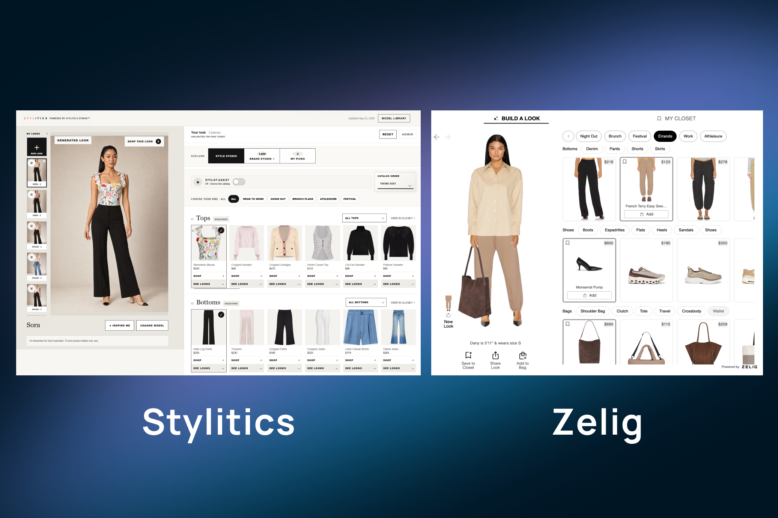
Rules aren’t the constraint on the system. They’re what makes it deployable at a brand people care about, and they’re why styling automation belongs to merchandising rather than to engineering. The Stylitics platform is built around merchandiser control for exactly this reason, with fashion-trained human QC on generated output.
What does your product data need to carry?
Styling logic can only reason over attributes that exist. Most catalogs carry commerce attributes — color, material, size, price, category — and almost none of the styling attributes the four constraints above require.
The additions that matter: occasion (work, weekend, evening, event), formality, season and fabric weight, silhouette and fit (oversized, cropped, tailored, relaxed), styling role (anchor piece, layer, finisher), trend adjacency, and color family rich enough to reason about harmony rather than exact match.
Without those, a system can tell that a dress and a sandal are different categories and nothing about whether these two belong in the same outfit. With them, the same layer improves several things at once: outfitting quality, on-site search relevance, filter usefulness on category pages, and shopping feed quality. Catalog enrichment is the mechanism, and it pays for itself across site search and Google Merchant Center feeds before the outfitting benefit is counted. Boston Proper measured 16.4x ROI on the enrichment work alone.
Where else should the outfit appear?
The PDP is the highest-leverage surface, not the only one. Once styling logic exists as a data layer rather than a widget, it can merchandise everywhere a shopper meets product — and each surface answers a slightly different version of the question.
- Product listing pages: Composed looks placed into the grid break the tile monotony and give shoppers something to react to instead of 240 near-identical thumbnails to compare. This is the digital analogue of a floor set, and it works hardest on category pages where everything looks alike.
- On-site search: A shopper searching “summer wedding” is describing an occasion, not a product. Styling attributes let results answer the intent rather than string-match the query.
- Cart: The last honest moment to add the finisher — and, given 52% of sites are running irrelevant cart cross-sells, one of the easiest places to beat the field on relevance alone.
- Email and SMS: Triggered outfit content built around what someone browsed or bought is among the least contested placements left, and it reaches the returning shopper who already converts better (2.9% versus 1.7% for new visitors).
- Editorial and galleries: Campaign and lookbook imagery made directly shoppable closes the gap between inspiration and inventory. J.Crew and Madewell recorded a 20% cart-add rate doing exactly this.
- Post-purchase: The strongest signal you’ll ever have about someone’s wardrobe is what they just bought. Styled for You builds the next look off first-party purchase and browse signals rather than third-party identifiers.
The modules that carry this across surfaces are Complete the Look for the direct “what goes with this” answer, Shop the Look and Shop the Model for the assembled outfit shown on a body, and Shop Similar to keep a look intact when a piece sells out. The point of running them as one system rather than six separate widgets is consistency: the same styling rules, the same brand guardrails, the same inventory awareness, wherever the shopper is standing. That’s what AI outfitting is for, and what separates it from bolting a recommendations plugin onto each page.
One prerequisite worth stating plainly: the look has to be shown on a body. Baymard’s 2026 product page benchmark found 23% of sites still don’t show products on human models and 37% don’t provide in-scale imagery — the two asset types that resolve proportion and fit. Where the photo call doesn’t exist for a colorway or a size range, AI Image Studio generates the on-model asset instead of leaving the outfit as a row of cut-outs.
Does this differ by category?
The outfitting recommendation system is the same; the unit of the outfit isn’t. Getting this wrong is why generic cross-sell projects underperform in specialty categories.
Does a bigger basket survive the return window?
It has to, or the AOV lift is an accounting illusion. 19.3% of online sales were returned in 2025, against $849.9 billion in total US returns (NRF) — and a two-item order that comes back as a one-item order has moved cost, not revenue.
The mechanism that protects it is the same one that grew the basket: context. Shoppers who can see how a piece is worn, on a body, at scale, alongside the items meant to go with it, are buying with a clearer picture of what will arrive. Adobe’s 2025 holiday survey found 65% of AI-assisted shoppers felt more confident in their purchases and 68% said they were less likely to return what they bought that way (Adobe).
Which is why the styled outfit and the on-model image aren’t separate initiatives. The image resolves fit and proportion; the outfit resolves whether the pieces work together. Both close the expectation gap that becomes a return, and both live on the same page.
How do you measure it?
With a paired set — one basket metric, one conversion metric, one returns metric — read over full purchase-and-return cycles rather than a conversion snapshot.
- Styling coverage: Share of active SKUs with a complete, in-stock, rule-compliant look attached. The leading indicator, and the one most programs skip. Coverage predicts every downstream number.
- Attach rate and units per transaction: Conversion says the product sold. Attach rate says the styling sold the outfit.
- AOV and revenue per session: The lines the program is funded on.
- PDP-entry performance: Since a third of sessions begin on a product page, segment those specifically. Did styled pages hold shoppers who arrived cold?
- Return rate by reason code: Fit and “not as pictured” are merchandising diagnostics. Watch them like a conversion metric.
- Rule compliance: How often merchandisers override generated looks, and why. A falling override rate is the honest signal that the rules are encoded correctly.
One trap worth naming, because vendor case studies including ours are often built on it: engaged-versus-non-engaged comparisons overstate impact, since shoppers who interact with outfitting content already carry higher intent. Treat those figures as directional. The defensible reads come from randomized placement tests and period-over-period movement on covered versus uncovered catalog segments.
On results, the pattern is consistent across price points and categories. Rhone: 39% AOV increase and 10x ROI within 100 days, with conversion up 13% in men’s and 8% in women’s. Suzanne’s: 5.67x revenue per session and a 35% AOV lift from full-look bundling. JD Sports: Shop the Model driving 50% of total widget revenue with a 2.87x bundle-click multiplier. PUMA: roughly 235% conversion-rate boost alongside a 3%+ AOV increase. Huckberry: 9.3x higher revenue per session. Independently modeled, Forrester’s Total Economic Impact study put the composite at a 10% AOV lift, $3.6M NPV, and 563% ROI.
The strategic read is simple enough to put on one slide. Sessions cost more every year and convert slightly worse every year. The shopper standing on your product page has already been paid for. Whether they leave with one item or two is a merchandising decision — and right now, on most sites, nobody is making it.
FAQs
What does “what to wear with” mean on a product page?
It’s the styling answer shown alongside the item a shopper is viewing: the complete outfit built around it, in stock, in their size, styled to your brand’s rules. Sandals with the summer dress, a trainer and top with the leggings. It converts a single-item view into a multi-item basket at the moment intent is highest.
How does outfitting increase average order value?
By adding a second and third item to an order you already paid to acquire. Because the acquisition cost is sunk, styled add-ons carry unusually high contribution margin. Rhone measured a 39% AOV increase and Suzanne’s a 35% lift from full-look merchandising.
Why isn’t “frequently bought together” enough for apparel?
Because co-purchase data records what shared a basket, not what belongs in an outfit. Gifts, returns, and unrelated errands all pollute the signal, producing pairings that look arbitrary. Baymard found that a single questionable recommendation makes shoppers ignore every suggestion that follows, so incoherent pairings cost more than the missed add-on.
How do retailers keep AI styling on brand?
With an enforceable rule layer: brand and styling standards, commercial rules (boost, exclude, exclusivity windows, markdown and margin protection), inventory rules limiting looks to in-stock items and available sizes, and merchandiser override that persists. Merchandisers should be able to change all of it without engineering support.
What product attributes do you need for outfitting to work?
Beyond color, size, and category: occasion, formality, season and fabric weight, silhouette and fit, styling role, trend adjacency, and a color model rich enough to reason about harmony. Catalog enrichment supplies these, and the same attributes improve on-site search and shopping feeds.
Where should outfitting appear besides the PDP?
Category pages, on-site search, cart, triggered email and SMS, shoppable editorial and galleries, and post-purchase. Running them off one styling layer keeps rules, brand guardrails, and inventory awareness consistent across every surface rather than fragmenting across separate widgets.
Does a larger basket lead to more returns?
Not when the added items are styled rather than randomly attached. With 19.3% of online sales returned in 2025, the safeguard is context: on-model imagery and coherent pairings close the expectation gap. Adobe found 68% of AI-assisted shoppers said they were less likely to return their purchase.
What should we measure first?
Styling coverage — the share of active SKUs carrying a complete, in-stock, rule-compliant look. It leads every downstream metric, and it’s the number most programs never look at.
See it in your own catalog. Bring a season’s assortment and Stylitics will show you what full styling coverage looks like across your PDPs, category pages, and cart — with your merchandising rules enforced and your team holding the override. Request a demo.



 Shop the Look Let shoppers buy the full outfit directly from any styled image.
 Styled for You Personalized outfit recommendations based on individual shopper preferences.
 Complete the Look Suggest complementary pieces to round out whatever a shopper is already viewing.
 Shop Similar Surface visually comparable alternatives when a specific item is out of stock or out of budget.
 Flat Lay to Model Choose from diverse models with full control over pose, crop, and framing.
 Background & Scene Swaps Place products in clean studio backgrounds, lifestyle environments, or custom lighting moods.
 AI Colorway Swaps Create photorealistic images for every colorway from a single reference shot.
 Model Diversity & Inclusive Imagery Output-ready formats for PDPs, social platforms, and campaign lookbooks.