Automated On-Model Images: Build Higher Converting PDPs with AI
Stylitics Marketing Team
The Stylitics Marketing Team explores the intersection of AI, retail, and shopper experience, sharing strategies and insights that shape the future of product discovery and visual merchandising.
If you run ecommerce for an enterprise fashion brand, you already know which PDPs are hurting your conversion rate.
It’s the long tail. Hero SKUs get the full on-model treatment and convert fine. Click two levels deeper and the PDP changes: a flat lay on white, a ghost mannequin, one studio angle if you’re lucky. Shoppers can’t picture the fit, can’t gauge the drape, and bounce back to search. Your return rate on those SKUs tells the same story.
You know why it happens. On-model photography runs $75 to $150 per shot all-in, and a day of off-figure work covers 25 to 30 styles for around $4,000. At 100,000 SKUs, full on-model coverage isn’t a line item you can fight for. It’s a different P&L.
So every season the same call gets made above you: heroes get the budget, the long tail gets whatever the studio calendar can absorb. The shoppers who land on those pages pay the price, and so does your conversion rate.
Below, we’ll walk through how automated AI on-model imagery closes that coverage gap, what it does to your cost per shot, and where the conversion lift tends to show up first.
Key Takeaways:
On-model imagery is the biggest driver of PDP shopper confidence — and the biggest reason retailers under-invest in their long tail.
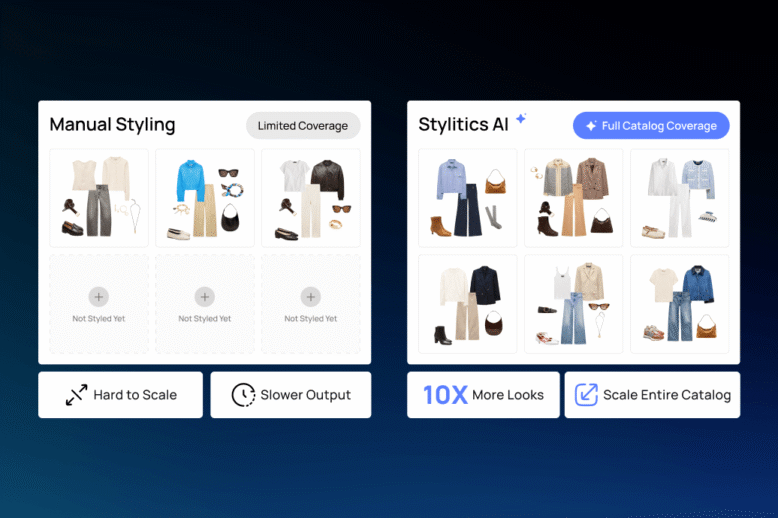
Studio economics force a triage: heroes get on-model, the rest get flat lays.
Automated AI imagery removes the triage — every SKU, colorway, and body type at catalog scale.
Shopper confidence isn’t a by-product — it’s the strategic outcome when every PDP holds to the same standard as the hero.
“I didn’t realize how expensive studio photography costs are. From what I’ve gathered, it’s usually like 100 to 150 dollars per shot, which is wild.”
— VP of Ecommerce, mid-market resort apparel brand
Why On-Model Imagery Is the PDP’s Highest-Leverage Asset
The first thing a shopper does on a product page is look at the imagery. Baymard Institute’s ongoing product page UX research finds that 56% of shoppers’ very first action on a PDP is to interrogate the imagery — before the title, before the price, before the description (Baymard Institute, 2025). That sequence is why imagery is the dominant input into purchase confidence, and it’s why imagery deficits are so costly. The shopper has already decided whether the garment looks like it will work before they read a single word of copy.
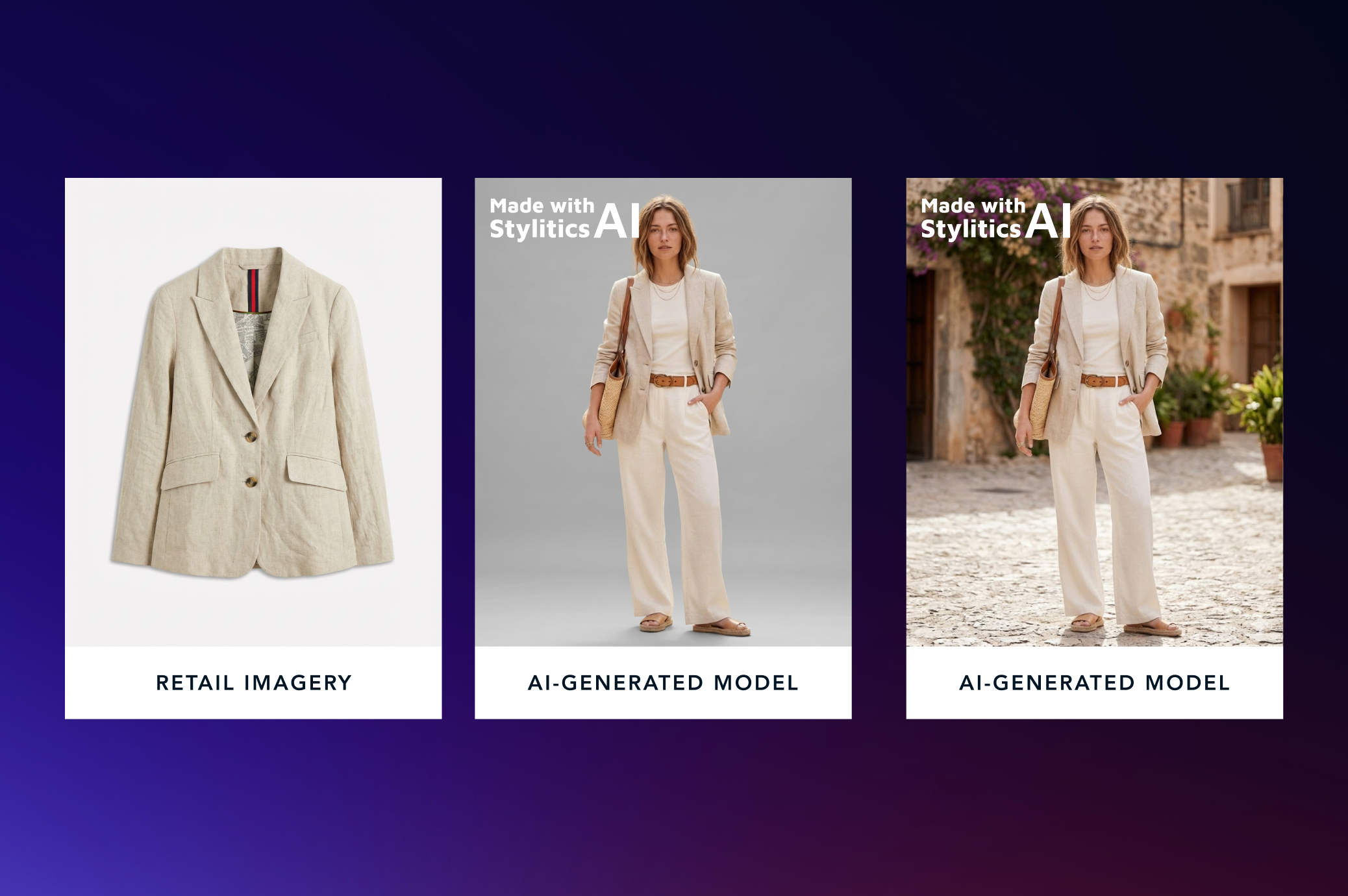
On-model imagery does work that no other PDP element can replicate. It shows drape on a body. It communicates how the garment falls at the shoulder, the waist, the hip. It tells the shopper whether the silhouette flatters, whether the proportion is right, whether the fabric reads how it appears in the lay-flat. A flat lay can show color and pattern. Only an on-model shot can show fit context. And fit context is where confidence — and conversion — actually lives.
The corollary holds in the returns data: roughly half of apparel returns trace back to size or fit, with appearance accounting for most of the rest (Coresight Research, 2023). Both are directly addressable through richer on-model imagery — which is why the brands moving fastest on this have started treating it as a P&L lever, not a creative preference. We unpack that math in detail in Why AI-Generated Imagery Reduces Returns.
The Production Triage That Created PDP Inequality
Most catalog imagery decisions don’t look like strategic choices when you walk into the merchandising meeting. They look like math. A merchandising lead at a plus-size and inclusive specialty retailer described it cleanly: the customer base spans size 10 through size 38, with two distinct body types possible at any given size, plus wide ethnic diversity. The photo shoots, by necessity, feature a single model around size 16 to 18.
The same pattern shows up at premium retailers. A head of digital at a global denim brand told us the biggest constraint isn’t budget — it’s that any time they want to show how a product looks across body types, they’d have to bring in a separate model, a separate stylist, a separate set day. Even brands that want to solve this can’t afford to in the existing production model.
The budget constraint forces a triage:
Tier 1 (the heroes): Full on-model coverage. Multiple angles, lifestyle context, sometimes multiple models. These are the SKUs with the biggest expected GMV.
Tier 2 (the seasonal core): One or two on-model shots. Usually one model, one setting.
Tier 3 (the long tail): Flat lay, ghost mannequin, or vendor-supplied imagery of inconsistent quality.
The problem is that revenue doesn’t follow the same distribution as imagery investment. The long tail is where most catalogs make their margin, and it’s where most shoppers spend their time. When the imagery quality drops at exactly the click depth where the shopper is closest to a purchase decision, the brand is degrading its own conversion funnel — and every retailer running this triage model knows it. They just don’t have a production approach that solves it.
What “Automation” Actually Means at Enterprise Scale
The phrase “automated on-model imagery” gets applied to everything from a self-serve Shopify app to a fully managed enterprise pipeline. The operational difference between those two categories is enormous, and it’s the difference that determines whether automation actually solves the catalog-coverage problem or just shifts it.
At the self-serve end of the market — Photoroom, Botika, Claid, Rawshot — automation means an image generation engine. Upload a product photo, choose a model, generate, download. For a 50-SKU Shopify brand with a team member who can review every output, this is fine. For a 100,000-SKU enterprise catalog, it’s the wrong architecture: the QC burden, the manual upload-download loop, and the lack of catalog integration consume the cost advantage that automation was supposed to deliver. We compare the tiers in detail in Best AI Fashion Photography Tools for Enterprise Retail in 2026.
Enterprise-grade automation means something operationally different. It means:
Asset ingestion from existing systems
Product feeds, hero shots, technical specs, and brand parameters flow into the generation pipeline directly from the retailer’s PIM or DAM. No manual upload. No per-SKU briefing.
Brand parameter configuration
Photographer aesthetic profiles, lighting treatments, model diversity standards, styling rules, pose preferences, and category-specific creative guidance are configured once during onboarding and applied consistently to every output.
Automated quality evaluation
Every generated image is scored against hundreds of brand and technical criteria by an AI QA agent — logo placement, fabric rendering, garment construction, color accuracy, styling adherence.
Human-in-the-loop QC
Images that pass automated evaluation are spot-checked by a fashion-trained QC team for the nuances that automated systems flag for secondary review. Any output that misses brand or quality standards is regenerated at no charge.
Delivery back into commerce systems
Finished images are returned to the retailer’s DAM or commerce platform in the correct formats and specifications, ready for PDP deployment.
Catalog-scale throughput
Production capacity is measured in tens of thousands of images per month, not hundreds. Client involvement compressed to under two hours per month.
This is what an enterprise customer means when they say automation. It’s not a faster way to generate one image. It’s a production system that delivers the entire catalog’s on-model imagery on a recurring SLA — without the QC, integration, and oversight overhead that consumed the savings on every in-house pilot the brand tried before. We walk through the brand-safety side of that QC layer in Inside Stylitics Labs: Our Journey to On-Brand AI-Generated Imagery.
“People want to see clothing on models that reflect what they look like — in size, in age, in skin tone, in body shape. In a studio, you can’t have 27 models shooting the same item. With automation, you can.”
Case Study: How a Global Sportswear Retailer Closed Its PDP Imagery Gap
The Challenge: A global sportswear retailer with a catalog of 100,000+ SKUs was running on a triage model. Hero products received full on-model coverage. The long tail was a mix of vendor-supplied imagery with inconsistent quality and studio shots that ran above $115 per image for private label brands. Early in-house AI experiments had stalled because the manual QC required to keep outputs on-brand consumed more time than the savings justified.
The Solution: Stylitics AI Image Studio was deployed against the full catalog with the hybrid AI plus human QA workflow. Source assets and brand parameters flowed from the retailer’s existing systems into the generation pipeline. Each SKU received at least two on-model variants spanning model diversity and lifestyle contexts. QC was handled end-to-end by Stylitics, with refund-backed guarantees on every delivered image.
The Results:
Over $20M in total photography budget savings
10,000+ images delivered per week at production-grade quality
Client team involvement: under two hours per month
Catalog coverage parity achieved across hero and long-tail SKUs for the first time
Why It Matters: The dollar saving is the headline number, but the operational shift underneath it is the strategic one. The retailer didn’t just reduce production cost — they eliminated the imagery quality cliff between their hero SKUs and their long tail. The shopper experience now holds up at click depth, where most of the catalog’s revenue actually lives.
From Catalog Coverage to Shopper Confidence
The reason this matters strategically is that PDP confidence is built at the SKU level, not the brand level. A shopper doesn’t form their impression of a brand by reading the homepage hero — they form it by clicking through to the product they actually want and evaluating what they see. If the hero SKU has rich on-model imagery and the SKU three clicks deep has a vendor-supplied flat lay against a beige background, the shopper experiences the brand as inconsistent.
Automated on-model imagery closes that gap in two specific ways that matter for confidence:
Coverage parity: Every SKU receives the same caliber of imagery treatment. The shopper’s experience doesn’t degrade as they explore the catalog, which means the brand’s visual identity holds across the full assortment instead of fading at the long tail.
Body and context representation: Multi-model coverage — generated from a single product ingestion — lets every shopper see someone who looks like them wearing the product. Lifestyle context swaps let the shopper evaluate the garment in its actual use case. Both reduce the pre-purchase ambiguity that drives hesitation and abandonment. We dig into the shopper-research side of this in AI-Generated Images on PDPs and Fashion Product Photo AI.
The downstream signals show up where you’d expect. H&M’s published 2025 results from its digital twin program reported a 24% lift in click-through rate on assets generated through the pipeline, alongside a 45% reduction in production cost (Business of Fashion, 2025). McKinsey and Business of Fashion’s State of Fashion 2026 puts adoption at more than 35% of fashion executives already using generative AI for imagery and other use cases, with the share widely expected to cross 50% in the next 12 months (McKinsey, 2025). A 2025 Forrester analysis of retail technology ROI also found that retailers deploying comprehensive virtual try-on solutions averaged 23% return-rate reductions across apparel categories (Forrester via Fytted, 2025) — a signal that downstream confidence gains from richer body-context imagery flow straight to the P&L.
The brands that win this cycle won’t be the ones that ran the cheapest AI pilot. They’ll be the ones that automated their PDP imagery end-to-end and let the catalog coverage compound across categories.
Where Self-Serve Automation Falls Short for Enterprise
It’s worth being direct about the asymmetry between the self-serve tier and managed enterprise automation, because the gap shows up most painfully at exactly the scale where the operational savings should be largest.
A self-serve tool generating images at 90% quality looks great in a small demo. At enterprise scale, a 100,000-SKU catalog with two images per SKU is 200,000 images. A 10% failure rate is 20,000 images that have to be caught, remediated, and regenerated before they reach the PDP. The internal QC team required to manage that volume costs more than the generation savings the tool was supposed to deliver. This is the failure mode that ended most in-house AI pilots before Stylitics customers came to us.
Managed automation doesn’t just generate faster. It absorbs the QC, integration, and oversight responsibilities into the service so the brand’s internal team can return to the work it should be doing — merchandising, creative direction, campaign strategy — rather than reviewing AI outputs one at a time. That handoff is the operational difference. It’s also what makes the shopper-confidence outcome reliable at scale instead of contingent on internal capacity.
Frequently Asked Questions
At enterprise scale, automation means more than image generation. It means asset ingestion from existing PIM/DAM systems, brand parameter configuration, AI plus human QC, and delivery of finished images back into the commerce platform — all on a recurring SLA with client involvement under two hours per month. Self-serve generation tools handle only the generation step; the rest of the automation has to be built around them by the brand’s internal team.
By eliminating the visual quality cliff between hero SKUs and long-tail SKUs. Shoppers form their brand impression at the SKU level, not the homepage level. When every product page carries the same caliber of on-model imagery — including multi-body, multi-context, and multi-colorway coverage — the brand experience holds at the click depth where most revenue actually closes. Baymard’s research confirms imagery is the first element shoppers interrogate on a PDP (Baymard Institute, 2025).
Yes, at scale that exceeds what studio production can deliver. Brand parameters — photographer tone, lighting profile, styling rules, model diversity standards — are configured once during onboarding and enforced on every output through AI QA scoring and human review. The thousandth image rendered through the pipeline holds to the same standards as the first, which is something a multi-day studio shoot with rotating crews struggles to guarantee. More on the QC architecture in Inside Stylitics Labs.
In a managed enterprise system like Stylitics AI Image Studio, the image is flagged through automated QA scoring or human review, regenerated, and re-delivered — with the failure tracked into the pipeline for ongoing brand model refinement. Any image that misses agreed standards is refunded or regenerated at no charge.
How does automation integrate with existing PIM, DAM, and commerce platforms?
Standard integrations connect to the retailer’s existing product feeds and asset libraries. Source assets and product metadata flow in automatically; finished images are returned in the correct formats and specifications for direct PDP deployment. Setup is handled during onboarding so the internal team doesn’t manage the pipeline day-to-day.
Conclusion
The original case for AI on-model imagery was cost reduction — a faster, cheaper alternative to the studio. The real case is operational: automated imagery lets enterprise retailers extend studio-quality coverage across the full catalog, eliminating the triage decision that has been quietly degrading PDP experience at exactly the click depth where most revenue lives.
When every SKU receives the same caliber of on-model imagery as the hero — across body types, contexts, and colorways — the catalog stops working against the brand. The shopper confidence gain isn’t a downstream by-product. It’s the strategic outcome that automation was always supposed to unlock.



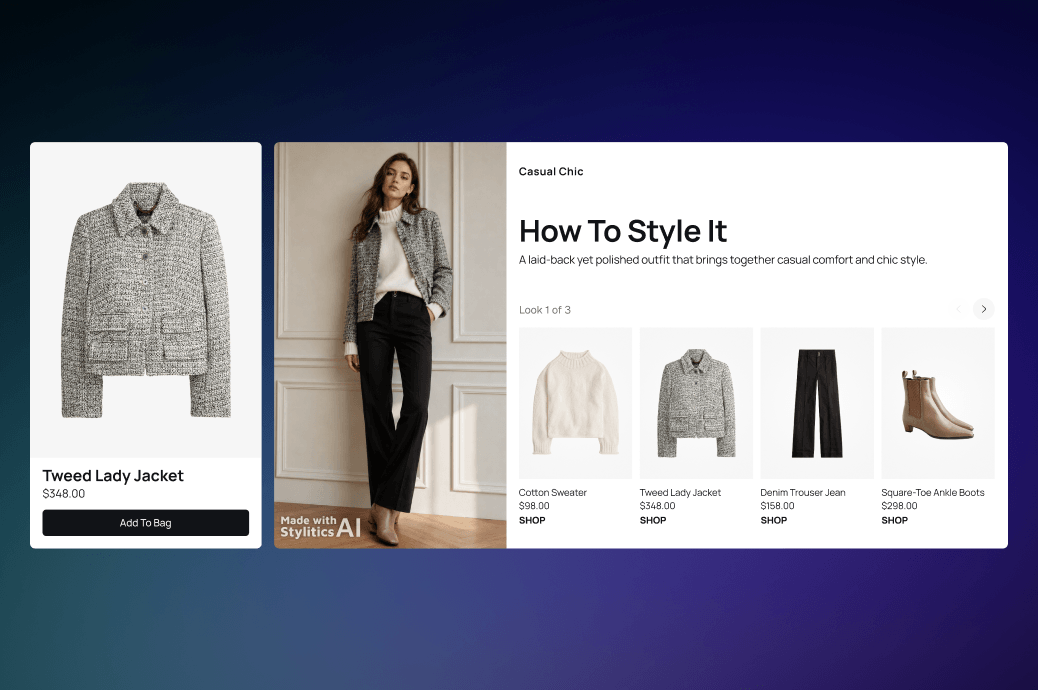
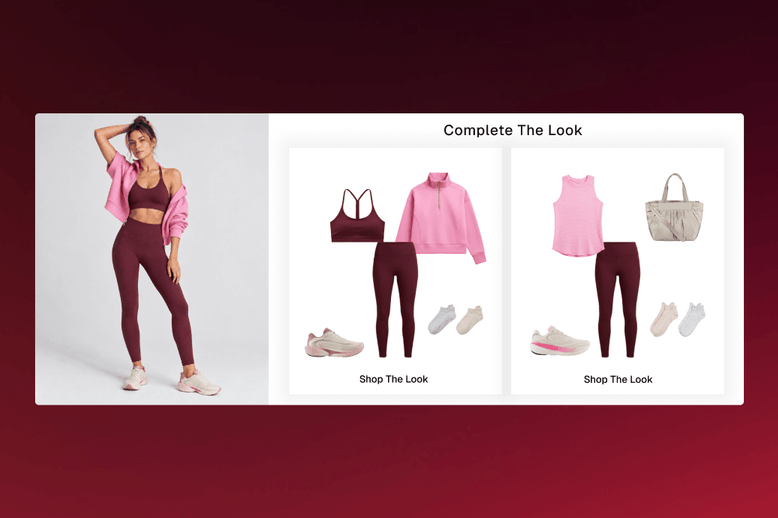
 Shop the Look Let shoppers buy the full outfit directly from any styled image.
 Styled for You Personalized outfit recommendations based on individual shopper preferences.
 Complete the Look Suggest complementary pieces to round out whatever a shopper is already viewing.
 Shop Similar Surface visually comparable alternatives when a specific item is out of stock or out of budget.
 Flat Lay to Model Choose from diverse models with full control over pose, crop, and framing.
 Background & Scene Swaps Place products in clean studio backgrounds, lifestyle environments, or custom lighting moods.
 AI Colorway Swaps Create photorealistic images for every colorway from a single reference shot.
 Model Diversity & Inclusive Imagery Output-ready formats for PDPs, social platforms, and campaign lookbooks.