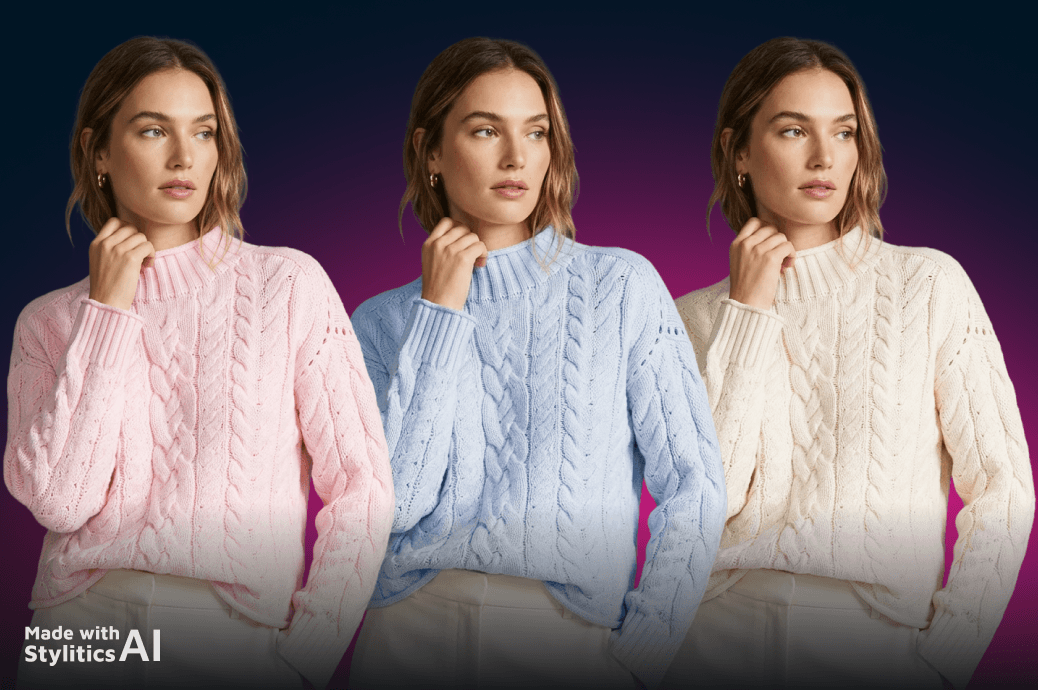
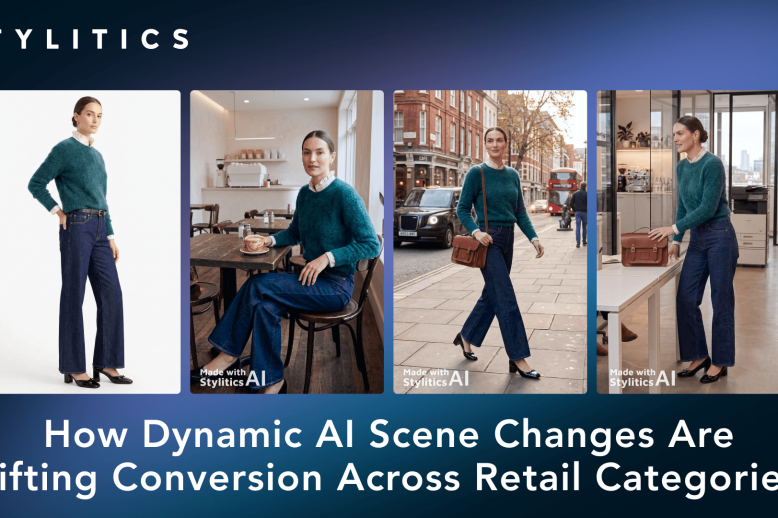
For most enterprise retailers, the colorway problem is quietly one of the most expensive inefficiencies in their entire visual operation. A single product—a fleece pullover, a running short, a polo—might come in ten, fifteen, even twenty color variants. Under the traditional studio model, each of those variants demands its own shoot: its own booking, its own model time, its own post-production pass. The result is a cost structure that forces painful tradeoffs at the product level every single season.
Key Takeaways:
- Eliminate reshoots – Generate all variants from one reference image.
- Protect conversion – Give every color full on-model PDP coverage.
- Ensure accuracy – Use fabric-aware rendering with validated color standards.
- Cut costs at scale – Replace per-image studio spend with AI generation.
Merchandising teams routinely deprioritize imagery for lower-volume colorways. The navy version gets the full shoot. The olive or rust variant gets a flat lay, a ghost mannequin, or nothing at all. The shopper arrives at a PDP, sees an uninspiring product image, and moves on. The conversion is lost not because the product was wrong—but because the visual merchandising never gave it a fair chance.
AI-powered colorway swap technology has eliminated the structural constraint that made this tradeoff necessary. Retailers can now shoot once and generate every variant on-model, with photorealistic accuracy, in hours. The economics and creative limitations that defined product color variant photography for decades are no longer the ceiling.
The Hidden Cost of Color Variety
Traditional studio photography prices per image range from $75 to $300 once model fees, studio time, styling, and post-production are factored in. For a brand carrying 500 styles across an average of eight colorways each, that translates to hundreds of thousands of dollars in photography costs for on-model coverage alone—before a single lifestyle or editorial image is produced.
Most retailers respond to this math by triaging. Hero colorways receive investment. Secondary colorways receive compromised treatment. The consequence is a PDP experience that is visually inconsistent and commercially underperforming across a significant share of the catalog. One retailer we spoke with described it plainly: they had a sweater photographed as a flat lay, paired in an outfit with a pant—and the colors between the two images didn’t even match. The shopper saw a disjointed look and moved on.
The scale of the problem compounds quickly. Mother Denim, for example, manages roughly 1,000 colorways across their catalog. For a brand of that size, the idea of shooting every variant on-model with traditional photography is cost-prohibitive. For larger retailers with 10,000 or 100,000 SKUs, it has historically been impossible. The missing colorway imagery gap in the catalog is not a minor operational detail—it is a measurable drag on conversion rates and revenue.
Why Reshoots Are the Wrong Model for Colorway Coverage
The traditional approach to colorway photography treats each variant as a discrete production event. Every new color means rebooking the studio, recalling the model, restyling the garment, and running a separate post-production pass. This workflow made sense when photography was the only option, but it was never efficient—it was simply the only available tool.
The inefficiency is especially visible when retailers try to combine colorway shoots with model diversity goals. A single on-model shoot already strains budgets. Adding multiple body types, skin tones, and ages into the equation for every colorway variant makes the cost curve exponential.
As one of our sales directors put it in a recent prospect conversation:
“Companies simply cannot shoot infinite permutations of all their products. They might bring in a model for a day and capture one outfit, but they cannot get that same product in four different body sizes, against different backgrounds, and in every color combination.”
This is where the legacy model breaks down entirely. Retailers are not just paying too much per colorway—they are structurally unable to provide the catalog colorway coverage that shoppers expect. Automating product color variants for ecommerce is not a luxury upgrade. It is the only realistic path to full visual coverage at scale.
How AI Colorway Swaps Actually Work
AI colorway swap technology begins with a single high-quality reference image—either an existing on-model shot or a flat-lay product photo. The AI generation engine ingests the garment’s structure, fabric characteristics, and styling details, then renders the same garment in each additional colorway while preserving every physical property: drape, sheen, texture, and fit.
This is not a simple color overlay or hue-shift filter. The technology models how different colorways interact with light and fabric structure differently. A navy twill behaves differently than a cream linen. A deep burgundy fleece has different surface behavior than a heather grey version of the same style. The output reflects this reality, producing images where color variants look photographed rather than digitally processed.
Color accuracy is validated against brand-provided hex codes and Pantone references, ensuring that what the shopper sees is a reliable representation of what they will receive. This is a critical distinction from early-generation AI color tools that treated color swaps as surface-level filters. Enterprise AI product color variant generation requires fabric-aware rendering that accounts for material behavior, not just pixel manipulation.
Every output is also run through automated QA processes and expert human review before delivery, eliminating the hallucination and color drift issues that have undermined in-house AI attempts. Several prospects have described failed internal pilots where output quality was poor and the manual quality control overhead made the effort unsustainable. A turnkey solution with integrated quality assurance removes that burden entirely.
From One Shot to Full Catalog Colorway Coverage
The commercial impact of AI colorway swaps extends well beyond cost reduction. When every colorway ships with full on-model imagery, the entire catalog performs at a higher baseline. Shoppers rely on model images to evaluate fit, drape, and real-world wearability. When a variant is represented only by a flat lay or ghost image, the conversion rate drops. The product is not failing—the imagery is.
With AI-powered catalog colorway coverage automation, the gap disappears. Every variant gets the visual treatment it needs to convert at the same rate as the hero colorway. Across a catalog of thousands of styles, the cumulative lift in conversion and revenue is substantial—and it compounds every season as the catalog grows.
The economics are equally compelling. Traditional photography costs of $100 to $150 per shot collapse to a fraction of that figure with AI generation. One global sportswear retailer with a 100,000-plus item catalog was spending over $115 per image on traditional studio photography. After switching to AI-powered generation, they achieved total budget savings exceeding $20 million while delivering over 10,000 images per week—with less than two hours of client involvement per month.
What to Look for in an Enterprise AI Colorway Solution
Not every AI color swap tool is built for enterprise retail. Many of the tools available today are designed for individual creators or small businesses and lack the infrastructure required for catalog-scale production. When evaluating an AI tool to show all color variants on model at enterprise volume, there are several capabilities that separate production-grade solutions from experimental ones.
Fabric-aware rendering is non-negotiable. Surface-level recoloring tools produce output that looks processed rather than photographed. Enterprise solutions must model how each fabric type—knits, wovens, performance materials, denim, outerwear—interacts with different colors and lighting conditions. The shopper should never be able to tell the difference between a photographed image and a generated one.
Integrated quality control is equally critical. Any AI generation pipeline will produce occasional errors—hallucinations, color drift, or fabric artifacts. The question is whether the solution catches those errors before they reach the catalog. A robust approach combines automated AI QA agents with expert human review, ensuring that every image meets broadcast-quality standards before delivery.
Finally, the solution must integrate with existing production workflows. Finished assets should flow directly back into your DAM or commerce platform through automated pipelines. If the colorway generation process creates a manual bottleneck in your publishing workflow, the efficiency gains upstream are undermined downstream. The goal is to generate product images for every colorway with AI and publish them on the same day, without adding operational overhead to your team.
The Revenue Case for Full Colorway Visualization
The argument for AI colorway swaps is not primarily a cost argument—though the cost savings are significant. It is a revenue argument. Every colorway that ships without on-model imagery is a product that underperforms on its PDP. The retailers who are adopting this capability are not doing so reluctantly. They are moving quickly, because the competitive implication is clear: brands that show every colorway on-model will convert better than brands that do not.
Model diversity further amplifies the impact. When colorway swaps are combined with the ability to show each variant on models of diverse sizes, ethnicities, and ages, the PDP experience becomes dramatically more inclusive and commercially effective. Shoppers consistently report wanting to see clothing on models that reflect what they look like. AI makes it possible to deliver that experience across every colorway and every body type—something that traditional photography could never achieve at scale.
The technology is available now. The economic case is proven. The only remaining variable is how long a brand is willing to leave that conversion on the table.