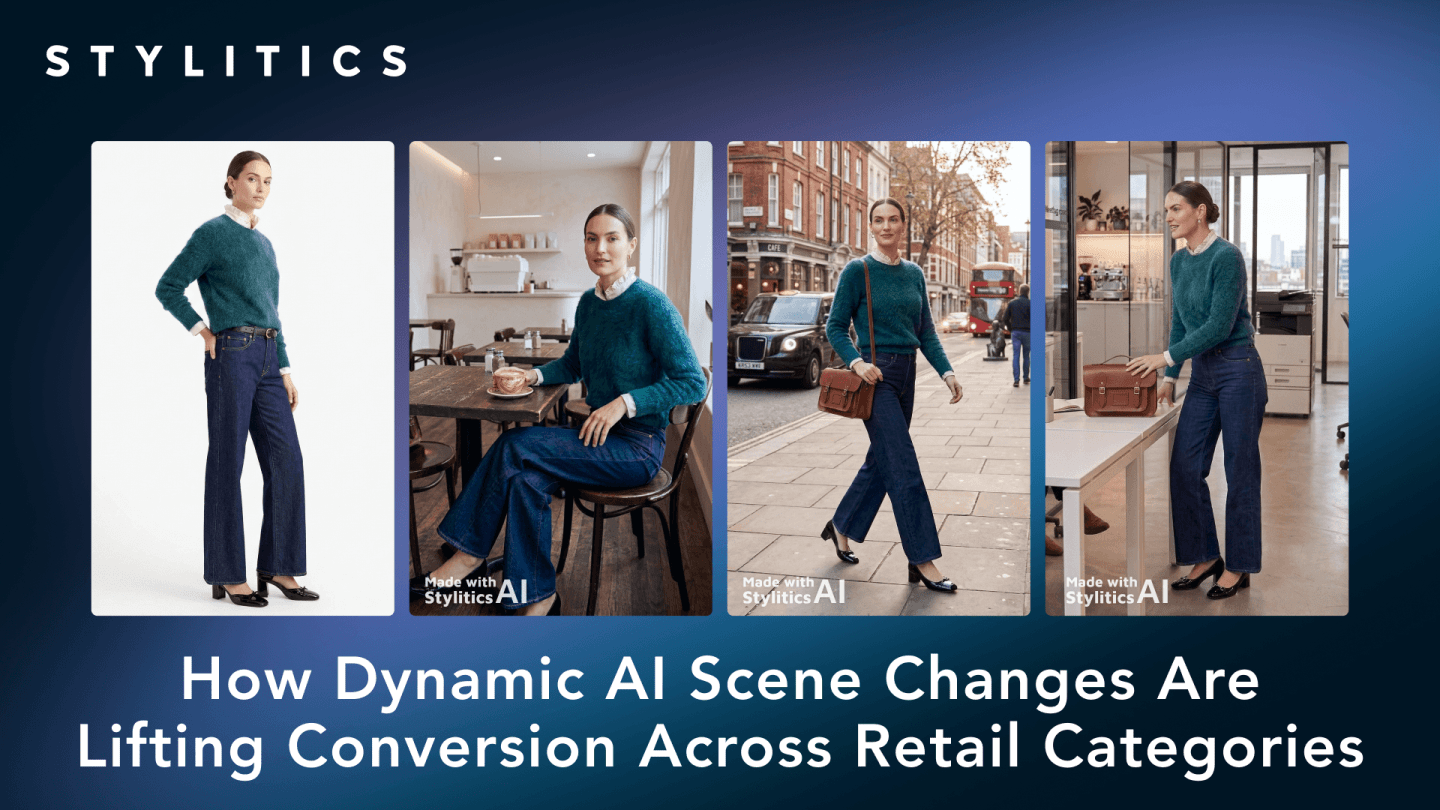
Context Sells: How AI Background Changes Are Lifting Conversion Across Retail Categories
Stylitics Marketing Team
The Stylitics Marketing Team explores the intersection of AI, retail, and shopper experience, sharing strategies and insights that shape the future of product discovery and visual merchandising.
For fashion brands, a new SKU photographed in a blank studio communicates one thing: what the product looks like. The same garment photographed in a mountain setting communicates something else entirely — where the product belongs, who wears it, and what life looks like when you own it. The setting is not a background detail. It is a commercial signal that shapes how shoppers interpret the product and how confidently they imagine themselves in it.
Key Takeaways:
Scene and setting imagery drives conversion by helping shoppers visualize how a product fits into their actual lives — a dimension that studio images alone cannot provide.
Dynamic scene changes can be generated from a single product reference, allowing the same garment to appear in urban, outdoor, lifestyle, and luxury environments without location shoots.
Setting imagery can be adapted for different marketing channels and campaign themes without generating new base images, making seasonal and campaign updates dramatically faster.
Market-localized scene settings help international shoppers see products in contextually relevant environments, supporting regional conversion lift without regional location shoots.
Location photography has always understood this. The reason brands invest in location shoots — whether on city streets, at coastal resorts, or in luxury hotel settings — is that the environment contextualizes the product in a way that drives purchase intent. The problem is cost. A location shoot requires travel, location fees, talent, styling, weather contingency, and post-production. For a catalog of any scale, location imagery is reserved for hero products and seasonal campaigns, not extended across thousands of SKUs. An apparel brand in Stylitics’ conversations described this plainly: only about 20 percent of new season products were actually shot flat, and only a fraction of that made it into the commerce platform. The gap between the imagery a catalog needs and what any production budget can actually deliver is not a small one.
Stylitics AI Image Studio changes what is economically possible. The same product that gets a studio PDP image can also appear in a city street scene, a nature environment, a luxury interior, or a seasonal setting defined by the brand’s creative brief — winter holiday, midsummer, autumn campaign — generated from the same base asset, delivered in hours, at a fraction of the cost of a location shoot. The same pair of jeans that appears on a sun-drenched boardwalk in July can appear in a cozy winter interior in December, without touching the original product image.
“Context is where purchase intent is built. AI scene generation means every product can tell the story of where it belongs.”
Why Setting Converts: The Psychology of Contextual Imagery
Purchase decisions are fundamentally acts of imagination. Before a shopper buys a product, they imagine wearing it, using it, or being seen in it in a specific context. The visual environment in a product image either supports that act of imagination or leaves the shopper to supply it themselves. When the image provides the context — a technical jacket photographed against mountain terrain, a linen dress in a coastal setting, an activewear set in an urban gym environment — the shopper’s imagination is guided toward a specific, compelling vision of ownership.
This is not a soft brand perception argument. It is a conversion mechanism. Research in visual merchandising consistently shows that contextual lifestyle imagery drives higher conversion rates than studio-only imagery for most apparel and lifestyle categories. The setting does not just make the image more beautiful — it makes the product more desirable by showing it in the environment where it is meant to live.
Retailers in Stylitics’ conversations recognize this intuitively. One brand’s creative team articulated the challenge with precision: understanding the seasonal backdrop, the feeling, and the overall mood of what a product needs to communicate is an entirely different creative problem from getting a clean studio shot. The idea of art direction — of making an image feel like something — has always been the ambition. What has historically been missing is the operational path to execute that ambition at catalog scale, not just for the fifteen hero products that make the shoot budget.
AI scene generation delivers this conversion mechanism across the full catalog. Every product, regardless of budget priority, can be shown in a setting that contextualizes it correctly for its category and target customer. The studio shot remains available for marketplace and wholesale requirements. The contextual scene image drives conversion on the brand’s own PDP and social channels.
Scene Flexibility for Campaign Agility
Beyond the baseline conversion benefit, AI scene generation enables a form of campaign agility that location photography cannot match. A brand running a summer campaign can update the setting for every product in a relevant category to match the campaign’s visual theme — beach, poolside, outdoor entertaining — without scheduling new location shoots or restructuring the production calendar.
The same base product images can be adapted to new settings as campaigns evolve, seasonal themes shift, or new marketing channels require contextual alignment. A product photographed against a neutral studio background in the base production run can appear in a city environment for the fall campaign asset, in a mountain setting for the outerwear category landing page, and in a luxury interior for the holiday gift guide — all from the same source image.
This flexibility compounds over time. As the brand’s library of base product images grows, so does the potential campaign asset library, because every base image can generate new setting variations on demand. The production investment made in the base shoot keeps generating value across every campaign cycle that follows.
For international retailers, market-localized scene settings extend this further. The same product can be rendered in environments calibrated to resonate with shoppers in China, Japan, South Korea, or Southeast Asia — matching regional aesthetic sensibilities without regional location shoots. The imagery that was previously reserved for global flagship markets can now reach every market in the catalog.
AI Image Studio: Scene and Setting Generation Capabilities
Capability
Description
Scene and Setting Changes
Urban, nature, luxury, abstract, and custom environments generated from a single product reference.
Lifestyle Scenes
Contextual settings calibrated to category — activewear, outerwear, casualwear, formalwear.
Market Localization
Scene settings adapted for regional markets to support international conversion.
Background Swaps
Swap between studio, lifestyle, and custom backgrounds per channel and campaign.
Campaign Ready
Thematic scene consistency for lookbooks, landing pages, and seasonal campaign assets.
Lighting & Mood
Golden hour, natural light, dramatic editorial, and studio options per setting.
Social Editorial
Scene imagery formatted for social platform native requirements and aspect ratios.
Model Diversity
Contextual scene imagery generated across diverse model representations.
Pose Control
Movement and posing adapted to scene environment for authentic contextual imagery.
Smart Crop
Scene images automatically cropped and formatted for every channel and placement.
CASE STUDY
Global Sportswear Retailer: $20M+ in Studio Photography Savings
$20M+ total savings achieved
10,000+ images delivered per week
Lifestyle and contextual variants produced alongside PDP imagery
A global sportswear retailer with a 100,000+ item catalog was unable to produce lifestyle and contextual imagery at scale — the cost and complexity of location shoots meant that environmental context was reserved for hero campaign products only. Stylitics’ pipeline produced contextual and lifestyle variants alongside PDP-standard images from the same product ingestion, delivering scene coverage across the full catalog without location shoot investment. Total savings exceeded $20 million.
The Setting Is the Story
Studio photography tells shoppers what a product looks like. Contextual scene imagery tells them where it belongs in their lives. Both serve important commercial functions, but only one builds the purchase intent that drives conversion for lifestyle and apparel categories. The brands that limit their visual merchandising to studio imagery are leaving the most persuasive part of the product story untold.
As Stylitics’ research with real shoppers confirms, the confidence that converts a visit into a purchase is built at the intersection of accuracy and aspiration — shoppers need to trust that the image is real and be drawn into the vision of ownership it creates. Contextual scene imagery does both simultaneously. It grounds the product in a believable, relevant environment while activating the imagination that turns browsing into buying.AI scene generation makes that story available for every product in the catalog, not just the ones that made the location shoot budget. The same base assets that produce studio PDP imagery can generate contextual scene variants at marginal additional cost. See how Stylitics AI Image Studio works.
FAQ
Yes. Stylitics ingests your creative brief and brand guidelines during onboarding to define approved scene parameters. Custom environments, lighting profiles, and setting aesthetics can all be configured as generation defaults.
Scene parameters are calibrated by category. Activewear receives athletic and outdoor settings. Casualwear receives urban and lifestyle environments. Formalwear receives interior and occasion settings. Custom category-specific parameters can be configured during onboarding.
Yes. Market localization generates scene settings and model aesthetics appropriate for specific regional markets including China, Japan, South Korea, and Southeast Asia — all from the same base product asset.
Scene setting updates can be applied across a defined product set in hours, enabling rapid campaign creative refresh without new production requirements. Turnaround SLAs are guaranteed.