Every pitch deck for AI fashion imagery opens with the same chart. Photoshoot cost on the left. AI cost on the right. An arrow pointing down and to the right. The savings are real. It’s also the smallest number on the page.
The line item that should make a CFO sit up isn’t the studio invoice. It’s the returns ledger. NRF and Happy Returns project US returns will reach $849.9 billion in 2025, with online sales running at a 19.3% return rate — and apparel sits well above that, with industry reporting consistently putting online apparel return rates in the 24–30% range and some categories climbing past 40% (NRF, 2025; 3DLOOK / Coresight, 2026). Better imagery doesn’t just save a shoot. It moves the returns number. And the second one is roughly ten times larger than the first.
Key Takeaways
- Roughly half of apparel returns trace back to size or fit, with color and appearance accounting for most of the rest — both directly addressable through on-model imagery a shopper can actually evaluate.
- US retailers are projected to lose $849.9 billion in returns in 2025, with online apparel return rates running in the 24–30% range — an order of magnitude larger than the studio photography spend retailers are trying to cut (NRF, 2025; 3DLOOK, 2026).
- One enterprise sportswear retailer cut over $20M from its photography budget with Stylitics AI Image Studio — but the bigger long-term lever was using diverse on-model imagery to fix the return-driving fit ambiguity flat lays create.
- Retailers consistently report shoppers want to see clothing on models that reflect their own body size, skin tone, and age. AI is the only practical way to deliver that coverage at catalog scale.
- The strategic case for AI imagery changes when you stop scoring it against the photoshoot line and start scoring it against the returns line.
Most retailers we talk to are already doing the math on photography. They know what they spend per shot. What they haven’t done — and what almost no AI imagery vendor frames the conversation around — is the math on what their PDP imagery is costing them downstream, every time a shopper buys something they couldn’t fully evaluate before checkout.
“I didn’t realize how expensive studio photography costs are. From what I’ve gathered, it’s usually like 100 to 150 dollars per shot, which is wild.”
— VP of Ecommerce, mid-market resort apparel brand (Stylitics customer conversation, 2026)
AI Imagery’s Real ROI: Reducing Returns
Apparel returns cost US retailers an estimated $25 billion in processing alone, on top of roughly $38 billion in returned merchandise — and that figure has only climbed as online apparel return rates have stayed stuck in the 24–30% range through 2025 (Coresight Research, 2023; 3DLOOK / Statista, 2026). The financial gap between “save on photoshoots” and “shrink returns” isn’t close. A 50,000-SKU brand spending $300 per shot saves $15M by going AI. The same brand losing 20–30% of online revenue to returns is bleeding nine to ten figures every year (Business of Fashion, 2024). The order of magnitude is the story.
The reason most vendors lead with the studio-cost narrative isn’t that it’s the biggest lever — it’s that it’s the easiest one to draw on a slide. Returns avoidance requires attribution work that production savings doesn’t: which SKUs were returned less, which imagery treatment did the shopper see, what’s the counterfactual? It’s harder math. It’s also where the real dollars live. NRF’s 2025 returns analysis puts online return rates at 19.3% of online sales, with apparel running meaningfully higher, and reducing return rates is now a top priority for 2026 alongside growing online sales (NRF, 2025). For a $1B online apparel business, every single percentage point of return-rate compression is worth roughly $2.5M in net recovered revenue after restocking and markdown.
What Actually Causes Fashion Returns in 2026?
Of all apparel returns, 53% trace back to size or fit, 16% to color or appearance, and 10% to damage — meaning roughly two-thirds of the return volume is rooted in expectation mismatch the retailer can influence before the shopper clicks Buy (Coresight Research, 2023). Narvar’s 2025 consumer survey corroborates the dominance of fit: 42% of shoppers cited size and fit as the reason for their most recent return (Narvar, 2025). These aren’t logistical problems. They’re imagery problems.
Fit and color are the two attributes that flat-lay photography and single-model PDPs systematically misrepresent. A flat lay tells you nothing about drape on a body. A studio shot of one 5’10” model in a sample size tells you almost nothing about how the same garment will fall on a 5’4″ shopper in size 14. The 21% “other” bucket — duplicate orders, style preference, gifting — overlaps heavily with bracketing behavior. NRF’s October 2025 report found that close to two-thirds of consumers admit to costly return behaviors like bracketing or wardrobing, and Gen Z shoppers in particular now average 7.7 online returns per year — more than any other generation, with around 51% of them buying multiple sizes intending to return most (NRF, 2025). Bracketing is a confidence problem dressed up as a logistics problem. If shoppers were confident in how a garment would look and fit, they wouldn’t need to order three.
That gap shows up directly in customer conversations. A merchandising lead at a children’s apparel retailer recently described their team’s decision-making this way: nearly everything new in fashion gets shot on-figure because, in their words, it’s all new silhouettes for the customer, and they need to show where it falls, how it’s supposed to look, and how it’ll look on the actual kid for the parent to understand. That premium on-figure logic exists for every category — but most retailers can’t afford to apply it everywhere.
The most acute version came from a luxury womenswear retailer, where the leadership team described their biggest return reasons as fit and sizing — driven by products coming back because the gathering on the garment hits at the wrong place on bodies that don’t match the six-foot sample-sized model used in studio. When the only model on the PDP doesn’t resemble the customer, the PDP itself becomes a return engine.
For a deeper analysis of how individual return reasons map to specific PDP weaknesses, see our piece on AI-generated images on Product Detail Pages.
What Shoppers Are Actually Asking For
Across hundreds of conversations with enterprise retail teams, the same shopper insight surfaces in different words. Shoppers want to see clothing on models that reflect what they look like — in size, in age, in skin tone, in body shape. Retailers know this. The constraint isn’t belief in the value. It’s production economics.
A merchandising executive at a plus-size and inclusive specialty retailer put the operational reality plainly. Their customer base spans size 10 through size 38, with two distinct body types possible at any given size, plus a wide ethnic diversity. Their photo shoots, by necessity, feature a single model around size 16 to 18. The gap between what their shopper looks like and what their PDP shows isn’t a strategy failure. It’s a math failure.
The same pattern shows up at premium and luxury retailers. A head of digital at a global denim brand told us their biggest constraint isn’t budget — it’s that any time they want to show how a product looks across body types, they’d have to bring in a separate model, a separate stylist, a separate set day. Even the brands that want to solve this can’t afford to in the existing production model.
“People want to see clothing on models that reflect what they look like. In the context of age, ethnicity, body size, skin color. When you’re in a studio, you can’t have 27 models shooting the same item. With AI, we can.”
— Stylitics enterprise account lead, customer survey debrief
How Does AI Imagery Directly Reduce Return-Driving Uncertainty?
The mechanism is straightforward: AI on-model imagery dissolves the two biggest sources of pre-purchase ambiguity — body context and visual variety. A 2024 peer-reviewed study in the Journal of the Academy of Marketing Science found that exposing shoppers to garments modeled in their own size category measurably reduced perceived fit risk and improved purchase decisions (Journal of the Academy of Marketing Science, 2024). Baymard Institute’s product-page UX research is blunter: 56% of shoppers’ very first action on a PDP is to interrogate the imagery, before they read the title, price, or description (Baymard Institute, 2025).
That sequence — imagery first, copy second — is why imagery interventions outperform copy interventions on fit confidence. You can write the world’s most precise size guide, but the shopper already decided whether the garment looks like it will work before they scrolled to it.
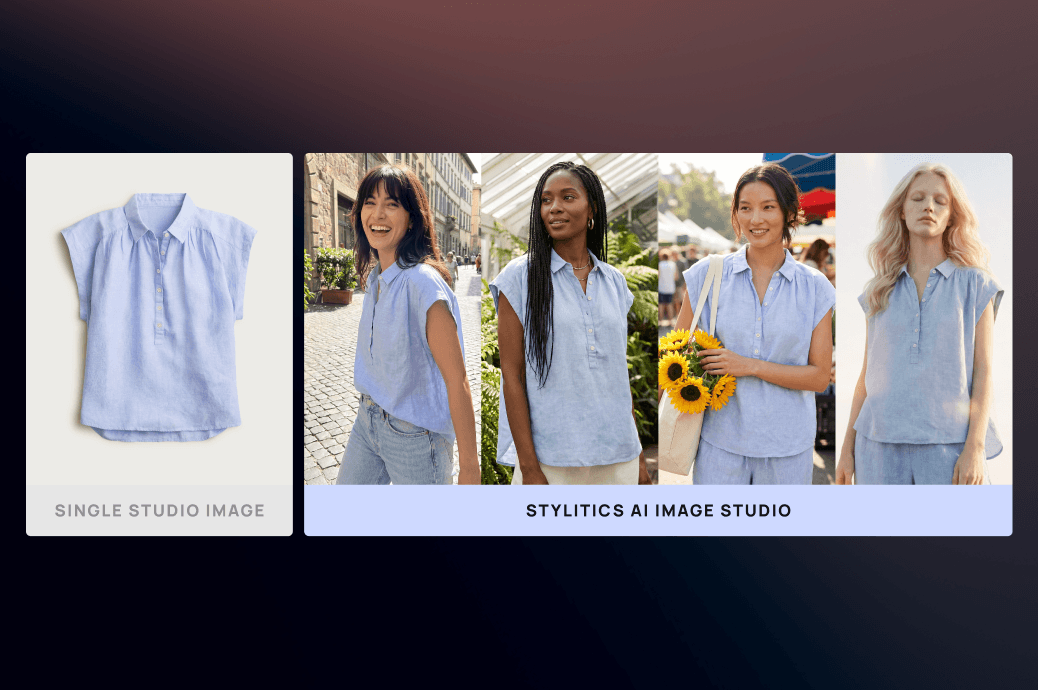
AI-generated on-model imagery is the only practical way to give every SKU multi-size, multi-ethnicity, multi-context coverage without a production budget that would consume the saving you’re trying to capture. A 200-SKU drop shot on three body types in two settings is 1,200 individual shots; at studio rates that’s a quarter-million-dollar production. The same coverage generated through Stylitics AI Image Studio is days, not months — and that’s before factoring in the fashion-trained quality control that keeps every output on-brand.
There’s a quieter mechanism at play too: variety reduces bracketing. When a shopper sees the same dress on three body types in two real-world contexts, they get the visual evidence they were going to order three sizes to obtain. The return-with-intent behavior softens because the imagery did the work the bracketed order was supposed to do.
Case Study: How a Global Sportswear Retailer Saved $20M+ on Photography
The Challenge: A global sportswear retailer with a catalog north of 100,000 SKUs was running into three compounding problems. Vendor-supplied photography lacked uniformity across product categories. Traditional studio photography for private label brands ran above $115 per image. And early in-house AI experiments had stalled because the output quality couldn’t hold up under manual QA at scale.
The Stylitics Solution: Stylitics AI Image Studio was deployed against the full catalog with a hybrid AI-plus-human QA workflow. Source assets and metadata flowed in from the retailer’s existing systems with automated delivery back into the catalog. Each SKU received at least two on-model variants spanning model diversity and lifestyle contexts.
The Results: Over $20M in total photography budget savings, generating 10,000+ images per week at production-grade quality. The client team’s involvement compressed to under two hours per month, with Stylitics handling generation, QA, and delivery end-to-end. Because every SKU now carries multiple on-model variants — instead of a single flat lay — the underlying imagery ambiguity that drives fit and color returns has been systematically removed across the catalog.
Why It Matters: The $20M studio saving is the headline. The downstream margin defense — fewer fit-driven returns on every SKU now carrying body-context imagery — is the recurring annuity sitting underneath it.
What Returns-Reduction Imagery Actually Looks Like at Scale
Returns reduction through AI imagery isn’t one capability. It’s a stack of capabilities applied together to remove specific ambiguities a shopper would otherwise resolve by ordering multiple sizes or returning what doesn’t fit.
Flat lay to on-model conversion addresses fit and drape ambiguity, the single largest return driver, by turning existing flat-lay or ghost mannequin assets into photorealistic on-model imagery that shows how the garment actually falls on a body.
Model diversity addresses size, body shape, and complexion mismatch by generating the same SKU across a range of model sizes, ethnicities, and body shapes — so every shopper can see someone who looks like them.
AI colorway swaps address color mismatch, the second-largest return driver, by producing accurate on-model imagery for every colorway from a single reference shot, so what the shopper sees matches what arrives.
Background and scene swaps address context and use-case uncertainty by placing products in lifestyle environments — work, weekend, travel — so shoppers can evaluate the garment in its actual use context.
Pose control and editorial formats address movement and silhouette ambiguity, providing the visual variety shoppers were going to order multiple sizes to obtain — without the return event.
Why Returns Savings Outweigh Photoshoot Savings
Here’s the math that doesn’t get drawn enough. Production-cost savings scale linearly with SKU count and shoot complexity, capping at the size of the existing photography budget. Returns savings scale with revenue and compound across categories. For a $1B online apparel retailer running a 25% return rate, a single-point reduction is worth approximately $2.5M in recovered net revenue, while the entire annual photography budget for a brand that size is typically $5–15M. AI imagery doesn’t replace a $10M line — it reshapes a $200M+ one.
A returned $40 sweater costs the retailer roughly $26 to process, once you stack reverse shipping, restocking labor, the markdown on inventory that comes back out-of-season or damaged, and customer-service overhead — a figure echoed across Optoro’s reverse-logistics benchmarks and Coresight’s apparel cost models. Cutting the return rate from 25% to 22% on a 1M-unit annual program means 30,000 fewer return events at ~$26 of friction each, or roughly $780K in direct cost avoidance — and that’s before factoring in retained revenue. Stack that against a once-yearly $5M photoshoot saving and the asymmetry becomes obvious.
Across Stylitics’ enterprise retailer deployments, we consistently see the biggest return-reduction signal in categories that historically underperform on PDP imagery: knits, swim, denim, and any category where drape and fit ambiguity dominates the buying decision. Those are also the categories where flat-lay or single-model imagery leaves the most ambiguity on the table — which is why the imagery-quality lever pulls hardest there.
How Are Enterprise Retailers Measuring the Returns Lift From AI Imagery?
H&M’s 2024–25 digital-twin program with Uncut is the most-watched enterprise deployment to date, and the published numbers are telling: a 24% lift in click-through rate and a 45% reduction in production cost on the assets that used AI digital twins, with rollout expanding from the Nordics into the US and Japan through 2025 (Business of Fashion, 2025; PYMNTS, 2025). On the virtual try-on side, which sits adjacent to AI imagery as a returns lever, a 2025 Forrester analysis of retail technology ROI found that retailers deploying comprehensive virtual try-on solutions averaged 23% return-rate reductions across apparel categories, with some categories landing at 40% reductions, and Shopify AR merchants continue to report return reductions around 40% on participating products (Forrester via Fytted, 2025; Glossy, 2024).
The McKinsey and Business of Fashion State of Fashion 2026 report puts the adoption curve into context: more than 35% of fashion executives are already using generative AI for image creation, customer service, search, or product discovery, and that share is widely expected to cross 50% within the next 12 months (McKinsey, 2025). The virtual try-on market — the closest comparable category — is projected to grow from $9.17B in 2023 to $46.42B by 2030 at a 26.4% CAGR (Grand View Research, 2024). Returns-rate compression is what’s pulling that capital in. It’s not photoshoot disruption.
For more on how visual context and styling inspiration drive both conversion and returns reduction, see our piece on how Stylitics increases conversions and reduces returns.
What Should CFOs and Merchandising Leaders Do Next?
If the goal is to defend operating margin, the action sequence inverts the typical AI imagery rollout. Most programs start with high-volume categories to maximize photoshoot savings. A returns-led rollout starts with high-return categories — usually swim, denim, knits, dresses, outerwear — where the dollar lift per percentage point of return compression is largest, even if those categories are a smaller share of SKUs. Audit return reasons by category before you decide which SKUs to re-shoot virtually. The categories with the biggest fit-and-color return tails are the ones where new imagery treatments will move the most P&L.
The second move is measurement discipline. Most retailers don’t currently track imagery treatment as a variable in their returns analytics — they track price, size, color, channel, but not “which PDP imagery variant did the shopper see.” Wire imagery treatment into the returns data model so the lift can be attributed cleanly. Without that, the returns ROI will get credited to “operational improvements” and the CFO will keep scoring AI imagery against the photoshoot line — the smaller line.
Ready to model the returns lift for your catalog? Stylitics works with enterprise fashion retailers to deploy AI on-model imagery anchored in a decade of outfitting and styling data, with fashion-trained human QC and a 100% refund guarantee on every generated asset. Request a returns-reduction modeling session →
Does AI on-model imagery actually reduce returns, or is that vendor marketing?
Both retailer deployments and academic research support the link. A 2025 Forrester analysis found that retailers implementing virtual try-on averaged a 23% reduction in apparel return rates, with some categories hitting 40%, and Shopify AR data continues to show return reductions around 40% on participating products. A 2024 study in the Journal of the Academy of Marketing Science found that size-diverse model imagery measurably reduces perceived fit risk (Forrester via Fytted, 2025; Glossy, 2024; JAMS, 2024).
What’s the difference between AI imagery and virtual try-on for returns reduction?
Virtual try-on lets a specific shopper see a garment on a model of their own dimensions or on their own body via AR. AI on-model imagery scales the merchandiser’s side of the equation — generating multi-size, multi-context PDP photography without a studio. They’re complementary, but AI imagery reduces returns for every shopper who lands on the PDP, while virtual try-on only helps the subset who engage with the AR experience.
How much can AI imagery realistically reduce fashion returns?
Published deployments span 30–40% return-rate reductions for AR and virtual try-on, with AI on-model imagery showing similar order-of-magnitude lift in early enterprise programs. For an apparel retailer with a 25% baseline return rate, a relative 20–30% reduction is a realistic planning target, which translates to 5–7 absolute percentage points of return-rate compression.
Which apparel categories see the biggest returns reduction from AI imagery?
Categories with the highest fit-and-drape ambiguity see the largest lift: knits, denim, swim, dresses, and tailoring. With roughly half of apparel returns driven by size or fit — McKinsey puts the figure as high as 70% globally, and industry research consistently shows fit and sizing as the dominant return reason in 2025 (Coresight Research, 2023; 3DLOOK, 2026) — any category where flat-lay or single-model imagery leaves drape and fit unclear is a prime candidate for AI on-model treatment.
Is AI imagery cost savings or returns savings the bigger ROI lever?
Returns, by roughly an order of magnitude. A typical $1B online apparel retailer might save $5–15M annually on photography through AI imagery, while a single percentage point of return-rate compression is worth ~$2.5M and most programs are targeting 5–7 points of compression. The studio line is the marketing pitch. The returns line is the P&L story.
How does Stylitics keep AI imagery on-brand at the scale needed to reduce returns?
Every Stylitics image goes through a hybrid AI-plus-human QA workflow. Brand styling rules are ingested up-front and enforced through proprietary computer vision evaluation agents that score hundreds of attributes per output. Stylitics QA experts spot-check generated images, and any output that misses brand or quality standards is regenerated at no charge or refunded. Client teams typically spend under two hours per month on the program. Learn more about our approach in Inside Stylitics Labs: Our Journey to On-Brand AI-Generated Imagery.
Conclusion
The cost-savings narrative around AI fashion imagery is true. It’s also incomplete in a way that makes it strategically misleading. Reframed against the returns line — where apparel retailers lose $25B+ annually in processing and 20–30% of online revenue to returned inventory — AI imagery isn’t a procurement optimization. It’s a margin-defense program. The retailers that win this cycle won’t be the ones who shot the most SKUs cheapest. They’ll be the ones who used better imagery to send fewer shoppers to the return portal.
For the full strategic picture on how AI imagery, outfitting, and PDP design combine to defend margin, explore Stylitics AI Image Studio, our companion piece on multi-format AI product photography, and the Stylitics retail AI platform overview.



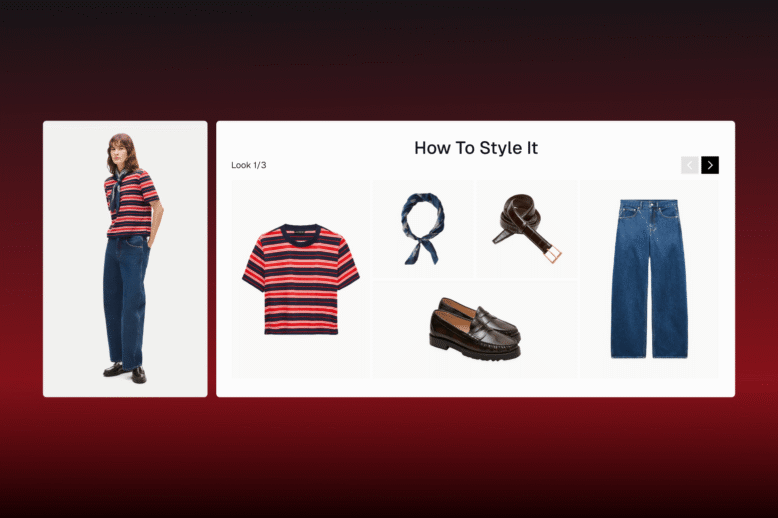
 Shop the Look Let shoppers buy the full outfit directly from any styled image.
 Styled for You Personalized outfit recommendations based on individual shopper preferences.
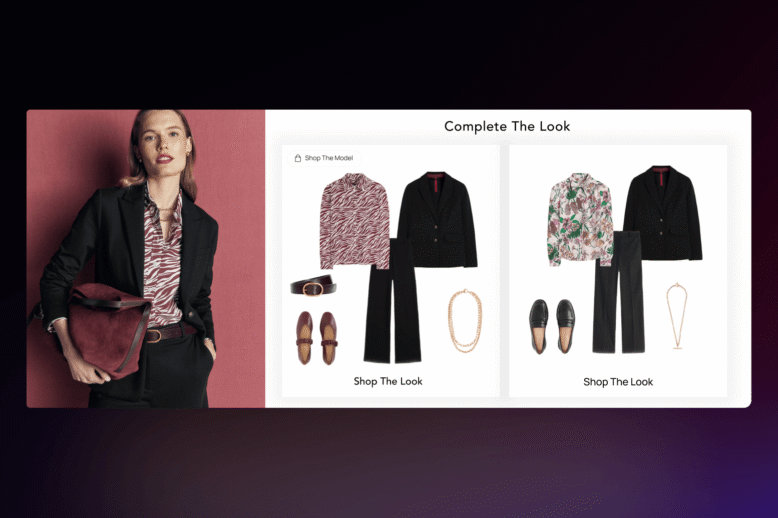
 Complete the Look Suggest complementary pieces to round out whatever a shopper is already viewing.
 Shop Similar Surface visually comparable alternatives when a specific item is out of stock or out of budget.
 Flat Lay to Model Choose from diverse models with full control over pose, crop, and framing.
 Background & Scene Swaps Place products in clean studio backgrounds, lifestyle environments, or custom lighting moods.
 AI Colorway Swaps Create photorealistic images for every colorway from a single reference shot.
 Model Diversity & Inclusive Imagery Output-ready formats for PDPs, social platforms, and campaign lookbooks.