Every Angle, No Reshoot: How AI Pose Control Is Transforming Product Detail Pages
Stylitics Marketing Team
The Stylitics Marketing Team explores the intersection of AI, retail, and shopper experience, sharing strategies and insights that shape the future of product discovery and visual merchandising.
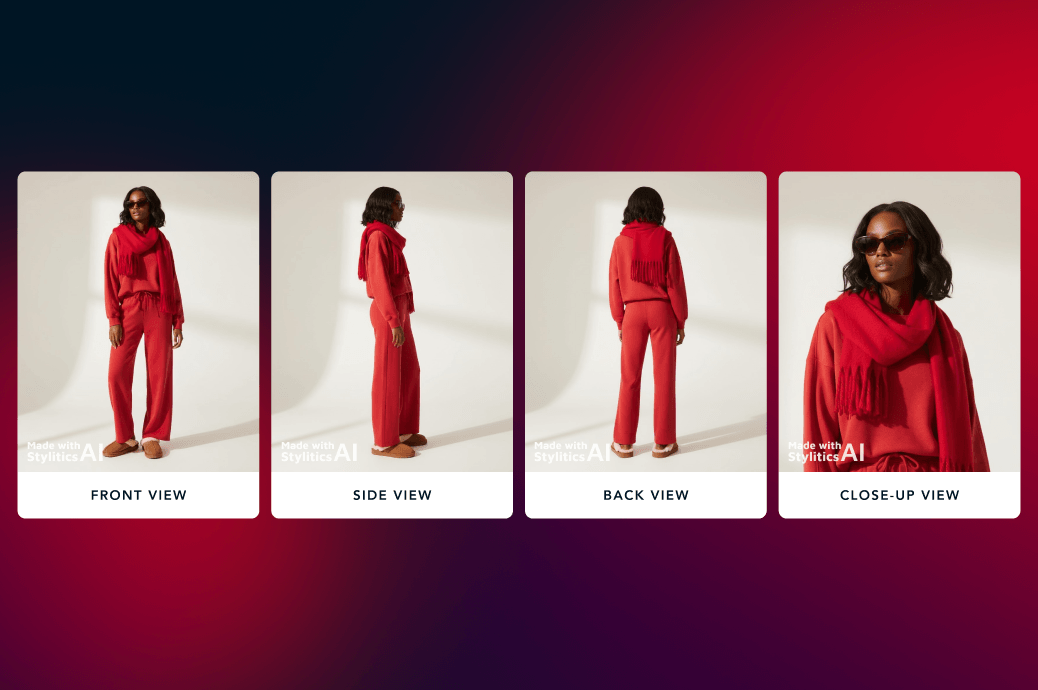
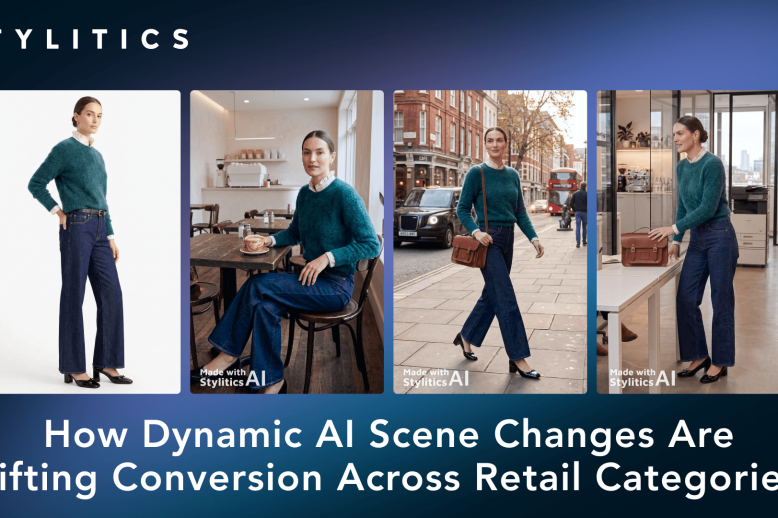
The pose a model holds in a product image communicates more about a garment than most brands realize. A standing, straight-on shot tells a shopper about the basic silhouette. A walking shot reveals how the garment moves. A sitting shot shows how fabric behaves when the body is in a different position. A three-quarter turn communicates fit across the back. Each pose answers a specific question that shoppers are asking when they evaluate a product — and every question that goes unanswered is a source of uncertainty that can prevent a purchase.
Key Takeaways
AI pose control generates standing, walking, sitting, and custom movement variations from a single product reference, eliminating angle-specific reshoots.
Different categories require different signature poses — activewear needs movement, dresses need drape shots, outerwear needs layered styling. AI delivers all from one base asset.
Pose variation on PDP carousels increases shopper confidence by showing how garments behave in motion, not just at rest — directly impacting conversion and reducing returns.
Multi-angle coverage that previously required multiple model bookings and shoot sessions can now be produced in hours from a single product image.
Under the traditional studio model, pose variety is an expensive upgrade. Multiple poses per product means more model time, more direction, more shooting, and more post-production. For a catalog of any meaningful size, the cost of comprehensive pose coverage is prohibitive, and the trade-off is always the same: one or two hero poses per product, and the rest of the shopper’s questions left unanswered. Retailers in Stylitics’ conversations describe the constraint clearly — a brand might bring in a model for a day and get an outfit, but they cannot get that same model in four different poses across all the combinations of backgrounds, colorways, and styling variations the catalog actually requires.
Stylitics AI Image Studio fixes this problem. Multiple pose and angle variations can now be generated from a single product reference, delivering comprehensive motion and perspective coverage without a single additional shoot booking. Every product can show the shopper exactly what they need to know — in whatever position or movement frame best communicates the garment’s value.
“A walking shot answers questions that a standing shot never can. AI pose control means every product gets both — and everything in between.”
The Conversion Case for Pose Variation
Pose variation on a PDP carousel is not a creative luxury — it is a conversion tool. Research consistently shows that shoppers who view multiple images per product convert at higher rates and return products less frequently. The mechanism is straightforward: more images, from more angles and in more positions, resolve more of the uncertainty that prevents purchase confidence.
For specific product categories, particular poses are not optional — they are the images that answer the category’s most important shopper questions. Activewear needs movement shots that show how fabric performs under dynamic conditions. Dresses and skirts need walking shots that demonstrate drape and length in motion. Outerwear needs sitting and layered poses that show how the garment functions in real-world scenarios. Without these poses, the PDP fails to answer the questions that matter most for each category.
Stylitics’ own conversations with enterprise retailers confirm that this gap has direct commercial consequence. One retailer noted that conversion rates go up quite a bit when shoppers can see even a single well-composed posed shot — and that observation held across multiple category contexts. Another flagged a specific need: being able to control how a garment’s length appears on different body heights, so that shoppers can see where a hemline would actually fall on a taller versus shorter frame — something that a single static standing shot cannot communicate. These are not edge cases. They are the questions every shopper is silently asking on every PDP visit.
AI pose control enables these category-specific requirements without the production overhead of managing separate shoot sessions for each. The same product asset that generates a standard standing PDP image can yield a walking shot, a sitting shot, and a three-quarter back view — all within the same automated production run, all quality-controlled to PDP standards.
Custom Poses and Brand Signature Movement
Beyond standard pose variations, Stylitics AI Image Studio supports custom movement and brand signature poses that align with a retailer’s specific creative identity. Brands that have developed a recognizable model aesthetic — specific postures, hand positions, directional movement, or composition approaches — can configure these as default generation parameters, ensuring every output reflects the brand’s visual identity rather than a generic commerce standard.
This capability matters particularly for lifestyle and campaign imagery where the pose is as much a part of the brand message as the product itself. A brand known for active, dynamic imagery can configure movement-forward generation parameters. A brand with a more refined, editorial aesthetic can define postures and compositions that reflect that identity. The AI generation system executes these parameters consistently across the full catalog, maintaining brand signature at a scale that human direction alone cannot sustain.
Custom pose parameters are established during the onboarding process and encoded into the generation pipeline, so brand-consistent pose output is automatic rather than requiring per-product direction. As brand aesthetic evolves, parameters can be updated and applied across new production runs.
AI Image Studio: Pose and Movement Capabilities
Capability
Description
Pose Control
Standing, walking, sitting, or custom movement — every variation from a single source image.
Cropping & Framing
Focus on fit and drape, full-figure, or editorial crop based on pose and channel.
Tuck & Drape
Fabric physics that adapt authentically to each pose — drape changes as body position changes.
Garment State Control
Specify styling states per output — zipped, unzipped, layered open, or tucked — so the same garment can be shown in multiple wear configurations without reshooting.
Full Outfitting
Complete outfit styling applied consistently across every pose variation generated.
Model Diversity
Pose variations generated across diverse model representations from the same source.
Lifestyle Scenes
Urban, nature, and environmental backgrounds applied to movement and pose variations.
Social Editorial
Pose-specific crops formatted for social channel performance.
Lighting & Mood
Lighting parameters maintained consistently across all pose variations for catalog coherence.
PDP Standard
High-res, zoom-capable PDP images delivered for every pose variant.
Smart Crop
Automatic format adaptation per pose and channel requirement.
CASE STUDY
Global Sportswear Retailer: $20M+ in Studio Photography Savings
$20M+ total savings achieved
10,000+ images delivered per week
2+ images per SKU including pose and angle variation
A global sportswear retailer with a 100,000+ item catalog was delivering only a single pose per SKU in most categories — budget constraints made multi-pose coverage unsustainable at scale. Activewear products were particularly underserved, with movement shots absent across a significant portion of the catalog. Stylitics’ automated pipeline delivered two or more images per SKU including pose variation, enabling the activewear category to show the movement performance that shoppers needed to see. Total savings exceeded $20 million.
The Pose Gap Is a Conversion Gap
Every product on a PDP that shows only a single, static standing shot is leaving shopper questions unanswered. For some products in some categories, that gap is tolerable. For many products — particularly in apparel categories where fit, drape, and movement are central to the purchase decision — that gap is measurable in conversion rate and return rate.
As Stylitics’ shopper research confirms, consumers make purchase decisions based on the visual confidence a PDP creates. When that confidence is incomplete — because the garment has only been shown in a single position, under a single set of conditions — shoppers either hesitate, bounce, or buy and return. All three outcomes have commercial cost.AI pose control closes the gap without adding production cost or timeline. The brands committing to multi-pose coverage across their catalogs are not just improving the shopping experience — they are systematically reducing the uncertainty that drives cart abandonment and post-purchase returns. The pose and angle diversity that shoppers need to buy with confidence has always been achievable in theory. AI Image Studio makes it achievable in practice, at the scale and cost that catalog-wide coverage requires.
FAQ
Technically yes, but there is an important legal consideration to be aware of.
Modifying the likeness of a real human model from a photoshoot requires obtaining likeness rights from that individual, which typically means paying additional royalties. This is one of the reasons Stylitics works with digital performers — proprietary AI model personas that are not based on any real individual — giving brands full creative flexibility to generate pose variations, background swaps, and styling changes without licensing constraints or model recall requirements.
Stylitics supports standing, walking, sitting, three-quarter turn, back view, and a range of editorial and dynamic movement poses as standard options. Custom poses and brand-specific movement profiles can be configured during onboarding.
Each model how each fabric type behaves differently in different body positions — a sitting shot will show different fabric behavior than a standing shot, authentically reflecting how the garment would look in that position.
Yes. Pose parameters can be configured globally or by product category, ensuring that activewear, dresses, outerwear, and other categories each receive pose treatments that best address their specific shopper questions.
There is no hard limit. Generation volume scales with catalog size and production requirements. Standard production runs typically deliver two or more looks per SKU, with custom pose packages available based on category and commercial priority.