Luxury Ecommerce Merchandising: Styling at Scale Without Diluting the Brand
Stylitics Marketing Team
The Stylitics Marketing Team explores the intersection of AI, retail, and shopper experience, sharing strategies and insights that shape the future of product discovery and visual merchandising.
Your boutique staff would never hand a client one jacket and walk away. Your product pages do it thousands of times a day. Online now carries 21% of the luxury market, and most of those pages still show a single piece on a white background, or a row of “you may also like” items no stylist would ever put together.
The usual fixes don’t help, because hand styling can’t cover a full catalog and recommendation engines built for mass retail pair pieces by what sold together, not by what the house would wear. Luxury ecommerce merchandising has to scale without that trade-off.
You can have both, and below you’ll see how hybrid AI lets models propose looks while fashion-trained stylists approve them, which styling decisions to automate and which to keep, why returns make a stronger business case than cost savings, and a 90-day plan to prove it on one category.
Key Takeaways
Online reached 21% of the luxury market in 2025 (Bain & Company), so styling has to work without a stylist standing beside every page.
Hybrid AI lets models propose looks while fashion-trained stylists approve each one, which keeps brand codes intact at catalog scale.
Measure the program on returns first. Online shoppers send back 19.3% of what they buy (NRF, 2025), and luxury returns cost margin and trust.
What is luxury ecommerce merchandising?
Luxury ecommerce merchandising is how a luxury brand presents, pairs and pictures its products online so the site sells complete looks the way a boutique does. It matters more each year, because online held 21% of the luxury market in 2025, up from 20% the year before (Bain & Company, 2025).
In stores, a sales associate does this work by instinct. They pull the trousers that suit the blazer, add the loafer, and explain why the colors work together. The showroom itself tells a story through what hangs next to what. Online shops have to do all of that with no one in the room, on small screens, often for a shopper scrolling on a smartphone between meetings.
In the boutique
On the website
A stylist builds the look for the client in front of them
The page has to suggest the look for thousands of shoppers at once
The fitting room shows how pieces work together
On-model imagery has to show it before anything ships
Storytelling happens in conversation
Storytelling happens in layout, copy and pairings
The associate knows what’s in stock
The site has to check live inventory for every piece it shows
Brand-operated websites showed encouraging signs in 2025 while multibrand marketplaces stayed under pressure, according to the same Bain study. That puts the burden on a brand’s own digital commerce to carry the experience.
Search for “luxury visual merchandising” and you’ll mostly find window displays and store fixtures. This article is about the digital side, which is where the outfitting for luxury brands work happens.
Why does styling at scale feel risky for luxury brands?
Luxury lost a lot of customers recently. The number of luxury consumers fell from 400 million in 2022 to around 340 million in 2025, and Bain warns that brands must use AI-enabled efficiency “without dulling desirability” (Bain & Company, 2025). One off-brand pairing costs a luxury house more than a lost sale. It costs the reason someone pays full price.
Most recommendation engines were built for mass retail. They learn from what gets bought together, and in a mass catalog that logic is fine. In luxury it produces pairings that no creative director would approve, such as a logo belt with a logo bag, an evening piece next to a gym short, or last season’s coat beside a new collection. Generic artificial intelligence doesn’t know that the house never shows two monograms in one look. It only knows that both items sold well.
Imagery carries the same risk, because a model shot that looks synthetic, a hand with the wrong number of fingers, or a fabric that renders like plastic can undo years of brand building in the moment a customer sees it.
McKinsey’s latest fashion outlook adds pressure from the other side. It notes that luxury players raised prices without matching improvements in quality or creativity (McKinsey & Company, 2025). Shoppers who already doubt the price-to-value equation won’t forgive a page that looks careless.
So the risk is real, but it isn’t automation itself. The risk is automation nobody controls. Black-box tools ask a brand to trust output it can’t inspect, which is why transparent AI in outfitting matters so much more in luxury than anywhere else. The future of luxury online belongs to brands that keep approval rights over every look.
How do luxury brands style at scale without diluting the brand?
The answer is hybrid AI, where models propose looks from the full catalog and fashion-trained stylists approve or reject each one before a shopper sees it. Stylitics runs this way across 175+ retailers reaching 200M+ shoppers a month, built on a decade of stylist-curated outfitting data, and every look and image passes human QC before it goes live.
That split between proposing and approving is the whole game. AI is fast at the parts that don’t need taste, such as finding every compatible item, checking stock, and producing variations. People are better at the parts that do. Here’s how the workflow holds together in practice.
Codify brand codes and tone of voice first
Before any model touches the catalog, write down what the house will and won’t do. That means signature silhouettes, color rules, forbidden pairings, how heavily logos can stack, and which pieces only appear with others from the same season. Include the tone of voice for product copy too, because a look described in generic retail language reads as off-brand even when the pairing is right. Craftsmanship details belong here as well. If the brand always leads with the hand-stitched welt or the mill that wove the cloth, the rulebook should say so. A written rulebook gives the model and the stylist the same reference, and it gives a new merchandiser something better than tribal knowledge. Stylitics calls this a brand encyclopedia, and it’s the step most teams skip.
Keep a stylist in the loop
Once the rules exist, the model can propose looks for every product in the catalog, including the long tail that no team would ever style by hand. A fashion-trained stylist then reviews them, approves the good ones, and rejects or edits the rest. Merchandisers keep final say over what appears, and they can pin hero looks for launches. This is what human-in-the-loop AI means in practice. The stylist isn’t checking every pixel. They’re catching the pairings that are technically compatible and still wrong for the brand.
Sell the outfit, not a recommendation carousel
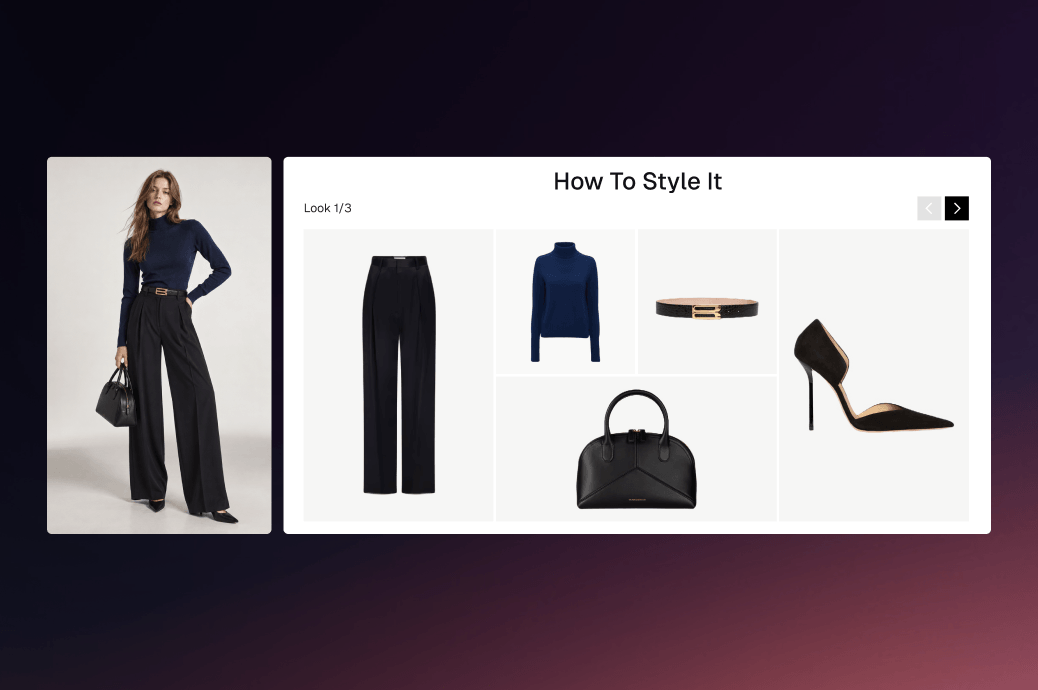
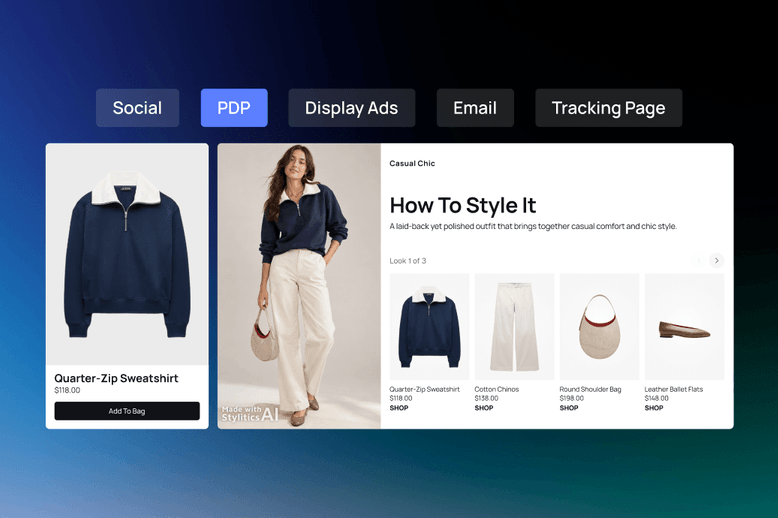
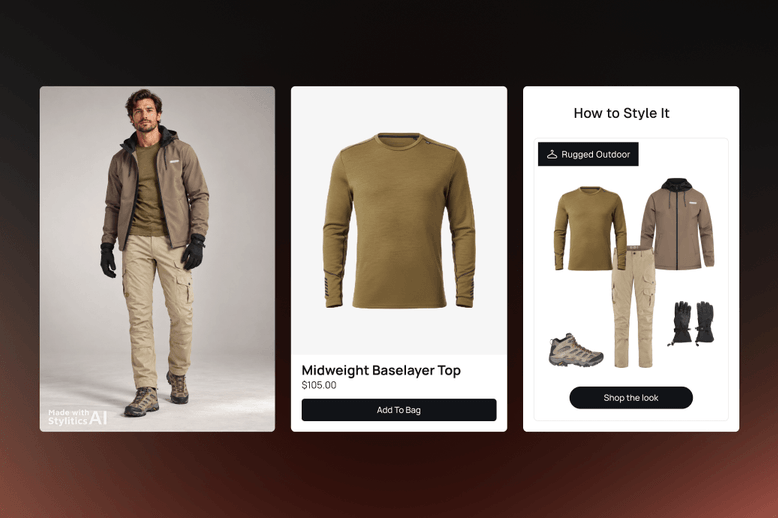
A “you may also like” strip of six similar items is the mass-retail default, and it looks cheap on a luxury page. Complete the Look modules show the shoe, bag, jewelry and eyewear that finish a piece in an editorial layout instead. Picture a cashmere sweater shown with the tailored trouser, the suede loafer and the leather tote it was designed alongside, rather than five other knitwear items. The same looks can feed category navigation, a homepage banner for a new collection, or campaign-style shoppable galleries that turn editorial content into something a shopper can buy. With Shop the Look, a shopper adds the whole outfit in one step, with each piece sized separately. The items on the page stop competing and start working together.
Hold AI images to campaign standards
A look only sells if the shopper can picture it. A traditional production schedule can’t shoot every pairing on a model, so most luxury sites fall back to flat packshots. Generative AI on-model imagery fills that gap by placing approved looks on models and in settings that match the campaign. The non-negotiable part is human QC on every image. Stylitics’ fashion-trained reviewers check drape, fit, fabric texture and hands before an image joins the brand’s digital assets. That is the difference between on-brand AI-generated imagery and the uncanny shots that make shoppers question the label.
Carry the look into emails, chat and personal shopping
Approved looks shouldn’t stop at the product page or any single one of your channels. The same outfits can render in the brand’s own email marketing templates at send time, checked against live inventory, so a client never opens a beautiful look with half the pieces sold out. Client advisors and sales consultants can share them over chat or in personal shopping appointments, and before private events. That keeps omnichannel personalization consistent, because the personalized content a client receives was approved by the same stylists who set the rules. The client relationship gets one voice across every channel, from the site to the boutique.
Use this split as a starting point for deciding who owns each styling decision.
Styling decision
Who owns it
Why
Finding every compatible item in the catalog
AI
Speed and coverage across thousands of products
Checking stock and sizes before a look goes live
AI
Inventory changes hourly and no person can track it
Writing the brand codes and forbidden pairings
Stylists and brand team
Taste and house rules can’t be inferred from sales data
Approving each look before it appears
Fashion-trained stylist
Catches pairings that are compatible but off-brand
Generating on-model images of approved looks
AI with human QC on every image
Scale with campaign-level quality control
Pinning hero looks for launches and campaigns
Merchandiser
The brand decides what leads the season
Rhone, a premium menswear brand, used stylist-built outfits to lift average order value 39% and reach 10x ROI in 100 days. Read the Rhone case study to see how the approach played out.
Why should returns, not cost savings, justify the investment?
Returns are the cost luxury teams feel most and measure least. Retailers expected 19.3% of online sales to come back in 2025, part of $849.9 billion in returned merchandise across US retail (NRF, 2025). For a luxury brand, each return costs the margin, the return shipping and some of the client’s confidence.
Most vendors pitch AI on cost savings, and that’s the wrong lead for luxury. A brand that cuts photography spend and then sees more returns hasn’t saved anything. Styling attacks the purchasing decision that causes returns in the first place. When a shopper sees how a piece drapes on a body, what it pairs with, and how the colors read together, they buy with fewer doubts. Stylitics reports return reductions of 30 to 40% from this kind of contextual, on-model presentation. The reasons are covered in more depth in why AI-generated imagery reduces returns.
Basket size moves in the same direction. A Forrester Total Economic Impact study of Stylitics found a 10% lift in average order value, a $3.6M net present value and a 563% ROI. At JD Sports, Shop the Model accounts for 50% of widget revenue, which shows how shoppers respond when they can buy the outfit rather than the item. Conversions and AOV are worth tracking. They just shouldn’t be the only scoreboard.
Metric
Result
Source
Online return rate, US retail, 2025
19.3% of online sales
NRF, 2025
Return reduction from on-model, styled presentation
30 to 40%
Stylitics
Average order value lift
10%
Forrester TEI study of Stylitics
ROI
563%, $3.6M NPV
Forrester TEI study of Stylitics
Rhone AOV lift
39%, 10x ROI in 100 days
Stylitics case study
Cost still matters, and the savings are a real opportunity. Generative AI on-model imagery runs at 10 to 20% of the cost of a traditional photoshoot, which frees the production team to spend its budget on the campaign shoots that define the season. Fewer returns also mean fewer garments shipped twice, which counts toward any sustainability report. Treat both as the bonus, not the business case.
What should a luxury merchandising platform give you?
A luxury merchandising platform should give merchandisers approval rights over every look before anything else. That bar matters now because adoption is moving fast, with more than 35% of fashion executives already using gen AI in areas such as customer service, visual creation and search (McKinsey & Company, 2025). Speed of adoption is no reason to accept tools the brand can’t steer.
Run any vendor through these questions before you sign.
Can a merchandiser approve, edit or block every look before it appears?
Does a fashion-trained person check each look and image, or is review left to your team?
Was the styling model trained on stylist-curated outfits, or on mass-market purchase data?
Does the platform check live stock so a look never shows a sold-out piece?
Can you A/B test layouts and looks, with ongoing optimization and reporting tied to AOV, conversion and returns?
Do approved looks flow into email, SMS and clienteling tools in your own templates?
Plenty of tools and platforms on the market answer two or three of these well. Very few answer all six, and the gaps usually show up in approval control and human QC. A company that can’t show you who approves a look before it goes live is asking you to take its taste on trust. For a side-by-side view of how outfitting technology differs, see Stylitics vs. FindMine.
A 90-day strategy for luxury ecommerce merchandising
The fastest way to prove the approach is a contained pilot, measured against the Forrester TEI benchmark of a 10% AOV lift and against your own return rate. Ninety days is enough time to see both.
In days 1 to 30, write the rules down by documenting brand codes, forbidden pairings, seasonal rules and tone of voice. Pick one category with high return rates, such as ready-to-wear outerwear.
In days 31 to 60, run the pilot with approval on. Let the model propose looks for that category, have stylists approve them, and add on-model imagery for the approved looks. Start A/B testing against the current page.
In days 61 to 90, extend and measure. Push approved looks into email and clienteling, then compare AOV, conversion and returns against the control.
Each step builds the evidence a creative director and a CFO both need before rolling the program across the catalog. To see how Stylitics would style your own catalog with stylist approval on every look, request a demo and bring one category.
FAQs about luxury ecommerce merchandising
Luxury brands raise AOV by styling complete looks instead of discounting single items. A Forrester TEI study of Stylitics found a 10% AOV lift, and Rhone saw 39%. Outfits act like a personal shopper on every page, showing the shoe, bag and accessory that finish a piece so shoppers buy the look at full price.
Yes, if stylists approve the output. Hybrid AI lets models propose looks while fashion-trained stylists approve, edit or reject each one against written brand codes. Stylitics applies this human QC across 175+ retailers, so the brand keeps the final word on every pairing that appears on its site, in email or in clienteling.
Styling reduces returns by answering the doubts that cause them. When shoppers see a piece on a model and paired with the right items, they understand fit, drape and color before buying. NRF expected 19.3% of online sales to be returned in 2025, and Stylitics reports 30 to 40% fewer returns with styled, on-model presentation.
It is when every image passes human QC. Stylitics’ fashion-trained reviewers check drape, texture and anatomy before images go live, at 10 to 20% of traditional photoshoot cost. Without that review, generative images risk the uncanny details that make luxury shoppers question the label. Read more about on-brand AI-generated imagery.
Complete the Look suggests the pieces that finish a product, while Shop the Look lets a shopper buy the full outfit shown on a model in one step. At JD Sports, Shop the Model drives 50% of widget revenue. Most luxury sites use both. See the full breakdown in Shop the Look vs. Complete the Look.
Stylitics fits luxury and premium brands that want styling at catalog scale without giving up control. Merchandisers approve every look, fashion-trained reviewers QC every image, and the models draw on a decade of stylist-curated outfitting data. Rhone reached 10x ROI in 100 days. Start with the luxury outfitting overview.



 Shop the Look Let shoppers buy the full outfit directly from any styled image.
 Styled for You Personalized outfit recommendations based on individual shopper preferences.
 Complete the Look Suggest complementary pieces to round out whatever a shopper is already viewing.
 Shop Similar Surface visually comparable alternatives when a specific item is out of stock or out of budget.

 Flat Lay to Model Choose from diverse models with full control over pose, crop, and framing.
 Background & Scene Swaps Place products in clean studio backgrounds, lifestyle environments, or custom lighting moods.
 AI Colorway Swaps Create photorealistic images for every colorway from a single reference shot.
 Model Diversity & Inclusive Imagery Output-ready formats for PDPs, social platforms, and campaign lookbooks.