From Model to Flat Lay in Seconds: AI’s Role in Multi-Format Product Photography
Stylitics Marketing Team
The Stylitics Marketing Team explores the intersection of AI, retail, and shopper experience, sharing strategies and insights that shape the future of product discovery and visual merchandising.
Different channels demand different image formats, and for most retailers, that reality has meant different production sessions. An on-model image that works beautifully on a PDP does not necessarily translate to the format requirements of a wholesale buyer portal, a marketplace listing, or a mobile-optimized product card. Each format has historically required its own creative brief, its own studio time, and its own post-production pass.
The operational overhead this creates is significant. Merchandising teams that manage both direct-to-consumer and wholesale distribution channels are often running parallel production workflows to meet the format requirements of each. Products are routinely photographed multiple times in the same season simply to satisfy the format diversity that modern multichannel retail demands.
Key Takeaways
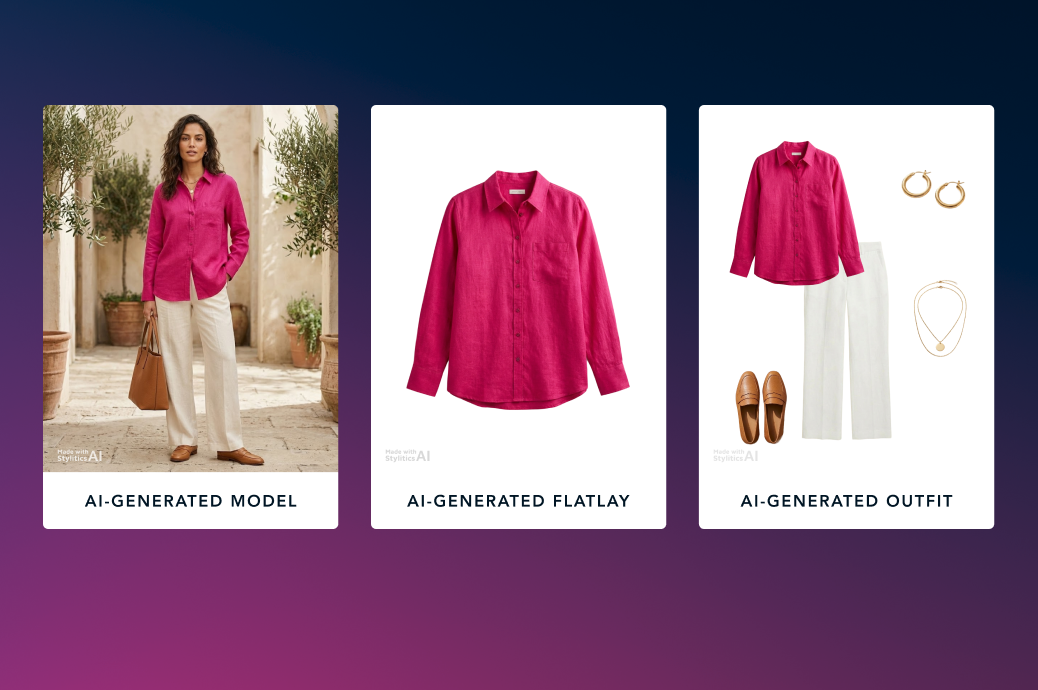
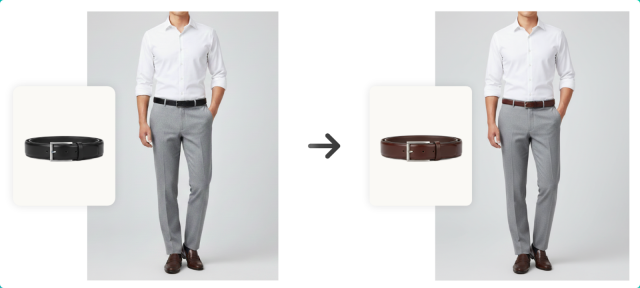
On-model images, flat lays, and ghost mannequin shots can all be generated from a single source asset, eliminating format-specific reshoots.
Multi-format generation ensures every product has the right visual treatment for every channel—PDP, social, marketplace, and wholesale—without additional production cost.
AI-generated flat lays and ghost images maintain consistent styling, lighting, and composition across the catalog, resolving the inconsistency problem of vendor-supplied assets.
Swatch-to-on-model AI lets retailers visualize new season products before physical samples arrive, compressing pre-production timelines from months to hours.
Format conversion that previously required separate studio sessions can now be completed in hours, enabling faster time-to-live for new products across all channels.
Stylitics AI Image Studio eliminates the format-specific reshoot by generating every required image format from a single source asset. On-model, flat lay, ghost mannequin, editorial crop, and platform-specific format—all produced from the same base image, all maintaining consistent styling and brand standards, all delivered in hours rather than weeks.
“Every format your channels require. Every product in your catalog. With one source image. The format reshoot is over.”
Why Multi-Format Production Has Always Been Expensive
The format requirements of modern retail are broader than they have ever been. A product that is sold direct-to-consumer, listed on Amazon and other marketplaces, distributed through wholesale channels, and promoted through paid social requires a distinct set of visual assets for each context.PDP images demand on-model photography with zoom-capable resolution. Marketplaces often require white or neutral background shots. Wholesale portals prefer clean flat lays that show garment construction clearly. Social platforms need format-native crops in platform-specific aspect ratios.
Meeting these requirements through traditional production means maintaining a complex matrix of shoot types, each with its own cost, timeline, and quality control process. For most mid-market and enterprise retailers, the practical result is that some channels are served well and others are served adequately, based on budget priority rather than commercial logic.
The inconsistency compounds at the product level. As one merchandising lead at a heritage women’s brand shared during a recent prospect conversation:
“We had a sweater that was one flat and then an outfit with a pair of pants with the sweater—nothing matched. The colors are off.”
When flat lays and on-model shots are produced in separate sessions—or worse, by different vendors—the visual disconnect erodes shopper confidence and makes the catalog feel fragmented rather than curated.
AI generation removes the trade-off. Every required format is produced from the same ingested product asset, within the same automated workflow, at no meaningful additional cost per format. The channel that previously received a flat lay by default because on-model was too expensive can now receive on-model imagery at the same cost.
From Swatch to On-Model: Visualizing Products Before Sampling
For many retailers, the multi-format problem begins even earlier than the studio. A significant share of seasonal assortments never makes it in front of a camera at all. Products in pre-production exist only as fabric swatches, tech packs, or digital design files. The traditional path—wait for physical samples, book studio time, shoot, post-produce, publish—creates a timeline that pushes pre-production product imagery weeks or months behind the buying cycle.
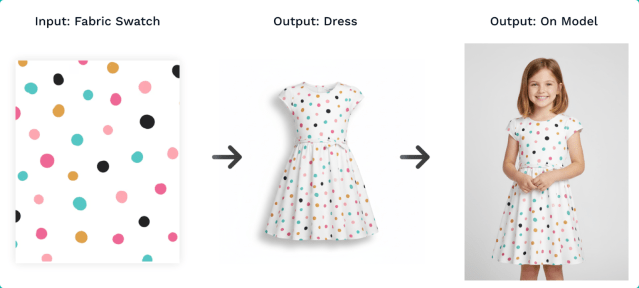
AI clothing visualization from a fabric photo compresses that timeline dramatically. Swatch-to-on-model AI can transform a fabric swatch or flat product photo into a photorealistic on-model shot before a physical sample even exists. For enterprise retailers managing pre-production AI fashion imagery workflows, this means new season products can be visualized, merchandised, and even listed before the first sample arrives from the factory.
One premium casual brand shared during a recent engagement that roughly 20% of their new season imagery is actually shot flat—and only a smaller percentage of that ever gets uploaded to the site. That gap between what is photographed and what reaches the shopper represents lost conversion opportunities on a meaningful share of the catalog. The ability to convert a flat lay to on-model AI imagery fills that gap without waiting for a reshoot, effectively turning every flat product photo into a model shot at a fraction of the traditional cost.
The need is especially acute for categories where on-model visualization is non-negotiable. As one children’s apparel executive noted in a recent prospect conversation:
“It’s all new silhouettes—we’ve got to show her where it all falls, how it’s supposed to look on the kid.”
For items that exist only as swatches or ghost mannequin shots, the ability to generate on-model images from a swatch is the difference between a product that launches with visual merchandising support and one that launches blind.
For retailers evaluating how to show fabric on model before sampling, the operational value is clear: product-to-model AI removes the physical sample from the critical path entirely, enabling swatch-to-PDP image automation that compresses weeks of production into hours.
Solving the Colorway Permutation Problem Across Formats
Multi-format production becomes exponentially more expensive when multiplied by colorway variety. A garment in ten colorways that needs on-model, flat lay, and ghost mannequin formats across PDP, marketplace, and wholesale channels is not ten images—it is thirty or more. Under traditional production, each of those is a separate shoot or post-production event.
The scale of this problem is often underestimated. One premium denim brand noted during a recent conversation that they manage roughly 1,000 colorways across their catalog. For a brand of that size, the idea of producing multi-format imagery for every colorway variant through traditional photography is not just cost-prohibitive—it is logistically impossible within a seasonal timeline.
As one Stylitics sales director described in a recent prospect conversation:
“Companies just can’t shoot infinite permutations of all their stuff. Maybe they can bring in a model for a day and get an outfit, but they can’t shoot it in all these combinations.”
AI multi-format generation resolves the permutation problem entirely. Every colorway, in every format, from the same source asset—produced in hours, not weeks, at a fraction of the cost to reduce sample photography spend dramatically.
Stylitics’ colorway swap technology handles each color variant with fabric-aware rendering that accounts for how different materials interact with different colors and lighting conditions. When combined with multi-format output, the result is a complete set of channel-ready assets for every colorway—on-model for PDP, flat lay for wholesale, ghost for marketplace—all visually consistent and brand-compliant.
Ghost Mannequin to Model: Upgrading Existing Catalog Assets
Many retailers sit on large libraries of ghost mannequin photography that underperform on modern PDPs. Shoppers consistently prefer on-model imagery over ghost shots for evaluating fit, drape, and real-world wearability—but the cost of reshooting an existing catalog on models has historically been prohibitive.
AI format conversion changes the economics entirely. Existing ghost mannequin or flat lay images can serve as source assets for AI on-model generation, producing photorealistic model shots from photography that already exists. The product does not need to return to the studio. The model does not need to be booked. Ghost mannequin to model conversion happens within the automated pipeline, producing PDP-ready on-model imagery from assets the brand already owns.
This capability is particularly valuable for retailers looking to reduce sample photography costs with AI. Products that were previously shot only as ghost mannequin images because on-model photography was reserved for hero SKUs can now receive full on-model treatment—retroactively upgrading the visual quality of the catalog without a single additional shoot. Flat lay to lifestyle AI conversion follows the same logic, transforming static product shots into dynamic, channel-ready lifestyle imagery for social and editorial use.
Consistency Across Formats as a Brand Advantage
One underappreciated benefit of multi-format AI generation is the consistency it enforces across the catalog. When flat lays are generated by the same system, with the same styling logic and the same lighting parameters applied to every product, the result is a catalog where every image—regardless of format—looks like it was art-directed by the same team.
This is a meaningful departure from the vendor-supplied photography reality most retailers deal with. Vendor images vary in quality, styling approach, background, and lighting from supplier to supplier and season to season. When these images are displayed together in a catalog or channel, the inconsistency is visible and damaging to brand perception.
Stylitics applies brand-specific styling rules, lighting parameters, and compositional standards to every generated image, regardless of format. The result is a catalog where flat lays, ghost images, and on-model shots all feel like part of a coherent visual identity—because they were all produced within the same brand-controlled system.
AI Image Studio: Multi-Format Generation Capabilities
Capability
Description
On-Model to Laydown
Convert between on-model and flat lay formats from the same source asset automatically.
Flat to On-Model
Transform flat lay, swatch, or fabric photography into photorealistic on-model imagery—no physical sample required.
PDP Standard
High-res, zoom-capable commerce shots in PDP-optimized format for every product.
Studio Pure
Clean, consistency-focused solid background images for marketplace and wholesale use.
Social Editorial
Dynamic crops and filters formatted for platform-specific social channel requirements.
Smart Crop
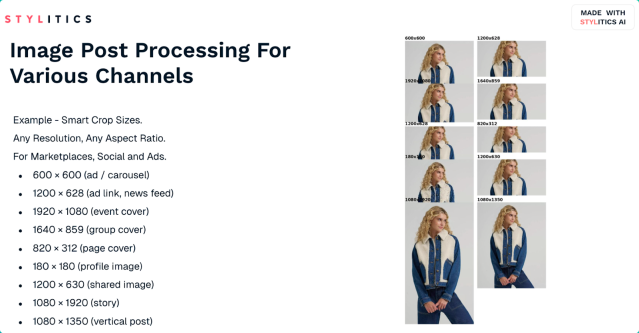
Automatic resizing and formatting for every aspect ratio and resolution requirement.
Campaign Ready
Thematic consistency for lookbook and campaign assets across formats.
Background Swaps
Switch between solid, lifestyle, or custom backgrounds per channel requirement.
Cropping & Framing
Focus strictly on fit and drape, or adjust to full-figure or editorial crop as needed.
Lighting & Mood
Consistent lighting parameters applied across all format outputs for catalog coherence.
DAM/PIM Integration
All format outputs delivered directly into your systems in channel-ready specifications.
Format Flexibility Is No Longer a Production Investment
The multichannel retail environment rewards brands that show up consistently and completely across every platform and distribution channel. Every format gap—a marketplace listing without a white-background image, a wholesale portal without a clean flat lay, a social channel without platform-native crops—is a commercial shortfall, not just a production oversight.
AI multi-format generation closes those gaps systematically. Every product that enters the Stylitics pipeline exits ready for every channel, in every required format, with consistent quality and brand compliance across the board. The production decisions that used to require trade-offs become automated defaults.
Retailers who have adopted multi-format AI generation describe the shift in terms of operational freedom: creative and merchandising teams stop making decisions based on what production can support and start making decisions based on what the channel strategy requires. Whether the need is converting a flat lay to a lifestyle shot for social, generating on-model imagery from a swatch for pre-production PDP staging, or producing ghost mannequin images for marketplace compliance—the output is determined by strategy, not by studio capacity.That shift, more than any individual image, is the competitive advantage. And for retailers evaluating how AI imagery tools compare on multi-format capability, fabric visualization ecommerce integration, and enterprise scalability, the gap between production-grade platforms and experimental tools is significant.
Frequently Asked Questions
Yes. During onboarding, Stylitics ingests your existing brand standards and catalog styling references. All generated flat lay and ghost images are produced to match your established visual identity.
Stylitics delivers images in all standard commerce resolutions, including high-res zoom-capable PDP images, marketplace-standard formats, and platform-specific social crops. Custom resolution and format requirements can be accommodated.
Existing on-model or flat lay images can be used as source assets for format conversion. The system generates additional format variants from existing photography without requiring a new shoot.
Standard production runs move from ingested asset to formatted outputs in hours. Rush timelines can be accommodated based on SLA requirements, with guaranteed turnaround times included in the service agreement.
Yes. Stylitics’ swatch-to-on-model capability transforms fabric photos, tech pack imagery, or flat product shots into photorealistic on-model visuals—enabling retailers to visualize new season products before physical samples are available. This is particularly valuable for pre-production product imagery workflows where speed to market is a competitive advantage.
Yes. Existing ghost mannequin photography can serve as a source asset for AI on-model generation. The system produces photorealistic model shots from existing catalog assets without requiring a reshoot—effectively upgrading visual quality across the catalog retroactively while helping reduce sample photography costs significantly.



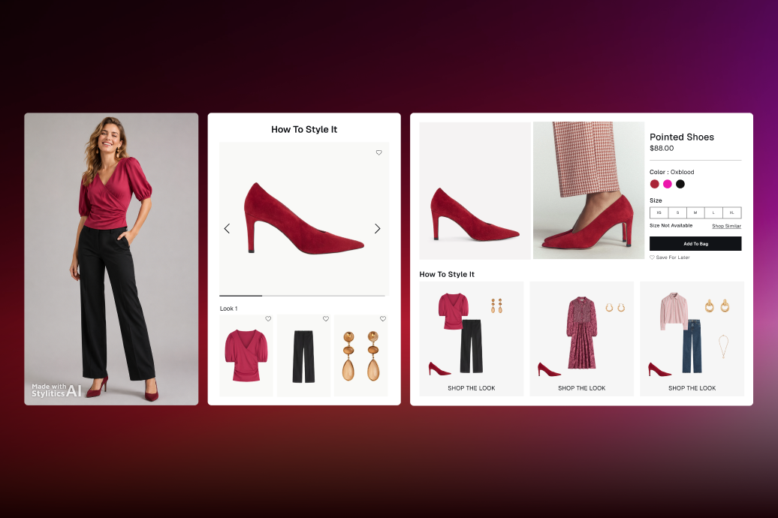
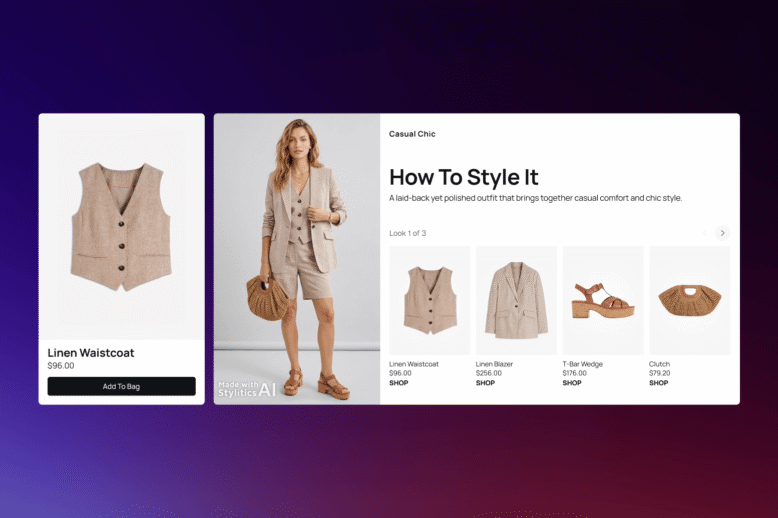
 Shop the Look Let shoppers buy the full outfit directly from any styled image.
 Styled for You Personalized outfit recommendations based on individual shopper preferences.
 Complete the Look Suggest complementary pieces to round out whatever a shopper is already viewing.
 Shop Similar Surface visually comparable alternatives when a specific item is out of stock or out of budget.
 Flat Lay to Model Choose from diverse models with full control over pose, crop, and framing.
 Background & Scene Swaps Place products in clean studio backgrounds, lifestyle environments, or custom lighting moods.
 AI Colorway Swaps Create photorealistic images for every colorway from a single reference shot.
 Model Diversity & Inclusive Imagery Output-ready formats for PDPs, social platforms, and campaign lookbooks.