Scroll-Stopping on a Budget: How Retailers Are Generating Social-Ready Content at Scale with AI
Stylitics Marketing Team
The Stylitics Marketing Team explores the intersection of AI, retail, and shopper experience, sharing strategies and insights that shape the future of product discovery and visual merchandising.
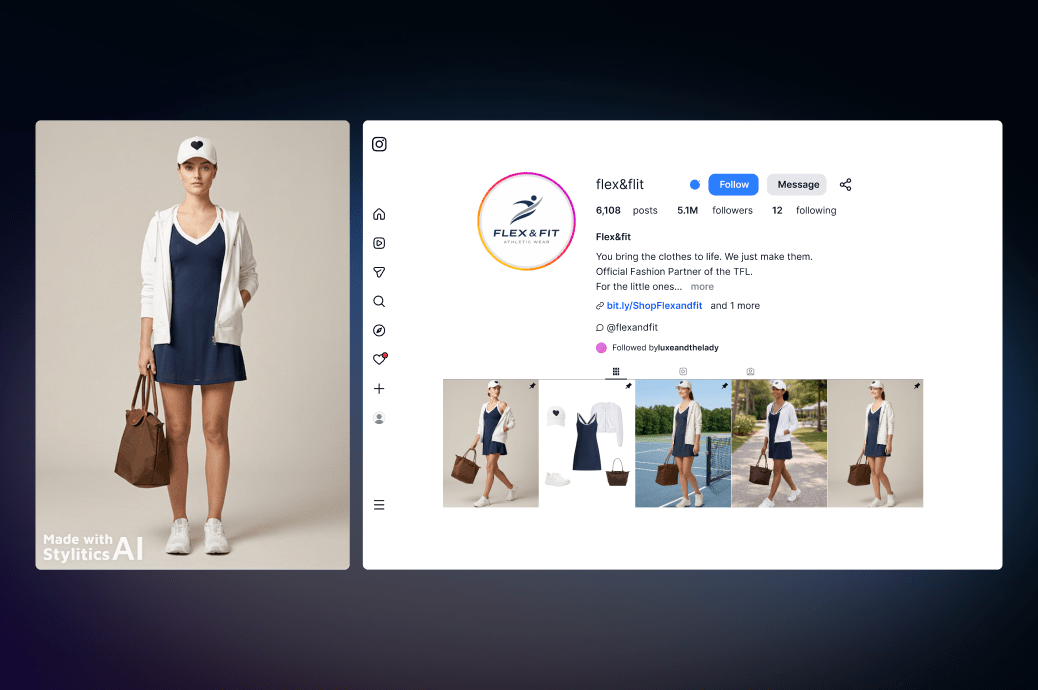
The content demands of social commerce have outpaced the production capacity of every traditional studio model. A brand maintaining active presence across Instagram, TikTok, Pinterest, and paid social requires a volume of original, platform-optimized, on-brand content that no agency retainer or in-house studio was ever designed to deliver sustainably. The math is simply not in favor of the traditional approach.
Key Takeaways:
Social content demands far more volume and variety than the traditional studio model was designed to support—AI generation resolves the supply gap.
AI-generated social imagery is produced in platform-native formats and aspect ratios, eliminating the post-production bottleneck between shoot and publish.
UGC-style, editorial, and lifestyle looks can all be generated from the same product asset, giving brands creative range without creative overhead.
Social imagery generated at scale enables real testing—brands can run more creative variations, learn faster, and optimize channel performance with actual data.
Most brands have responded to this gap with a compromise strategy. They shoot a handful of hero campaign assets and stretch them across as many placements as possible, supplemented by UGC reposting and influencer content that varies unpredictably in quality and brand alignment. The result is a social presence that looks inconsistent, publishes infrequently, and rarely tests creatives because the production cost of a failed test is too high.
Stylitics AI Image Studio changes the fundamental economics of social content production. By generating platform-ready imagery directly from product assets, retailers can produce the volume, variety, and format diversity that social commerce demands—at a cost that makes real creative testing viable for the first time.
“The content calendar used to be limited by the studio calendar. AI generation means the two are no longer connected.”
Volume, Variety, and Format: Why Traditional Production Fails Social
Social platforms are not a single channel requiring a single asset. Instagram feed posts, Stories, Reels, TikTok videos, Pinterest pins, and paid social carousels all have distinct aspect ratios, compositional conventions, and audience expectations. A single studio shoot, even a well-executed one, typically produces a set of assets that require significant post-production reformatting before they are usable across all of these formats.
Beyond format, the velocity of social content is a challenge that studio production simply cannot meet. Platforms reward consistency and frequency. Brands that publish one batch of carefully produced content per season and then go quiet are at a structural disadvantage against competitors who publish continuously with variety and test against performance data regularly.
AI generation collapses the time between product asset and publish-ready social content. Stylitics delivers images in all major platform formats and aspect ratios—formatted, cropped, and styled for each channel’s specific requirements—from the same product ingestion that produces PDP imagery. The social content calendar stops being a production bottleneck and becomes a strategic tool.
The cost advantage reinforces the shift. As one Stylitics team member noted during a call with an enterprise fashion brand:
“We’re hitting quality and scale that just simply is unachievable for a fraction of the price.”
When the per-image cost drops by 85–90% compared to traditional studio photography, the calculus of what makes it into the content calendar changes entirely. Products that never would have received dedicated social creativity suddenly become viable—and the brands that activate those long-tail assets gain a measurable content advantage.
From Single Shoot to Multi-Format Creative Library
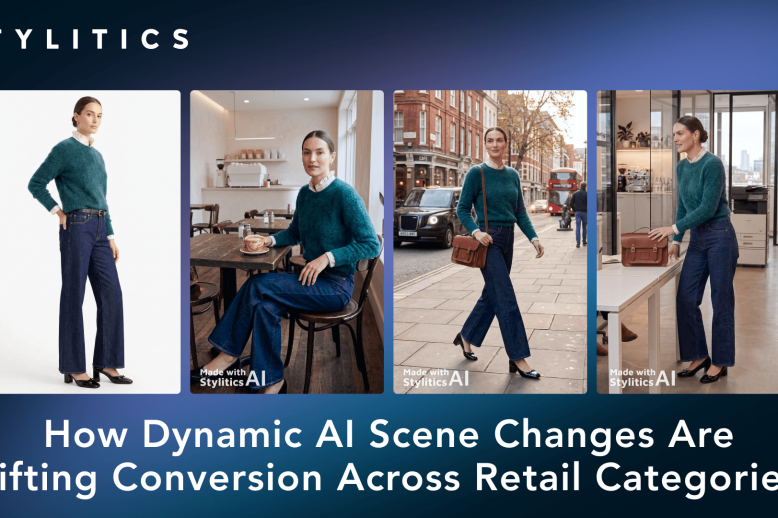
The creative range available through AI generation gives social teams a resource they have never had at scale: a library of distinct looks, styles, and formats for every product, available on demand. A product that enters the Stylitics pipeline doesn’t just produce a PDP image—it produces studio-style images, lifestyle scenes, UGC-style content, editorial crops, and platform-specific formats, all from the same base asset.
This creative library enables the kind of performance testing that separates social leaders from followers. Which creative style drives more clicks—studio or lifestyle? Which format performs better in paid social—carousel or single image? Which model representation converts better for a specific audience segment? These questions can now be answered with real data because the cost of producing test variants has dropped to near zero.
Stylitics’ AI generation maintains brand consistency across every format and style variation. Whether the output is a polished studio image or a UGC-style crop, every asset passes through brand-specific quality controls and the same AI and human-in-the-loop review process that governs PDP imagery. Social teams get creative range without sacrificing brand integrity.
Brands Are Already Using AI-Generated Models on Social
The shift from experimental to operational is happening faster than most retailers realize. Leading brands are not just testing AI-generated social content—they are publishing it to live channels and seeing results.
In a recent conversation with one luxury brand’s team, a representative shared:
“We actually used AI generated models on social media. So I guess the brand is on board with it. It’s definitely something they’ve explored elsewhere in the business.”
When a luxury label with that level of creative scrutiny is deploying AI imagery to social channels, the quality threshold has been met.
And the performance data is reinforcing the move. As one Stylitics representative noted during a recent prospect conversation:
“We’ve heard that conversion rates go up quite a bit when you have even just a posed shot like that. In the studio, we think some lifestyle videos might be even better.”
Combined generation makes it possible to test that hypothesis at scale—generating styled, on-model content that performs on social media without the studio overhead that previously made experimentation cost-prohibitive.
These are not isolated experiments. They signal a broader shift in how fashion brands are using AI to solve the social content production bottleneck—moving from manual, shoot-dependent pipelines to AI-powered systems that deliver volume, variety, and speed simultaneously. Flag & Anthem’s experience with Stylitics-powered social campaigns demonstrates the commercial impact: styled outfitting content deployed through Meta ads delivered a 20%+ increase in ROAS compared to benchmarks.
Body Diversity in Social Content: Showing Every Body Type at Scale
Social audiences expect representation. A brand’s Instagram feed or TikTok presence that shows clothing exclusively on one body type sends a signal that contradicts the inclusive messaging most retailers now prioritize. But the fashion photography body diversity challenge has always been a production problem, not a willingness problem. Shooting every product on models representing plus size, petite, and standard body types—in multiple colorways and styling configurations—would multiply an already unsustainable studio budget by an order of magnitude.
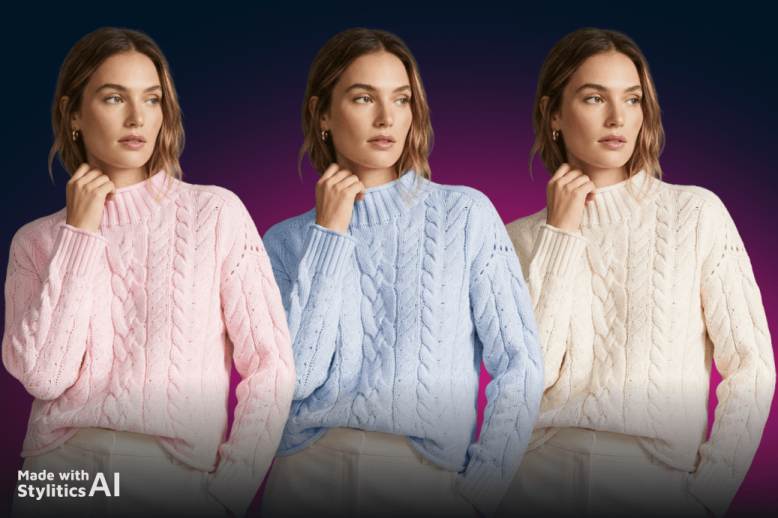
AI generation eliminates the production barrier entirely. Every social asset can now be rendered on AI models representing different body sizes, heights, and proportions—in every colorway and every styled configuration—from the same source image. This is not a marginal improvement in body-inclusive fashion photography for social. It is the difference between posting one look per product and posting dozens, each tailored to resonate with a specific audience segment.
The commercial case goes beyond brand perception. Shoppers consistently report wanting to see clothing on models that reflect what they look like. When that representation extends from PDP to social—where discovery increasingly begins—the full funnel benefits. Shoppers who see themselves in social content click through with higher intent, arrive at PDPs with more confidence, and convert at higher rates. For retailers struggling with high return rates driven by fit uncertainty, size-inclusive social imagery addresses the root cause at the earliest touchpoint: the moment a shopper first encounters the product.
As one Stylitics representative said:
“Companies just can’t shoot infinite permutations of all their stuff. Maybe they can bring in a model for a day and get an outfit, but they can’t get somebody in four different body sizes or shoot it against these different backgrounds or in all these combinations of outfits. As we think about those things, we’re basically opening up new capabilities.”
AI Image Studio: Social Content Generation Capabilities
Capability
Description
Social Editorial
Dynamic crops and filters formatted for Instagram, TikTok, and paid social.
UGC-Style Images
Authentic, user-generated aesthetic generated at scale and with full brand control.
Lifestyle Scenes
Urban, nature, luxury, or abstract environments for editorial and campaign social content.
Studio-Style Images
Clean, polished studio aesthetic for brand-consistent feed posts and paid social.
Smart Crop
Automatic resizing for every platform format and aspect ratio without manual post-production.
Campaign Ready
Thematic consistency for seasonal campaign social content and lookbook assets.
Model Diversity
Generate social content featuring diverse model representations—including different body sizes, skin tones, and ages—for segment-specific campaigns.
Lighting & Mood
Soft box, golden hour, or high-contrast editorial lighting adapted per channel and style.
Pose Control
Standing, walking, sitting, or custom movement optimized for social engagement.
Colorway Swaps
Generate social assets for every colorway without additional shoot cost.
CASE STUDY
Global Sportswear Retailer: $20M+ in Studio Photography Savings
$20M+ total savings achieved
10,000+ images delivered per week
Multiple format outputs per SKU for omnichannel use
A global sportswear retailer with a 100,000+ item catalog was spending over $115 per image on traditional photography, leaving social channels perpetually under-resourced. Vendor-supplied imagery lacked the variety and format flexibility needed for active social distribution. Stylitics’ pipeline automated the generation of multi-format imagery from each product asset, delivering PDP, social, and editorial outputs simultaneously. Client involvement dropped to under two hours per month. Total savings exceeded $20 million, with social content supply constraints eliminated.
The Social Content Gap Is a Choice, Not a Constraint
The brands that dominate social commerce are not the ones with the largest studios or the most generous agency retainers. They are the ones that publish the most consistently, test the most creatively, and learn the fastest from real performance data. That kind of operating cadence requires a content supply that traditional production methods can never sustainably provide.
AI generation makes that supply available. Every product in the catalog becomes a source of social-ready imagery across multiple styles, formats, and creative variations. The content calendar stops being limited by what the studio can produce and starts being limited only by what the strategy requires.The social content gap that most retailers accept as structural is actually a production constraint that AI has eliminated. The brands recognizing this shift are moving quickly, and the competitive gap between brands that have adopted AI social content generation and those still relying on traditional production is widening with every campaign cycle. Retailers who are ready to close that gap can see how Stylitics’ visual merchandising platform extends from PDP to social—delivering the volume, variety, and brand consistency that modern social commerce demands.
FAQ
They can supplement and de-risk the UGC supply gap. AI-generated UGC-style images provide the authentic, informal aesthetic of real user content with consistent quality, brand safety, and on-demand availability that organic UGC cannot guarantee.
Stylitics delivers assets formatted for all major platforms including Instagram feed, Stories, and Reels; TikTok; Pinterest; Facebook feed and paid social; and display advertising. All major aspect ratios and resolution requirements are supported.
Every output—whether studio, lifestyle, or UGC-style—passes through brand-specific quality controls established during onboarding. Style guide compliance is enforced across all outputs regardless of creative variation.
Yes. All Stylitics outputs are delivered as high-resolution assets suitable for paid social advertising, including carousel and single-image placements. The generation pipeline supports A/B creative variant production for performance testing.
Yes. Stylitics supports size-inclusive model imagery for social content—rendering products on AI models representing plus size, petite, and standard body proportions across every colorway and styling configuration. This allows brands to create segment-specific social campaigns that reflect the diversity of their actual customer base, directly addressing the representation gap that limits both engagement and conversion on social channels.



 Shop the Look Let shoppers buy the full outfit directly from any styled image.
 Styled for You Personalized outfit recommendations based on individual shopper preferences.
 Complete the Look Suggest complementary pieces to round out whatever a shopper is already viewing.
 Shop Similar Surface visually comparable alternatives when a specific item is out of stock or out of budget.
 Flat Lay to Model Choose from diverse models with full control over pose, crop, and framing.
 Background & Scene Swaps Place products in clean studio backgrounds, lifestyle environments, or custom lighting moods.
 AI Styling AI-paired outfitting with realistic fabric physics and the ability to highlight specific garments.
 Model Diversity & Inclusive Imagery Output-ready formats for PDPs, social platforms, and campaign lookbooks.